At The MBS Group, a studio schedule used to be a rather peculiar kind of knowledge. It existed, but separate studios could not see one another’s plans in real time. The company already had Salesforce. The information needed a better way to travel.
Mphasis Silverline revised the object model and implemented CalendarAnything. Occupancies and holds became visible across studios; outside users could see permitted schedules through a community. A question that once required a call could be answered by looking. The glamour of television production, it turns out, also requires a respectable calendar.
- The work: Salesforce strategy, implementation, integration, and ongoing support.
- The specialty: financial services, healthcare and life sciences, and media.
- The product: CalendarAnything turns Salesforce records into schedules people can use.
- The useful lesson: test the handoff between people and systems before buying another tool.
The stage was booked. Who knew?
The MBS Group’s Armbruster describes the shift to tracking occupancy in real time. The significance is organizational as much as technical. Two studios pursuing the same show could see each other’s holds; executives could inspect the position without asking around. CalendarAnything made an existing business relationship visible.
This is a useful introduction to Silverline because “digital transformation” can accommodate almost any sales pitch. A studio hold is less forgiving. There is a place, a period, a production, and somebody who needs to know. If those pieces fail to meet, the business discovers the defect before the presentation does.
“Now we’re tracking our occupancies in real time.”
Armbruster · The MBS Group customer account
A consultancy with a product-shaped clue
Silverline helps organizations plan, build, connect, and maintain Salesforce systems. Its advisory work addresses business processes; implementation turns those decisions into a working environment. Integration connects Salesforce with other systems. Managed services keep the installation evolving after launch. The distinction matters: a company can need considerable help without needing a replacement CRM.
CalendarAnything gives that broad description something tangible. It can display standard and custom Salesforce objects as calendars, organize resources, offer different views, and support availability scheduling. A record need not describe a meeting. It might represent a campaign, a production schedule, or a piece of equipment. The calendar becomes an interface to work already recorded in Salesforce.
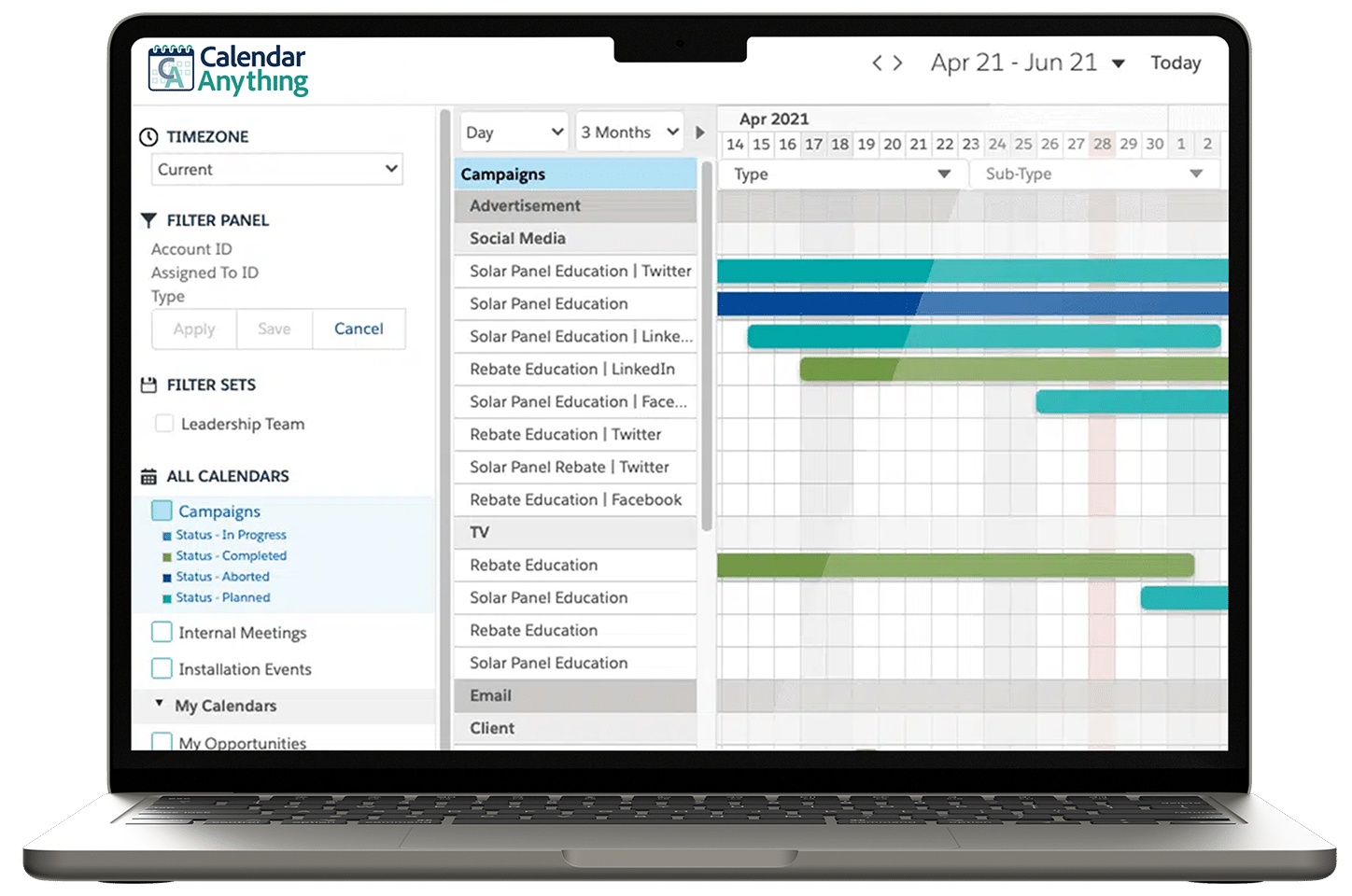
For Acxiom’s marketing team, that means campaigns, editorial schedules, events, meetings, and vacation days in a shared view. Conditional colors help distinguish stronger and weaker campaign performance. These are modest features with a practical advantage: the team can discuss the work while looking at it, rather than assembling an account of it from several places.
The phone test
Simmtronic, a lighting-controls business, had introduced Salesforce across its organization. Its account identifies a specific shortcoming: the native calendar on mobile did not let managers see their teams’ appointments. For engineers and managers who were frequently moving, that was an inconvenient place for visibility to stop.
Silverline demonstrated CalendarAnything against Simmtronic’s use cases and worked through tests. User feedback also produced a date picker, deployed for Simmtronic and other customers. The resulting views let people inspect appointments by team or project and move them through drag and drop. A second application emerged: booking office desks, with utilization analyzed in Tableau.
The lesson is worth borrowing. Put the actual job in the trial. Open it on the device that travels with the employee. Ask whether a supervisor can answer a real question without returning to a laptop. A demonstration is most informative when the buyer supplies the awkward details.
Twenty days, and the plumbing underneath
Peoples Bank faced siloed data and expiring contracts for existing systems. An eight-month Silverline implementation combined Financial Services Cloud for sales teams, nCino for commercial lending, and a platform for leads, referrals, and compliance workflows.
The bank reported that nCino’s approval automation and workflow reduced application-to-close time by 20 days. That is a customer-reported result from a particular implementation. It should interest a buyer as evidence of a concrete process change, with a concrete measure, rather than as a forecast for every other bank.
Less time from commercial loan application to close after nCino implementation.
Customer account published by Silverline. Initial implementation: eight months.Silverline’s healthcare work extends the same concern with coordination to patient access, referrals, and relationships between providers and payers. Its integration services include connections to electronic health records. A useful customer view depends on bringing together information that otherwise belongs to separate systems. Industry expertise helps determine which information people actually need.
The price of the calendar, the cost of the work
The business combines professional services with a subscription product. CalendarAnything’s published FAQ lists $199 per user per year and a minimum purchase of ten licenses. Its upgrade FAQ separately lists Lightning implementation starting at $2,500, including 15 hours of support. Those figures describe different purchases. The app subscription is one component of a Salesforce budget.
Illustrative list-price calculation: users × $199 annually. Excludes Salesforce, services, taxes, and negotiated discounts. Minimum: 10 licenses.
Managed services address the work that survives the launch date: enhancements, integrations, technical debt, analytics, and planning. Silverline describes quarterly business reviews and support for hundreds of environments. Buyers should think about who will own that continuing queue. Software rarely has the courtesy to finish changing when the implementation team leaves.
An industry accent, a larger address book
Gireesh Sonnad and Rich Resnick co-founded Silverline in 2009. Pamlico Capital invested in 2018 to support expansion, particularly around financial services and healthcare. Silverline added a media and entertainment practice when it completed its acquisition of Shift CRM in 2021. The progression suggests a deliberate interest in understanding particular businesses as well as a particular platform.
Mphasis acquired Silverline in October 2023 for cash consideration of up to $132.5 million. Mphasis described the deal as a way to strengthen its Salesforce capabilities and connect customer experience, contact centers, and conversational AI. Silverline gained access to its parent’s broader delivery and data resources.
For a buyer, the relevant comparison is with another Salesforce partner or an internal team that can do the same work. Silverline’s proposition combines industry knowledge, its own application, and ongoing services. That combination is worth examining when a generic deployment would leave important workflows unresolved. The product alone does not establish that the consulting team is the right fit for every project.
The customer who almost left
In July 2026, Silverline published Venture Home’s account of considering a move to Calendly. The solar installer thought CalendarAnything lacked the availability scheduling it needed. Testing the alternative exposed difficulties in its Salesforce workflow, including appointment updates and reassignment. A demonstration of CalendarAnything’s availability features changed the discussion.
Venture Home stayed and expanded its use to customer self-scheduling, alongside a custom Salesforce routing solution that assigns representatives by territory. The account illustrates how a renewal decision can turn on a capability the customer has not seen. It describes one company’s evaluation, rather than a universal comparison between schedulers.
AI inherits the same homework
Silverline’s September 2026 description of AI Innovation Studio brings AI engineering, data strategy, enterprise architecture, and experience design together. The work centers on Salesforce while reaching across enterprise systems. It includes making information, permissions, tools, and human oversight available to solutions that must act within a business.
There is continuity here. An AI agent and a calendar both depend on the quality of the information beneath them, even if their ambitions differ. A buyer can copy the discipline visible in the customer stories: identify the delayed decision, map the required records, test the workflow with its users, and measure what changes.
That approach makes most sense when Salesforce already matters to the operation, or is a considered destination for it. A Salesforce-native scheduler has less appeal when the relevant work and data live elsewhere. Neither scheduling software nor an agent supplies missing ownership of a process. Silverline’s most instructive work begins with a question a person needs answered, and then makes answering it easier.
Take a closer look
Explore the company, inspect the product, or watch it at work.