The restaurant business likes averages because averages sit still. Shannon McNiel's restaurants do not. At Tom's Watch Bar in Denver, a sleepy night can produce about $2,000 in sales. Baseball's opening day can push the same room toward $200,000. The distance between those numbers is not a rounding error. It is a different species of evening.
This is the puzzle McNiel has spent the past several years learning to solve: how to make a restaurant behave like a live venue without forgetting that somebody still wants a cold beer and a plate of wings. The co-founder and co-chief executive of Tom's Watch Bar is an operator by training and temperament. He has three decades in restaurants, including Darden, Cheddar's Scratch Kitchen, Texas Roadhouse and Bubba's 33. His education was built in dining rooms where a rush is expected. At Tom's, the rush comes with a bracket, a kickoff and occasionally a reality-show contestant.
The public face of the concept is pleasantly obvious. More than 100 screens wrap the room. A central stadium display makes the local television in the corner look like a postage stamp. The menu keeps burgers and wings but makes room for ahi tuna towers and lobster tacos. Yet the spectacle is only the front end. Behind it sits a careful machine of event calendars, staffing plans, handheld orders, bar stations, fan groups and kitchen equipment selected for speed.
One room, two radically different nights
01 / The calendar is the bossForecast the feeling
A conventional restaurant can look at last Wednesday, adjust for weather and guess at this Wednesday. McNiel's teams have to ask different questions. Which game matters tonight? Which college alumni group has claimed the room? Is the local arena full? Will the crowd arrive before the event, after it, or stay for both? A Wednesday is merely a box on a calendar. The event gives it meaning.
That changes the work long before anyone walks in. Screen programming shapes marketing. Marketing shapes reservations and walk-in demand. Demand shapes staffing, prep, ordering and where an extra service station belongs. The aim is to make a complicated plan feel effortless to the guest. The fan should notice the game, the crowd and the speed of the next round. The routing logic can remain backstage.
“We operate so different from a restaurant; it's not just lunch traffic or dinner traffic - we sell and market and put on events.”Shannon McNiel
McNiel has said he had never seen $15,000 in sales in an hour before Tom's. The phrasing matters: not a day, an hour. High-volume hospitality punishes hesitation. A server fighting through 1,000 people at the Los Angeles venue cannot walk every order back to a terminal. So servers carry handhelds, food and drinks move through dedicated runners, and orders are routed to the right station. Traditional casual-dining bars often have one service station. Tom's installs two. The bar can begin making a drink before the server has left the table.
Technology, in McNiel's telling, is useful when it removes friction. Forecasting and scheduling tools help translate an irregular sports calendar into a labor plan. Equipment can cook a burger in two minutes. Handhelds collapse the distance between table and bar. None of this is presented as a robotic future. McNiel pairs talk of automation with a repeated commitment to “good old-fashioned restaurant running.” A gadget still has to earn its counter space.
02 / Fandom travelsThe night a martini beat the wings
Then Love Island arrived. In the summer of 2025, Tom's locations held watch parties for the reality series, complete with DJs, influencers and cast appearances. Attendance beat many conventional summer sports events. On those nights, a lavender lemon drop martini overtook beer and wings as the top seller.
For a business decorated in screens and scoreboards, this might have looked like a detour. It turned out to be a useful definition. Tom's was built for sports, but its deeper product is a roomful of people caring about the same thing at the same time. A fourth-quarter comeback and a recoupling ceremony differ in almost every technical respect. Socially, they can rhyme.
Sales at some Love Island events rose by nearly nine times, a reminder that the mechanics of a watch party can serve communities far beyond traditional sports.
McNiel's watch-party strategy rests on three practical sources of community. Local teams bring their fans. College alumni organizations create dependable gatherings. Vendors connected to leagues and franchises can add access and programming. The national chain becomes local one relationship at a time. A screen is merely a rectangle until somebody in the room desperately needs what happens next.
03 / Two people, one titleTrust before territory
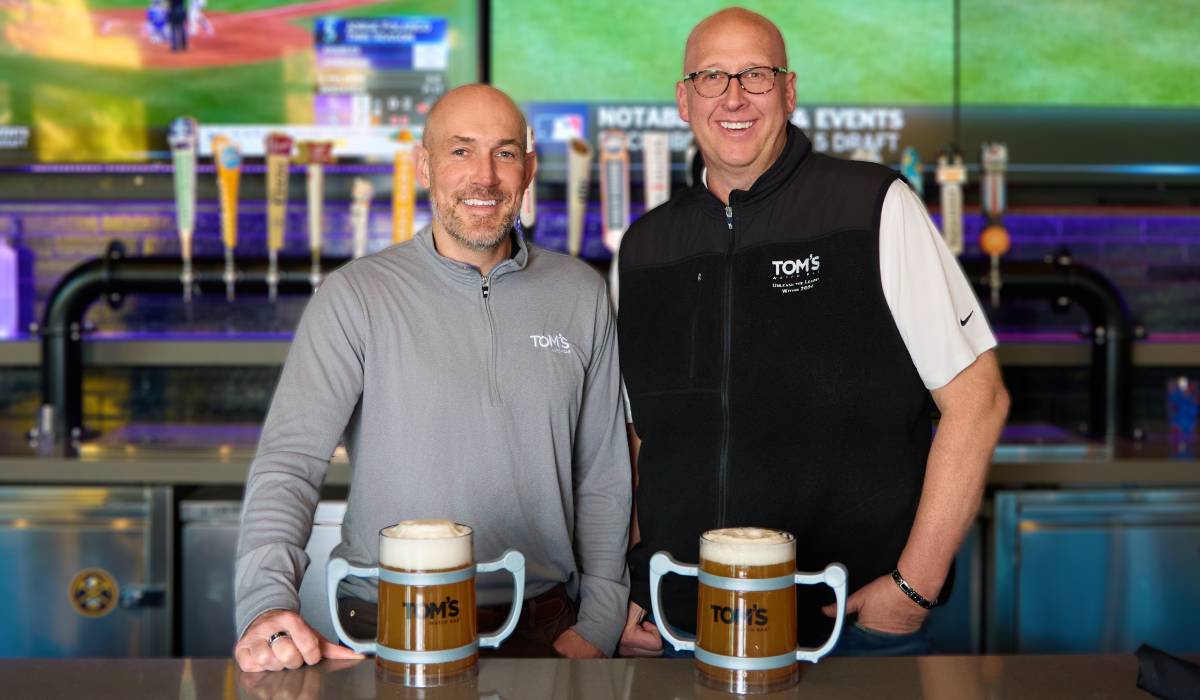
McNiel became co-CEO with Brooks Schaden in November 2024. The arrangement could invite a small opera of crossed wires. Instead, the two describe a division that grew naturally from years of working together. Schaden leads finance, real estate and development. McNiel leads operations, training and people development. They communicate constantly, but the split respects what each does well.
McNiel's account is warmer than an org chart. “I don't have to work with this guy. I get to work with this guy,” he said in a 2025 interview, adding that they are best friends. Schaden calls them friends and brothers as much as co-CEOs. The sentiment would be sugary if it were not attached to clear responsibilities. Affection is lovely. Defined ownership is lovelier before a lease is signed.
The shared leadership operating system
The pairing also reveals McNiel's preferred side of the business. His language returns to teams, training and the mechanics inside the four walls. When industry coverage celebrates revenue or expansion, his public comments redirect credit toward employees. Culture, in his description, lives in standards, pride and how people show up for guests. It is not a framed list of values hovering above the time clock.
04 / People, then placesThe concrete can wait
Tom's grew from four locations in 2019 to 18 by September 2025 and nearly 20 by early 2026. Annual revenue passed $100 million, and reported average unit volume reached roughly $7 million. The opportunity map is larger than the company: hundreds of potential sites, stadium districts eager for tenants and fan bases looking for a clubhouse. Speed is available. McNiel's harder job is refusing the wrong kind.
“I learned a long time ago that the people come first, and then you build the concrete.”Shannon McNiel
The line turns expansion logic right side up. A lease does not create a general manager. A grand opening cannot improvise a bench. McNiel wants trained leaders ready before a new room asks them to execute a $40,000 hour. His concern is not whether Tom's could open many restaurants. It is whether each location would have the people and fundamentals to recover quickly when demand lands like weather.
That discipline has strategic consequences. The company favors locations near stadiums and arenas, where fan traffic already exists. It studies blocks, not just cities. It has used percentage-rent structures to soften the volatility of entertainment districts. It can fit spaces from roughly 4,000 to 20,000 square feet. Flexibility is not drift; it is a way to preserve the operating model under different roofs.
McNiel also expresses value as an unfussy equation: product plus experience, divided by price. The arithmetic is metaphorical, but the managerial demand is real. Better ingredients do not compensate for a lost order. A fast beer does not excuse a forgettable room. A huge screen cannot make the check feel fair. Every part leans on the others.
05 / The useful spectacleMake the machine disappear
There is an old theatrical trick in Tom's Watch Bar. The more work happening behind the curtain, the less the audience should sense it. The guest sees a wall of games, hears the room rise and receives a drink before impatience can form. McNiel sees the schedule, the stations, the training and the supply chain that made the moment possible.
His career has moved from large-chain restaurant discipline toward something closer to experience entertainment. The fundamentals came along. That may be the central point of his work: novelty scales only when the boring things become excellent. A watch party can feature dog surfing, mixed martial arts, the WNBA or a reality-show finale. The kitchen still has to make the burger. The manager still has to know who is coming.
McNiel has described Tom's ambition as a network of “fan sanctuaries,” places where every team can have a home. Sanctuary is an extravagant word for a bar. Then the game turns, 800 strangers leap to their feet, and the word earns its keep. The screens make the gathering visible. The operator makes it possible.