In the kitchen photograph, Majed Al Mehdi leans into a line of chefs and gives the camera a thumbs-up. There are stainless-steel surfaces behind them, green cakes in front of them and several quite different smiles. His white shirt and dark tie sit among the chef jackets. The pose is cheerful, slightly crowded and entirely comfortable with being crowded. It makes a good place to begin a story about someone whose career has involved getting people to work together.
He shared the photograph in September 2019 with a salute to the chefs. The kitchen matters here. Before the Calo title, before the app-based business, his professional record was a succession of jobs in hospitality and restaurants. A company can give an executive a handsome title in one afternoon. Acquiring experience in restaurant operations takes rather longer, and produces fewer opportunities to keep one’s shirt immaculate.
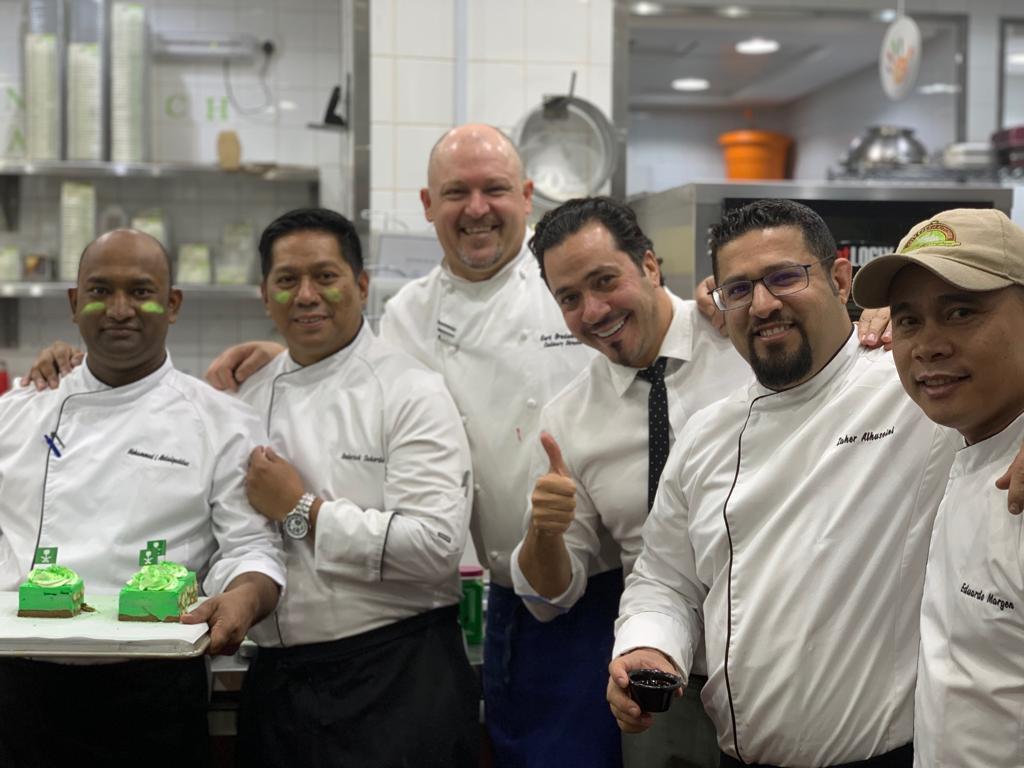
The kitchen before the title
His education was in hospitality: a diploma in Hospitality Administration/Management at the Hotel & Tourism Institute, with attendance listed from 2002 to 2005. An early role followed at Four Seasons Hotel Damascus, where his record identifies him as a trainer between January 2005 and July 2006. Training appears near the beginning of this career, well before his later reflections on how colleagues learn to lead.
By November 2006, he was at ALFA Company as a restaurant supervisor. The subsequent appointments form a patient ladder: assistant restaurant manager in 2008, restaurant manager in 2009, Piatto concept manager in 2011 and Piatto operations manager in 2013. In November 2017, he became Director of Operations. His ALFA tenure continued until April 2021.
There is something useful about seeing those intermediate jobs written out. The word executive tends to flatten a career into its final appointment. Here, there are several changes in responsibility to consider. A supervisor, a restaurant manager and an operations director occupy different positions in the same working world. Put their titles side by side and the biography acquires steps rather than a single convenient leap.
- 2006Restaurant Supervisor
ALFA Company - 2011Piatto Concept Manager
ALFA Company - 2017Director of Operations
ALFA Company - 2021General Manager
Calo - 2023Chief Business Officer
Calo
A promotion is also a change of scale
In June 2021, Mehdi took a General Manager role at Abdullah Al Othaim Investment Co. That was a brief chapter. In September, he joined Calo as General Manager; October 2023 brought the Chief Business Officer appointment. Today, his professional base is Riyadh.
Read that sequence against the earlier restaurant roles and the transition becomes interesting without needing an invented turning point. The settings changed. The work remained attached to food, service and organizations. The Calo chapter placed a hospitality operator inside a company whose customers interact with an app and whose service depends on work performed away from the screen.
A meal subscription offers a particularly concrete way to think about business operations. The transaction is digital, but the purchase eventually has to become something that can be cooked, packed and delivered. The phone provides a tidy view of the arrangement. Elsewhere, people must make the arrangement work. A pleasant interface cannot take the delivery downstairs.
That relationship between an easily understood purchase and a complicated working organization gives this career its setting. It also explains why the restaurant stages deserve space in the story. They are years spent within the kind of business where the customer eventually encounters the result of several people’s work together.
A company with room for many kinds of work
Calo’s recruitment language brings several professions into the same conversation. Its public jobs material asks for feedback, humility, dedication, speed and continued learning. The company describes feedback as something everyone should be willing to receive. It pairs quick action with data and iteration. These are the expectations it publishes for people considering joining.
The mixture is worth pausing over. Speed sounds splendid until two people are moving quickly in opposite directions. Feedback offers a way to notice that before the collision becomes a meeting. Humility, meanwhile, leaves room for the possibility that the person nearest the work knows something the person furthest up the reporting line does not.
Mehdi has publicly shared Calo’s workplace video and said that he sees its description reflected in daily life. A separate post sharing a marketing leadership vacancy placed him in the company’s public recruitment conversation. The advertised role combined individual accomplishment with the ability to coach and build a team. Hiring, in that account, involved looking for both kinds of contribution.
For a reader following an operator’s career, this is a useful detail. Organizations need people who can perform a task and people who can help several others perform theirs. Sometimes those capacities sit in the same person. Sometimes they have to be learned at different times. A promotion changes the arrangement, but it does not automatically settle the question.
What colleagues carry forward
Mehdi’s own reflections give the question a memorable image. Writing about people who take ownership, make decisions and then develop leaders themselves, he calls the process a school. His pleasure lies in seeing an earlier investment in colleagues continue through their work with other people.
“It becomes a school that passes from one to another!”
Majed Al Mehdi, on colleagues developing the next generation of leaders
Elsewhere, he describes the groundwork for a team’s response to rapid growth: support during quieter periods, help when colleagues struggle and credit when they succeed. His account puts the relationship before the moment when the business asks for extra effort. That is a recognizable management problem, especially in an organization that is expanding.
There is a practical companion to this emphasis on people in his recommendation of Calo automation manager Mohammed Al Shareef. Mehdi praises systems that work within operational constraints and reduce manual effort. His description connects technical knowledge with an understanding of what the business needs. The test is whether a solution works in the circumstances where colleagues actually use it.
This is the unglamorous end of technology, and perhaps the more interesting one. A system earns its place through what it helps someone do. It may save time, simplify a task or remove a recurring source of confusion. The elegance of its presentation is a separate matter. Mehdi’s praise goes to practical usefulness.
His recommendation of HR professional Amer Alkurdi makes a related point about another discipline. He describes working together for about three years and values the combination of finance knowledge, HR knowledge and workable management initiatives. In both recommendations, expertise becomes interesting through its application. The colleague understands a field and finds a way to make that understanding useful to others.
Another view comes from Yousif Okal’s account of his own Calo career. Looking back on five and a half years, Okal describes the company’s growth and thanks a group of colleagues, including Mehdi, for setting standards around work, culture and customer experience. He discusses choices about product quality, hiring and judging results.
Okal’s examples make workplace culture sound less like a decorative word. Cutting a cost can affect the product. Hiring someone can affect the people already there. Measuring work can encourage particular behaviors. The decisions are ordinary enough; together, they shape the organization colleagues experience. His acknowledgment places Mehdi among several people associated with those standards.
A larger map, the same daily test
The company around this career has moved into a wider international chapter. Calo was founded in Bahrain in 2019 by Ahmed Al Rawi and Moayed Almoayed. By April 2025, its expansion into the United Kingdom included the acquisition of Fresh Fitness Food and Detox Kitchen. The move added an operating setting beyond its Gulf markets.
In July 2025, Calo announced a $39 million Series B extension led by AlJazira Capital. Added to the earlier $25 million tranche, that brought the Series B round to $64 million. These are company milestones. For an account of Mehdi’s career, their value is in showing the size and changing geography of the organization in which he now works.
December 2024 tranche + July 2025 extension. Company financing, not personal wealth.
Expansion changes the number of people who must understand a business and the number of places where its promises have to hold. An acquisition adds another set of working relationships. A funding announcement gives the public a date and a figure. The daily organization continues after everyone has finished reading it.
For Mehdi, the documented career has reached a business officer’s title. The kitchen photograph offers another way to hold the story in view: a colleague in a tie, leaning into a group of chefs, sharing the frame. Years later, his school metaphor gives that group-minded image a forward direction. People learn, take responsibility and help someone else do the same. The next chapter can belong to several of them.