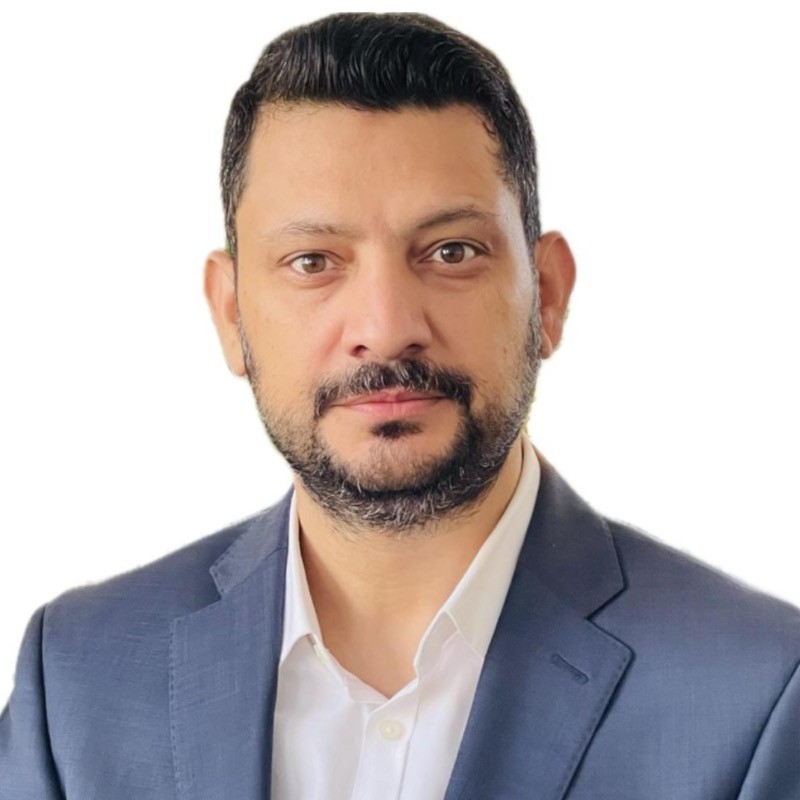
The architect of Pakistan's payment rails - now building the world's
Most people in tech want to change the world by disrupting it. Shahzad Shahid did something quieter and harder: he built the infrastructure that other people's disruption runs on.
As Group CEO of TPS Worldwide - a Karachi-born, globally stretched payments technology company - Shahid leads a team of 600+ people delivering digital banking and payment systems to financial institutions across the Middle East, South Asia, Africa, and Europe. The company his career grew up in serves over 100 clients in more than 30 countries. Before most people had heard of "fintech," TPS was already laying down the rails.
Shahid joined TPS in 1999 as a software engineer. He left as CEO. Well - he hasn't left. That's the point. In an industry that rewards jumping ships and collecting LinkedIn endorsements, he stayed. He grew every role from the inside. Software developer to regional sales manager to global head of business development to CMO to CEO. It took 15 years. He did it at the same desk - different chair.
Digital Pakistan can be built on digital railroads which allow secure, contextual and cost-effective payments by individuals and businesses directly from account and digital wallets for e-commerce purchases, government services and all other payment needs.
- Shahzad Shahid, Group CEO, TPS WorldwideThat loyalty is not nostalgia. It is philosophy. "Not putting all your eggs in one basket, and developing less fertile markets while you continue to benefit from those where you already have a large market share" - this is how he described TPS's strategy in 2009. It is also, if you read it again, how he managed his own career.
The invisible infrastructure most Pakistanis use every day
When you tap your ATM card in Karachi and money appears, something happens in the background. Data moves. Systems talk to each other. Authentication happens in milliseconds. Most people assume this is magic. It is not. It is engineering, and much of it runs on TPS.
1LINK - Pakistan's national interbank ATM and POS shared switch - was built with TPS technology. That is the backbone of the country's banking connectivity. Before 1LINK, Pakistani banks were isolated islands. After it, your card from Bank A works at Bank B's ATM. This is not glamorous. It is essential.
Then there is NIFT ePay. In 2018, Shahid led the strategic partnership that connected TPS and NIFT (National Institutional Facilitation Technologies) to build Pakistan's domestic interoperable e-payment gateway. Three years later, NIFT ePay launched. The vision: "a success story of two local, successful companies coming together for disrupting the e-commerce landscape of Pakistan."
Under Shahid's leadership, TPS has expanded its product surface: ATM and POS controllers, switching middleware, interbank shared switches, payment gateways, remittance platforms, mobile wallets, EMV card personalization, open banking APIs, digital lending infrastructure, Banking-as-a-Service, cybersecurity solutions, and AI-driven digital transformation tooling. This is not a startup pivot story. This is systematic product expansion, decade by decade, by a team that understood financial systems before "fintech" was a word.
The customer is the key driver of change and customer convenience is going to rapidly bring paradigm shift in the way the banks operate today.
- Shahzad ShahidFrom Karachi to Riyadh: going global without losing the plot
One of the quieter achievements in Pakistani tech is TPS's global reach. Not "global" in the way that startup pitch decks use the word. Actually global - financial institutions in the Middle East, Africa, and Europe paying for Pakistani-built technology to run their core payments infrastructure.
In 2024, Shahid oversaw TPS's formal expansion into Saudi Arabia via AstroLabs, positioning the company directly inside the Kingdom's Vision 2030 digital economy push. His words on the strategy were precise: "we are focused on delivering innovative solutions that empower government entities, financial institutions, corporates, fintechs, and SMEs - from digital transformation to specialized IT services, payments, open banking to cybersecurity and AI."
That same year, he stood on the stage at 24 Fintech in Riyadh - the region's largest fintech exhibition - as a keynote speaker, talking about digital wallets and open banking. Eight Pakistani firms were at that event. Shahid was among the faces representing a country that has built more payment infrastructure capability than most of the world knows.
"As a leader in the digital payments industry, we recognise the importance of integrating climate action into our operations and infrastructure. Our collaboration with Fils underscores our commitment to providing a comprehensive suite of digital banking and payments technology, enabling our partners to seamlessly embed sustainability throughout their operations."
Shahzad Shahid - on TPS partnership with Fils, UAE, 2024The Fils partnership is worth noting for what it signals. Fils is a UAE-based sustainability tech company focused on integrating climate metrics into financial transactions. TPS partnering with them means Shahid is positioning TPS not just as a payments infrastructure player but as one with a sustainability edge - a distinction that matters enormously in GCC markets where ESG commitments are becoming procurement criteria.
The long game, year by year
When the pandemic hit, he picked up the microphone
In 2019, Shahid was elected Chairman of P@SHA - the Pakistan Software Houses Association. It was a vote of confidence from an industry that does not offer such positions lightly. Then COVID-19 arrived.
As Chairman, Shahid became one of the most visible advocates for Pakistan's IT and IT-enabled services industry during a period of genuine existential pressure. He spoke publicly - including on Geo News - about the adverse effects of the pandemic on the sector and argued for policy support, tax relief, and recognition of the industry's contribution to Pakistan's export earnings.
Today he serves as Treasurer and Board Member of P@SHA, a member of the President of Pakistan's Committee on Emerging Technologies, a member of the Sindh Government's IT Committee, and sits on the Advisory Council on IT and Digital Economy at Digital Pakistan. This is not a title collection. This is a person who believes that industry-government coordination is how countries build tech sectors - and who shows up to do the work.
NIFT ePay has a true potential to help the country realize its dream of Digital Pakistan and to support the SBP in its national payment systems strategy success and digital financial inclusion.
- Shahzad ShahidThe quiet discipline behind 25 years at one table
There is a particular kind of ambition that does not look like ambition from the outside. It does not job-hop for salary bumps. It does not collect VC-backed startup titles. It plants itself in a place, learns every root and branch of the organization, and grows with it. Shahzad Shahid is that kind of ambitious.
His Twitter bio - not exactly a platform for philosophical manifestos - reads: "Learn from positive brain-pickups..follow constructive rules of Life..let the humans learn from you in due course." There is something in that phrasing. "In due course." The patience of someone who plays a long game on purpose.
His leadership style, by accounts of those who work with him, is collaborative and inspiring. He motivates through influence, not authority. The word that surfaces repeatedly is "inclusive" - in his business strategy (financial inclusion), in his civic work (Open Karachi), in his industry position (P@SHA advocates for the whole sector, not just TPS). The pattern is consistent.
He also understands market development strategy with unusual clarity. His 2009 observation - "developing less fertile markets while you continue to benefit from those where you already have a large market share" - describes exactly how TPS has approached expansion. Pakistan first, then the Middle East, then Africa, now Saudi Arabia. Not a scatter-gun. A sequence. Every market de-risked by the one before it.
What the payments industry misses when it talks about Pakistan
Pakistan has a fintech story that does not get told often enough outside the country. It is a story of engineers who came back from America in 1996, built a company from Karachi, won contracts across the Middle East and Africa by being technically rigorous and commercially sharp, and quietly became essential infrastructure for dozens of banking systems.
Shahzad Shahid is the person who, in many ways, carries that story now. Not as a figurehead - as an operator who knows where every wire runs. He joined TPS when the world wide web was new to Pakistan. He built products, sold them in new markets, managed global teams, and eventually ran the whole thing. His understanding of the technology is not theoretical. He wrote the code.
That combination - deep technical credibility plus executive experience plus civic engagement plus genuine long-term thinking - is rare in fintech anywhere in the world. In the context of emerging market fintech, it is remarkable.
When Shahid talks about digital financial inclusion - and he talks about it often, and specifically - he is not delivering a keynote talking point. He is describing the reason TPS built systems like 1LINK and NIFT ePay. He understands, from 25 years of working on it, that financial infrastructure is the precondition for economic participation. Build the rails first. Everything else follows.