Consider a $200 purchase. In one version, it is a $200 problem. In another, it is four $50 appointments with your bank account. The merchandise has not changed. Neither has the price. But the calendar has, and the calendar is where Sezzle found its business.
- The product: split purchases into installments, usually four payments over six weeks.
- The twist: paid subscriptions extend the relationship beyond a merchant’s checkout.
- The catch: moving a payment does not remove it. Fees and credit consequences depend on the product and repayment behavior.
The Minneapolis company occupies a familiar corner of finance: the gap between wanting something today and having enough cash today. Its more revealing story concerns another gap, between an appealing payment button and a business that can afford to keep offering it.
The first idea was the wrong one
When Charlie Youakim and Paul Paradis started Sezzle in 2016, they were pursuing cheaper merchant payments through the automated clearing house network. That addressed the seller’s processing bill. The eventual opportunity sat on the other side of the counter.
In a 2023 interview, Youakim recalled that his wife, Jenn, spotted an Afterpay advertisement on social media. Sezzle shifted toward buy now, pay later in 2017. His description of his own talent was cheerfully unglamorous: “picking the wrong idea at the start and then adapting.”
There is a useful distinction here. A merchant can appreciate a lower processing fee without giving shoppers a reason to change how they pay. Installments offered the shopper an immediate reason. For a retailer, that possibility could justify paying for the service.

Four dates, one purchase
With the familiar Pay in 4 arrangement, the shopper pays a quarter upfront and three more installments every two weeks. That is six weeks altogether. The customer gets the purchase now; the merchant receives settlement under its agreement while repayment continues.
For someone paid every fortnight, this can make a necessary purchase easier to schedule. It does not make the purchase cheaper. Approval is conditional, and the available plan matters. Sezzle also offers shorter payment arrangements and longer monthly financing, which should not be treated as interchangeable products.
The checkout button grew a subscription
The competitive neighborhood is crowded: Affirm, Klarna, Afterpay, PayPal and Zip all offer alternatives. Sezzle’s particular combination includes optional credit reporting and a paid relationship that can travel beyond the retailers displaying its button.
Premium adds shopping benefits and merchant access. Anywhere adds virtual-card use where Visa is accepted, subject to restrictions. On-Demand offers transaction-based access without a recurring subscription. These are different answers to the same distribution question: must a customer wait for a favorite store to integrate Sezzle?
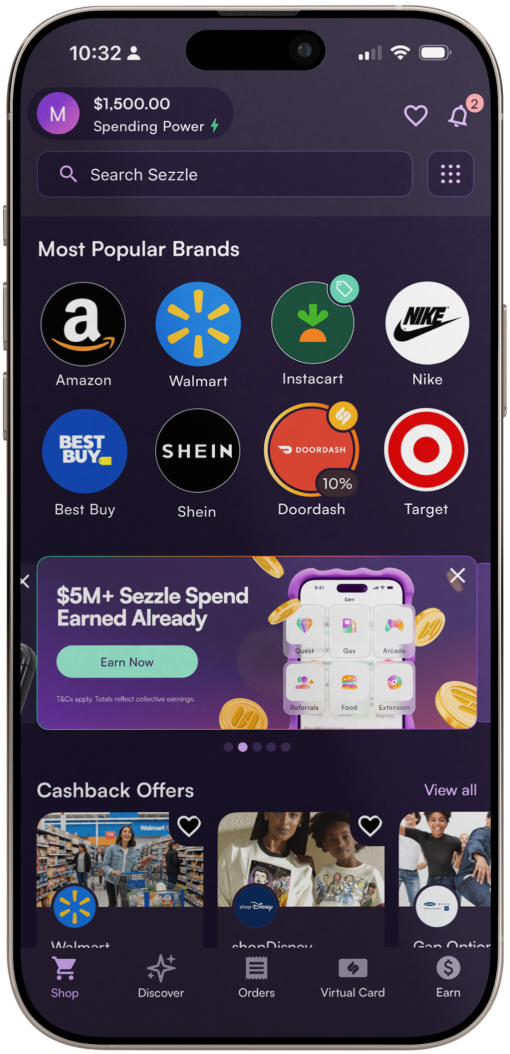
Retailers remain important. In September 2026, Sezzle announced checkout additions including Gymshark, Debenhams Group and Follett Higher Education. Campus retail makes the cash-flow problem especially tangible: required course materials arrive on an academic timetable, whether or not a student’s paycheck does.
Then the money got expensive
During 2022, investors soured on the growth-at-all-costs approach common among financial technology companies. Sezzle cut roughly a fifth of its staff and pulled back internationally. Its proposed combination with Zip was terminated by mutual agreement that July. Zip did not become its parent.
The abandoned transaction came with an $11 million reimbursement from Zip for merger-related costs. Sezzle pursued profitability as an independent company. The human cost included those job cuts; the operating lesson was that transaction growth could no longer stand in for sustainable economics.
By 2025, annual revenue reached $450.3 million, up 66.1%, and net income reached $133.1 million. Those figures establish that the business made money. They do not establish that every customer saved money, or that every additional loan will be equally profitable.
Someone still pays for the time
Merchant processing fees form only part of the model. Sezzle also earns consumer fees and subscription revenue. Its US fee schedule, checked in October 2026, lists Premium at $13.99 monthly and Anywhere at $19.99. Subscriptions renew automatically unless canceled.
The same schedule permits late fees up to $16.95 and rescheduling fees up to $7.50, with legal limits and exceptions. Certain transactions carry service charges. The sensible comparison is the total cost of the particular offer, including membership, against the alternatives available to that shopper.
Moving a payment does not remove it.An installment plan changes the calendar.
Sezzle pays for time, too. In May 2026 it announced a $300 million receivables facility with Mesirow Alternative Credit, priced at SOFR plus 3.86%, down from the prior 6.75% spread. That is borrowing capacity, not equity investment. Funding terms matter because somebody finances the interval before shoppers finish paying.
The approach depends on underwriting, collections and access to capital. A subscription needs repeat use to justify its price. A payment plan needs dependable future cash. When those conditions disappear, the calendar can become another source of pressure.
A credit file, and a classroom
Sezzle Up optionally reports eligible payment history to credit bureaus. Timely repayment may help establish a record, but reporting includes negative information. The feature rewards a behavior the customer must actually sustain; it does not promise a higher score.
Money IQ, powered by Zogo, adds financial lessons inside the app. In October 2026, Sezzle reported more than two million completed modules among over 338,000 users. Core lessons are free. Those are participation figures, rather than proof that borrowing outcomes improved.
Thirty people in the feedback loop
That month, Sezzle also spotlighted a council of 30 users aged 18 to 25. Monthly hour-long sessions cover financial frustrations and product feedback. The company says members influenced referral-link placement and a virtual-card design.
That is a practice another business can copy: put actual customers in a recurring conversation with the people building the product. Sezzle began by changing which side of a transaction it listened to. Its next chapter depends on listening closely enough to distinguish a useful little delay from a bill postponed too often.