The first thing to disappear was the shop floor. In 2020, when Colombia’s stores closed during the pandemic, Addi discovered how much of its young credit business depended on a customer standing in front of a salesperson. Within 20 days, co-founder Santiago Suárez later recalled, 99% of the business was gone. A company built to help people buy things had suddenly lost the place where buying happened.
There is a tempting version of this story in which software saves the day. The actual version has a bill attached. Addi moved toward mobile credit and e-commerce, and cut 60% of its team. That is the starting point for understanding the company: each new channel has required a decision about what it could afford to keep.
- Credit at checkout: eligible Colombian shoppers can split purchases without a credit card.
- Two sides of one network: consumers get financing; merchants get another route to a completed sale.
- Focus came at a cost: layoffs and a retreat from international expansion preceded the profitable business.
01 / A purchase needs time
Addi’s proposition begins with a familiar mismatch. A customer needs something today; the money arrives over several paydays. A merchant has the item, but cannot finish the sale. Addi inserts a credit decision into that moment. It was founded in 2018 by Suárez, Daniel Vallejo and Elmer Ortega. Its public offer now spans physical shops, online checkout and an app.
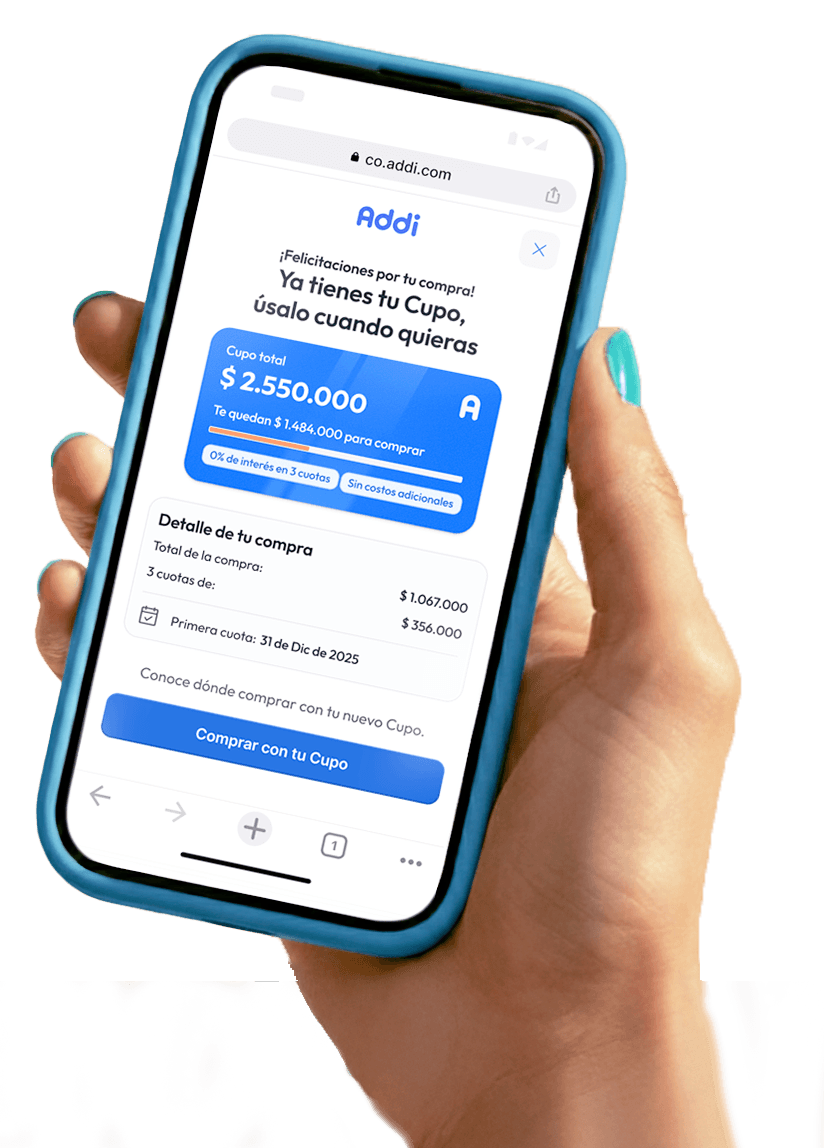
A shopper applies for a credit limit, chooses an eligible merchant and reviews the installment offer. Approval is assessed, rather than promised to everyone. The app lets customers inspect their available limit, follow purchases and pay installments. It also brings partner shops and offers together, so the customer can return without starting every shopping trip somewhere else.
The merchant proposition is equally concrete. Addi advertises no monthly subscription: the merchant pays when using the service, receives settlement under the agreed plan and offers financing without becoming the lender. Its network includes chains such as Alkosto, Éxito and Adidas. The same idea applies to a smaller shop: more customers can attempt a purchase when payment can be spread out.
02 / The fine print earns its place
“Buy now, pay later” sounds like a single product. Addi’s published terms describe a range of loans. Some eligible transactions carry zero interest. Others charge according to the borrower’s risk profile and the credit category. An interest-free banner cannot tell you what every customer will pay.
For October 2026, Addi lists ordinary consumer-credit rates from 0% to 28.49% effective annually. Its separate low-value credit category reaches 66.56%. A customer choosing an FGA guarantee may face a charge of up to 20%, plus VAT, depending on the purchase and profile. Late interest and collection expenses can add further costs. These are current published limits, not the price of a hypothetical average purchase.
The useful customer habit is to compare the total repayment, including any guarantee, with the cash price before accepting. For a merchant, the equivalent calculation is whether the extra completed sales justify the agreed fee. Installments help when the repayment schedule fits the customer’s income. They become a poor bargain when a smaller monthly figure disguises a larger obligation.
Merchant settlement follows its agreement. Customer terms follow the approved offer.
03 / A smaller map, a deeper business
The online pivot reopened the business. It also reopened ambition. In 2021, Addi announced $35 million in Series B equity alongside $30 million in debt, while building a presence in Brazil. Those two pools had different jobs: one supported the company; the other helped finance lending.
Then the funding climate changed. By March 2024, reporting described Addi concentrating on Colombia after shelving its Brazil and Mexico expansion plans. That financing announcement combined another $36 million of equity with $50 million of debt. Retreat did not mean credit stopped needing capital. It meant the capital had a narrower destination.
Suárez later described a two-year stretch in which profitability guided decisions, followed by a shift toward engagement. A founder can copy the discipline of choosing a clear priority. Copying the geography would be less useful: Colombia worked because Addi already had customers and merchant relationships there.

04 / The counter is part of the network
Addi competes with Sistecrédito, other installment providers and bank credit products. Its position rests on connecting the shopper and the shop, rather than merely displaying a payment button. The marketplace adds another meeting place. Each purchase also produces information that can inform later credit and fraud assessments.
Physical checkout remains central. Credibanco’s current offer lets an Addi customer scan a terminal’s QR code, select installments in the app and confirm the purchase. Merchants still need onboarding and activation. Software can simplify the counter; it cannot make every counter ready automatically.
The scale reported on Addi’s own About page explains why acceptance matters. A credit limit has practical value where it can be used. A merchant’s installment option has practical value when customers recognize it. Growing both sides makes each relationship more useful, although it still leaves Addi responsible for lending decisions.
05 / Growth still has to be paid for
In November 2025, Addi announced $190 million in annualized revenue and five consecutive profitable quarters. Annualized revenue is a snapshot extrapolated over a year, rather than audited annual sales. Its income includes interest and fees from consumers and merchants. Funding announcements measure something else again: the resources available to build the company or finance loans.
That distinction continued in 2026. A $150 million structured credit facility was reported in April; a roughly $85–86 million equity round followed in June. Addi CF also received authorization to operate as a financing company. Regulatory permission opens possibilities, but does not establish that every proposed product has launched.
“We prefer systems to heroes.”Addi’s published company values
That line from its careers page is a useful test of the whole enterprise. Addi needs repeatable approvals, usable repayment tools and dependable merchant acceptance. Its lesson travels beyond fintech: build around a customer’s actual transaction, choose the market you can serve, and count the cost of each new promise. Here, the promise is simple. The machinery behind it is not.
Go to the checkout
Visit Addi · Rates and fees · Merchant offer · Company updates
LinkedIn · X · Instagram · Facebook · TikTok
Watch Suárez on Fintech Leaders ↗ · The 2020 pivot · The Colombia decision · The 2026 equity round