Long before RecargaPay offered credit cards or fixed-income investments, it sold something that could disappear before dinner: prepaid phone minutes. The company's ancestry reaches to a 2002 Argentine website for cheaper international calling cards. In 2010 that operation became Recarga.com, a site where a mobile recharge could be bought with a credit card. It was a narrow product built around a broad truth. People may postpone opening an investment account. They do not postpone reconnecting a phone.
That humble transaction became the first rung of an ambitious ladder. Recarga.com turned into the RecargaPay app in 2015 and concentrated on Brazil. The service added transport-card reloads, utility bills, gift cards and a wallet. When Brazil's instant-payment network Pix arrived in 2020, RecargaPay plugged it into the same collection of daily chores. Today the São Paulo company presents four verbs to its customers: pay, finance, invest and earn.
The resulting app is busy by design. A consumer can send a conventional Pix, fund one with a credit card, pay a boleto, recharge a mobile or transit card, use a Mastercard, seek a personal loan, park money in a CDB and collect rewards. A micro-entrepreneur can open a business account, accept Pix, send a payment link or turn an NFC-equipped Android phone into a contactless card terminal. The company says more than 12 million people use the app. A current business product page puts annual transaction volume around R$30 billion.
A staircase built from chores
Most financial companies would prefer to discuss wealth. RecargaPay's advantage is its comfort with errands. The original recharge is small, recurring and measurable. So is a monthly electricity bill. Each gives the app another occasion to be useful and another chance to become the default place where a customer starts a transaction.
This makes the bundle more coherent than the phrase “super app” suggests. Payments supply frequency. Cards and rewards encourage spending. Credit helps when cash timing is awkward. Investments give idle money a reason to remain. Merchant tools put RecargaPay on the other side of the checkout. The app is less a cabinet of unrelated features than a staircase, with every completed task pointing toward a higher-value relationship.
How the relationship expands
The signature product is Pix with a credit card. Ordinary Pix moves account money instantly. RecargaPay lets an eligible user charge the transfer to a card and, depending on current terms, split the cost into installments. The receiver still gets a Pix; the sender converts a cash shortage into card debt. It is useful for a bill that cannot wait, but it is not free liquidity. Fees and the total cost matter, particularly when installments stretch the obligation.
The interesting product is not another way to move money. It is a bridge between the money a person has now and the payment that must happen now.RecargaPay's Pix-on-credit proposition, in plain English
That distinction explains where RecargaPay fits. Pix itself is public infrastructure managed by Brazil's Central Bank; no private wallet owns it. The commercial opportunity lives around the rail: funding, installment plans, interfaces, fraud controls, rewards and the larger account relationship. RecargaPay competes by packaging those layers around a payment behavior Brazilians already understand.
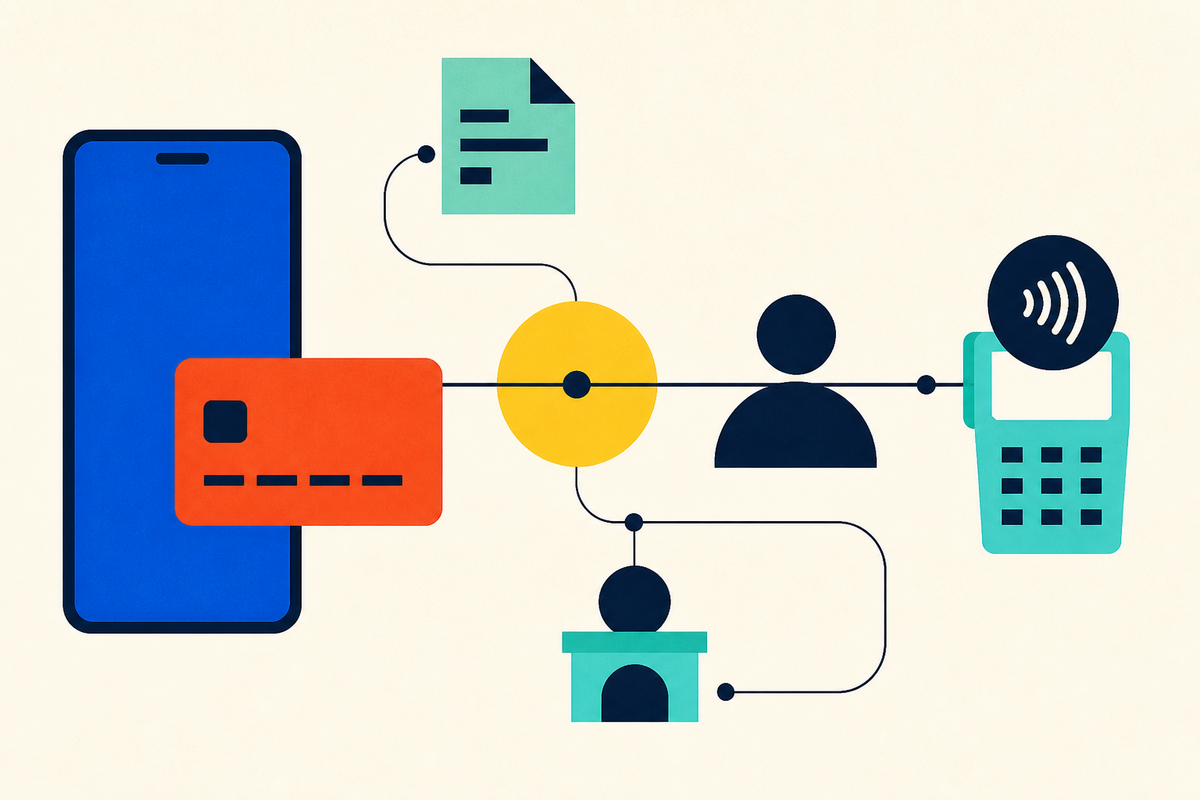
The intended customer is not neatly “banked” or “unbanked.” A person can have a bank account and still lack an available credit line, live far from a branch, use a prepaid mobile plan or manage several bills in cash. An autonomous worker can be a sophisticated smartphone user and still run business receipts through a personal account. RecargaPay addresses these uneven forms of access. The phone is the common denominator; the product assembles missing pieces around it.
That also clarifies the problem it claims to solve. The friction is not only exclusion from finance. It is fragmentation: one place for a recharge, another for a boleto, another for card acceptance and another for a short loan. Consolidation saves taps and travel, while a digital record can make recurring behavior visible. For RecargaPay, that visibility can improve personalization and underwriting. For the customer, it is valuable only if the resulting offer is understandable and fairly priced.
The merchant appears on the other side
RecargaPay's second act is aimed at Brazil's MEIs, autonomous workers and small shops. Its Conta PJ combines a free business account with Pix, payment links, a business card and administrative conveniences such as paying the DAS MEI tax document. A merchant can also act as a payment point, earning small amounts when customers pay bills or buy recharges. This reprises the company's oldest insight: a modest transaction can attract useful foot traffic.
Tap to Pay, launched with Visa in 2025, makes the proposition more physical without adding hardware. A compatible phone becomes the terminal; a customer taps a contactless card or wallet against it. For a plumber, market stall or beauty professional, avoiding a rented device is not a futuristic flourish. It is one less object to buy, charge, carry and reconcile. RecargaPay also added payment links for remote sales and collection, supporting cards as well as Apple Pay and Google Pay in the announced checkout.
The two-sided bet: consumers bring payment volume; merchants create places to spend and receive. The same account can observe both ends of a transaction, although each side still has abundant alternatives.
This is where the platform meets a dense competitive field. Nubank and Inter offer broad digital banking. Mercado Pago and PicPay combine wallets, credit and merchant networks. PagBank, Stone, SumUp and traditional acquirers court sellers. 99Pay competes for wallet attention. Conventional banks still command deposits, payrolls and lending. RecargaPay's defensible claim is not isolation from these rivals. It is a particular product sequence: recharge and bill-payment roots, a strong Pix-with-card identity, then a combined consumer and micro-merchant stack.
Free is the lobby, not the whole building
The business model follows the shape of that stack. Basic account services and conventional Pix can bring people in at little or no direct cost. Revenue can then appear around card interchange, financed transactions, merchant acceptance, payment links and lending. Credit products generate interest or origination economics. Balances and investment products can produce financial income. Exact prices, cashback rates and promotional yields change, so they are best understood as adjustable levers for acquiring and retaining customers rather than permanent features of the architecture.
The capital history shows how much expansion required. IFC backed the company during the Series B period, and RecargaPay announced a US$22 million Series B in 2018. A US$70 million Series C followed in February 2021, co-led by IDC Ventures and Fuel Venture Capital, with ATW Partners, LUN Partners and Experian participating. IDB Invest, IDC and Fuel added US$10 million later that year, taking the announced Series C total to US$80 million. RecargaPay now says it has raised more than US$120 million.
Announced major equity rounds
*Includes the announced 2021 extension. Bars compare disclosed amounts, not ownership.The company said it was EBITDA-positive with a revenue run rate above US$50 million when the Series C was announced. That figure is now historical, but it matters because it separates RecargaPay's story from a pure land-grab narrative. Its present workforce sits in LinkedIn's 501-to-1,000 range, with teams associated with São Paulo, Buenos Aires and Miami. A 2025 hiring campaign described the operating model as fully remote.
Regulation is the less colorful part of the product roadmap and one of the most consequential. RecargaPay became an electronic-money payment institution under Central Bank authorization and later secured broader credit permissions, including an SCFI license in 2024. In 2025 it began offering its own CDBs through RP Financeira. A top-up app can ship features quickly; a company handling deposits, investments and underwriting must also ship compliance, risk models, disclosures and capital discipline.
The long route to a short menu
RecargaPay states its culture in suitably practical terms: simplicity, security, purposeful innovation, customer focus and transparency. “Tornamos o complexo acessível” is the neatest line - make the complex accessible. The app's sprawl makes that promise difficult. More products mean more menus, exceptions, prices and risk warnings. A clean interface can reduce friction, but it cannot repeal the complexity of credit.
That tension is the company in miniature. RecargaPay wants the user who arrives for a ten-second Pix to stay for a years-long financial relationship. It wants the tiny merchant who needs no terminal to adopt an account, a card and working capital. It wants rewards to feel simple while the economics beneath them remain sustainable. Every fintech bundle faces the same test: whether convenience compounds faster than clutter.
The origin story offers a useful clue. RecargaPay did not begin with a theory about remaking finance. It began with expensive phone calls, then noticed recharges, then moved one adjacent job at a time. That habit of following the next ordinary problem remains more persuasive than the “super app” label. Brazil already has giant banks, celebrated neobanks and universal Pix. RecargaPay's place is in the seams between them, where a person has a phone, a payment due and perhaps a card limit, but not quite the right financial tool at the right moment.