The parcel is on its way. The money is still in your pocket. For an online retailer, that arrangement can be maddening. For a shopper wondering whether the right thing will arrive, it makes perfect sense. Tabby’s story begins inside that disagreement, with a customer behaviour that looked inconvenient until someone asked what it accomplished.
- The opening: let shoppers spread payments while merchants receive settlement upfront.
- The business: merchants pay fees; some consumer products have separate charges.
- The next move: turn an occasional checkout visit into an everyday money relationship.
The customer had a reason
Before Tabby, Hosam Arab co-founded fashion retailer Namshi. He recalls trying discounts to encourage card payments. Remove the discount and customers returned to cash. Charge for cash on delivery and they paid the charge. The experiment had an awkward result: the behaviour survived both the carrot and the stick.
Arab’s interpretation was that shoppers were protecting themselves against uncertainty about delivery and the goods. Keeping payment close to receipt gave them control. In 2019, he and Daniil Barkalov founded Tabby in Dubai. Payment flexibility offered a way to address that hesitation while spreading the purchase cost.
That origin is useful because it starts with observation. A stubborn habit may be doing work your proposed replacement ignores. Ask what the customer gets from the inconvenience before trying to price it away.

Four payments, two clocks
The familiar product divides an eligible purchase into four interest-free payments. A shopper pays the first instalment at checkout and the remainder on schedule. The merchant receives settlement without waiting for those last payments. Tabby stands between the two calendars.
For the buyer, the appeal is timing. For the retailer, it is the possibility of completing a sale that would otherwise disappear. Tabby works through online checkouts, physical stores, QR codes and payment links. Its network includes global retailers and smaller businesses; Amazon, IKEA, SHEIN and noon are among the named partners.
Shopper pays over time → Merchant receives upfront settlement, less fees
The fees matter. Tabby’s published merchant pricing has a variable commission, determined by the business profile, and a fixed fee per successful order. Payment gateway charges are included. A retailer should compare the additional gross profit with the contracted fee, returns and operational costs. A larger basket alone does not prove a better business.
The company advertises increases in basket size and conversion. Those are marketing claims, useful as questions to test against a store’s own results. The sensible merchant experiment measures contribution after fees, rather than celebrating every extra sale.
Someone has to finance the wait
The gap between paying a merchant and collecting from a shopper requires capital. In December 2023, Tabby announced up to $700 million in receivables securitisation from J.P. Morgan, alongside a Series D extended to $250 million. The first supplies lending capacity; the second is equity. They do different jobs.
February 2025 brought $160 million in Series E funding at a $3.3 billion valuation. An October secondary transaction implied $4.5 billion, but issued no new shares and paid no proceeds to Tabby. Existing holdings changed hands. A valuation headline can describe an event that puts nothing into the company’s bank account.
On September 14, 2026, Tabby announced $233 million at a $6.5 billion valuation, led by Blue Pool Capital. The announcement remained subject to regulatory approvals. Tabby reported profitability since 2023, 25 million registered users and 70,000 business partners. Its more than $18 billion in annualised transaction volume measures payments flowing through the platform, rather than revenue.
“We began with a button at an online checkout”Hosam Arab / September 2026
The button becomes an account
Tabby’s product expansion makes sense when you follow the customer beyond that first purchase. Tabby Shop helps people find deals. Buyer protection addresses qualifying problems with online orders. The UAE Tabby Card brings deferred payments to Visa purchases, including physical shops.
The card’s free plan offers fee-free Pay in 4 within its partner network; charges can apply outside it. Tabby Plus is advertised at AED 49 monthly, adding broader fee-free splitting and rewards. Its card cashback offer covers selected categories and is capped. Eligibility and spending limits still apply. The practical move is to read the plan shown in the app before committing.
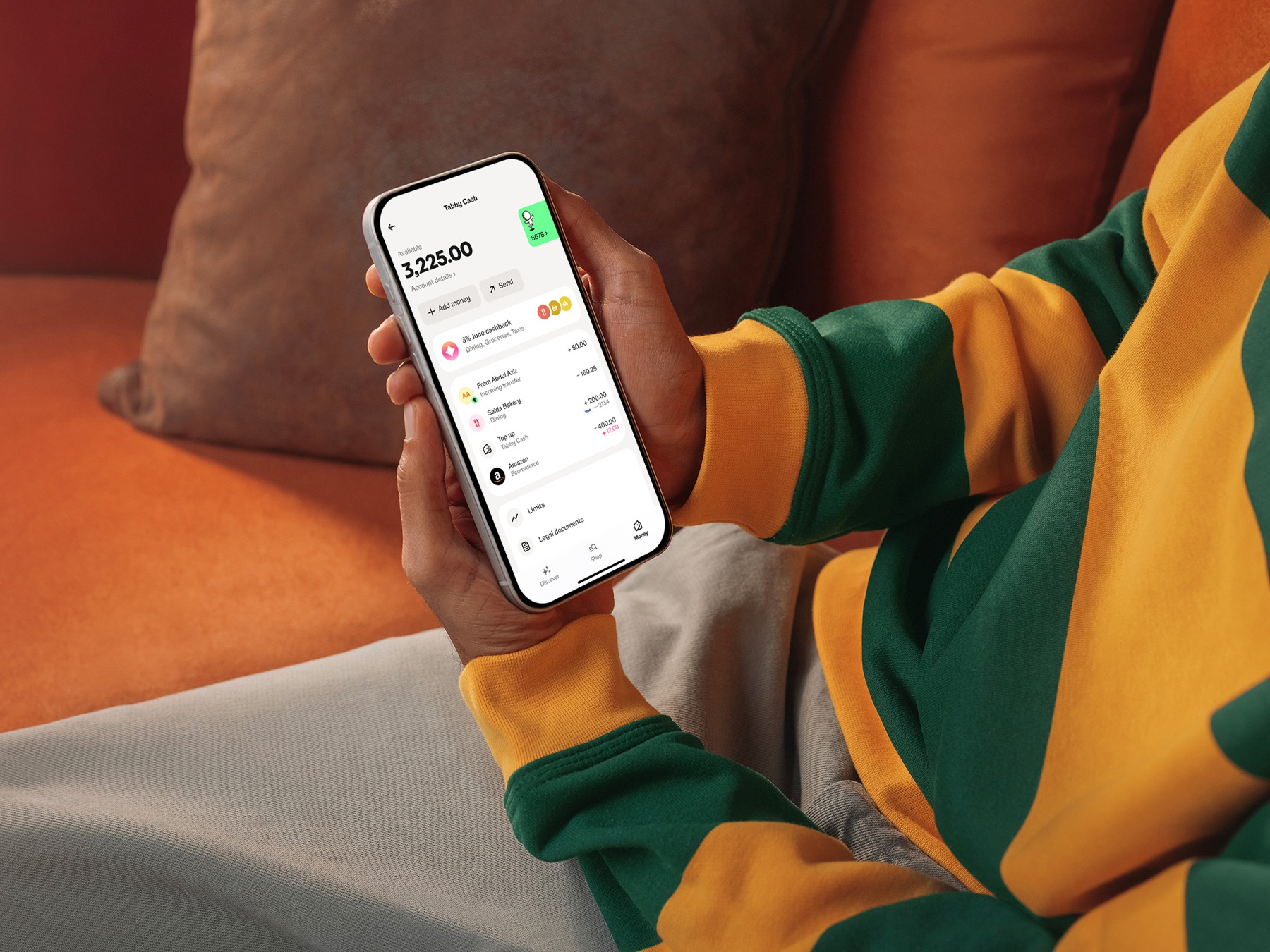
Tabby Cash, launched in the UAE in July 2026, moves into holding and transferring customers’ own money. The account has no account or card fees and no minimum balance. It rests on a UAE Stored Value Facilities licence. In Saudi Arabia, acquiring wallet provider Tweeq added another regulated foundation for accounts and payments.
Bigger purchases need different promises
Saudi consumer and SME finance licences announced in June 2026 widened the scope again. Eligible consumers can finance purchases up to SAR 50,000 across as many as 12 monthly payments. Those longer plans use Murabaha, with an upfront fixed cost. Calling every Tabby product free would miss the distinction.
Education is another step outside the shopping basket. A May 2026 partnership with zenda put payment plans into school payment systems; Tabby said it was live at more than 100 UAE institutions. The problem here is a household calendar: tuition arrives in a lump, while income usually arrives in pieces.
Tabby competes with Tamara, which advertises Saudi plans stretching to 24 months, as well as bank cards and conventional finance. Its position combines merchant distribution, consumer payments and regulated account products. That breadth also raises the difficulty: longer loans and customer balances demand more than a polished checkout.
For a shopper, flexibility helps when future payments fit future income. For a merchant, it helps when incremental profit covers fees. Neither condition follows automatically from an easy approval screen. Tabby’s useful lesson is to investigate the customer’s existing workaround, then build the funding and operations that make a better option dependable.