Serhii Kupriienko had a problem with formations. He was trying to explain software that lets drones cooperate. The people listening wanted to know what shapes the drones would make in the sky. It was a reasonable question, if you had arrived expecting an air show. It was a less useful question if you were trying to change how a group of machines makes decisions.
He eventually told his research team to implement some formations so he could stop explaining. The anecdote, which he told in a June 2025 podcast conversation, has the weary comedy of a product meeting. Somewhere between the engineering and the sales pitch, a feature had acquired a second purpose: allowing the conversation to move on.
For Kupriienko, the interesting part of a swarm happens between its members. Machines share information, divide work and adjust when circumstances change. Their geometry is incidental. You can arrange people beautifully around a conference table and still have a terrible meeting. The arrangement gives you very little evidence about the cooperation.
That distinction runs through his career. He spent years managing research into artificial intelligence and computer vision before co-founding Swarmer with Alex Fink in May 2023. In Ukraine, during Russia’s full-scale invasion, cooperation among machines became a practical question with consequences far beyond a demonstration. How much could a person delegate? What would the person still have to decide?
Before the drones, the cameras
Kupriienko’s technical education preceded the current enthusiasm for AI. He earned a master’s degree in computer science at Chernihiv Polytechnic National University in 2007. His later work at Ring in Ukraine took him through research management roles, including head of research, director of research and general manager of research. These were jobs concerned with making software work beyond the lab.
At Squad Ukraine, he served as general manager of AI from January 2021 to January 2023. His responsibilities included the end-to-end development and delivery of AI and computer-vision software to more than 25 million end-user devices. The number matters because a model on a researcher’s computer and a feature used across millions of devices are different managerial assignments.
A demonstration lets its creator choose the moment. A deployed product meets people, settings and interruptions its creator never selected. A camera can encounter an unfamiliar scene; its software still has to produce an intelligible result. Managing that transition gives an engineer reasons to care about reliability, testing and the distance between a clever idea and a useful product.
The continuity in Kupriienko’s story is the work of crossing that distance. The setting changed dramatically when he moved into defense technology. The underlying obligation to deliver software that people could use remained. His experience also placed him at the junction of two professions: building technical systems and building the teams that must take responsibility for them.
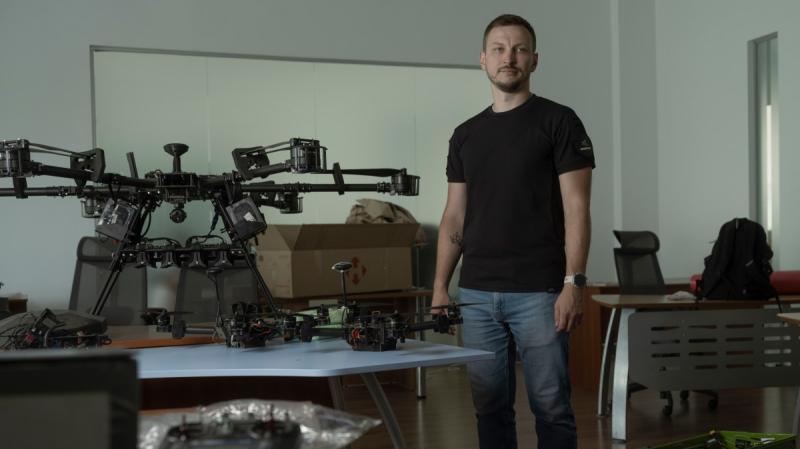
A company built around the space between machines
Swarmer began with a division of labor of its own. Kupriienko and Fink founded a software company rather than a drone manufacturer. The company’s task was to help different unmanned systems act as a coordinated group. The hardware could come from elsewhere. Swarmer would concentrate on the behavior connecting it.
This choice gave the business a specific place in a crowded field. A vehicle needs to navigate and perform its own task before it can contribute usefully to a group. The coordination software adds another layer: what should the group do when new information arrives? Who takes which role? How does a change affecting one member alter the plan for everyone else?
The distinction makes the word “swarm” both useful and troublesome. It evokes collective behavior immediately. It also imports expectations from birds, insects and the synchronized drones seen at public spectacles. Kupriienko’s formation story is a small account of what happens when a memorable company name brings its own uninvited product specification.
The company says its software entered combat operations in April 2024. By its current account, it has supported more than 100,000 real-world missions with nearly 50 Ukrainian military units. Those are company-reported deployment figures, describing the software’s use rather than the number of aircraft in any particular swarm. Keeping the units straight matters; a mission count cannot tell you everything about a system.
The button people want to press
In the early development of Swarmer, the team deliberately narrowed what the first version could do. The initial combat version supported one drone type, despite broader ambitions. Features were cut so the system could be passed to pilots in a form they understood. There was also a large red button to trigger safeguards and bring a drone home.
A red button is almost suspiciously familiar in a story about advanced AI. It belongs to machinery, factories and films in which someone has made a regrettable hiring decision. Here, its familiarity served a purpose. An operator needed a concrete way to interrupt the system, and a concrete answer to the question of whether that interruption would work.
Kupriienko has described human responsibility for key decisions as a basic principle of swarm management. The software operates within a framework defining what it may and may not do. Delegation therefore includes boundaries. Choosing a goal and setting constraints become part of the human job, even as the machines take on more of the coordination.
It is a demanding bargain. The person gives up some immediate control over individual movements while expecting the group to behave predictably. An interface has to make that bargain understandable. A test has to make it credible. The big button is memorable because it condenses an abstract question about authority into something a person can actually touch.
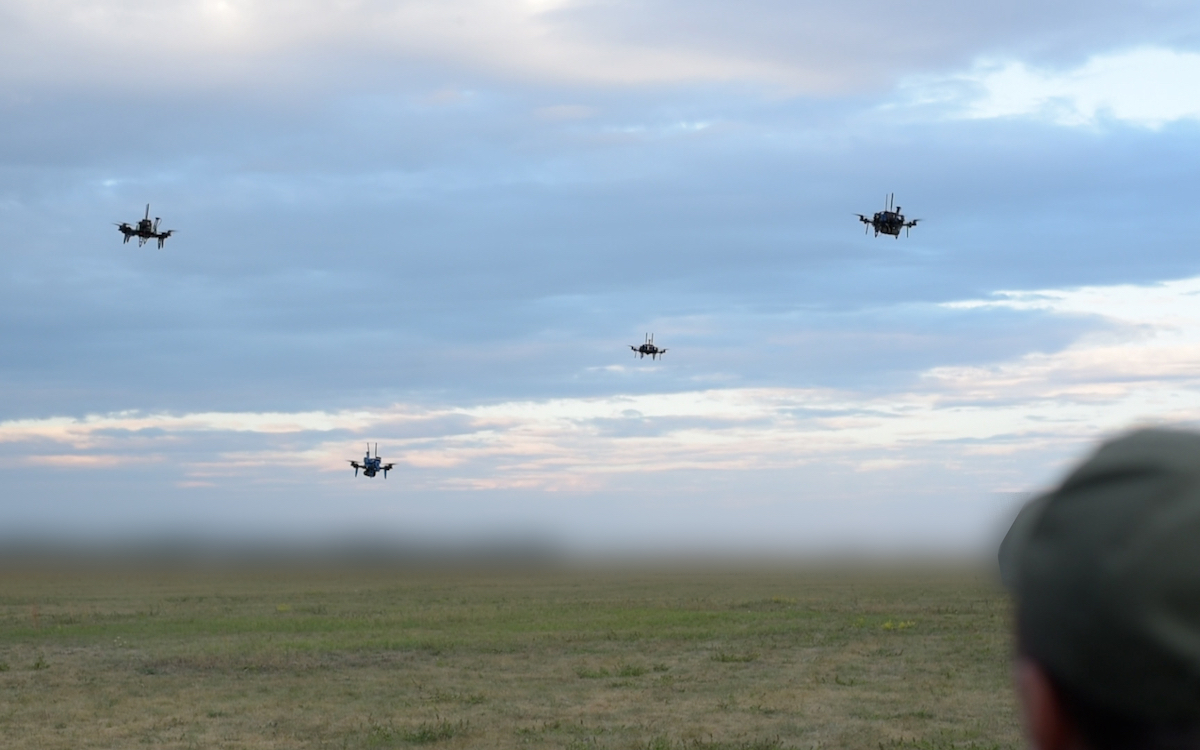
A bug can travel in company
Kupriienko is candid about the limits of the field. Asked in April 2026 how close reliable drone swarming at scale was, he answered: “It’s years away.” The answer sits awkwardly beside the usual startup calendar, where everything consequential tends to be imminent. It also helps distinguish an existing deployment from the completion of a much broader technical ambition.
He described a validation process moving through tabletop work, simulation, field testing and real-world deployment. The order is understandable. A system that coordinates several vehicles can distribute the consequences of a single software mistake across the group. The testing question grows with the responsibility being delegated.
His explanation offers a useful way to read his caution. With a single drone, people may imagine a pilot taking over when something goes wrong. With many machines, the opportunity for individual rescue becomes limited. The software has to prevent more of those situations before an operator is confronted with them.
This makes reliability part of the personal story, rather than a technical appendix. A founder’s appetite for speed meets an engineer’s awareness of failure. Kupriienko helped build a company under wartime urgency, yet his public account leaves room for unfinished components and repeated testing. The tension cannot be resolved with a confident sentence. It has to be managed in the work.
“It’s years away.”Serhii Kupriienko on reliable swarming at scale, April 2026
Two Septembers and a different kind of scale
Swarmer announced funding on September 16 in both 2024 and 2025. When asked about the repeated date, Kupriienko dismissed the apparent pattern: “It wasn’t planned. Pure coincidence.” Even a company working on coordinated behavior can have an uncoordinated calendar. The second announcement concerned a $15 million round.
He said the team had considered a quicker bridge round before choosing a full Series A. The larger round brought more obligations. He described the money’s purpose in practical terms: faster integration, delivery to military users and an expanded international presence. Travel had taken the team to Japan, Britain, European defense events and the United States.
By March 2026, Swarmer had listed on Nasdaq. The change brought a different audience and a different set of responsibilities. A public company must explain itself through governance and disclosures as well as demonstrations. For a founder whose product depends on systems cooperating, the corporate system now demanded attention of its own.
Kupriienko has spoken about investing early in company structure, compliance and paperwork. Paperwork makes an unlikely protagonist in a drone story, but it helps explain how the company moved into international markets. Buyers need more than an appealing technical proposition. They need an organization they can contract with, assess and hold to its commitments.
The title changes; the questions remain
On July 26, 2026, Kupriienko resigned as Swarmer’s Global CEO, effective immediately. He also stepped down from the corresponding role at subsidiary Autonomous Robotics Systems. He remains a director, with his board term running to the company’s 2029 annual shareholders’ meeting.
Fink, the U.S. CEO and president, continues as the company’s principal executive officer. Swarmer said it did not intend to appoint a successor to the Global CEO position at that time. The distinction is important to his present-day profile: Kupriienko is a co-founder and board member whose executive chapter has ended.
A company’s milestones tend to become a founder’s biography: founding date, first deployment, financing, listing. They give the story a tidy spine, but they do not entirely explain what interested the person. In Kupriienko’s case, the recurring question is how to organize intelligence so that a group can accomplish more without requiring a person to direct every movement.
His stated ambitions also extend beyond combat. In 2025, he described civilian testing for disaster response and public safety at large events. During his podcast conversation, he hoped a future discussion could take place in peacetime and concern civilian uses of Ukraine’s defense-sector developments. That aspiration changes the imagined destination of the work: coordinated machines assisting people in a different setting.
For now, his story leaves us with a founder who has spent considerable time explaining cooperation, and occasionally bargaining with the audience’s expectations. The formations anecdote is funny because the compromise is so recognizable. People like a shape they can point to. Kupriienko’s more persistent interest lies in what the machines can decide together after everyone has finished pointing.