The first big problem was a small one: a digit, written by a stranger, perhaps in a hurry. Its loops and slashes might look nothing like the tidy numeral in a textbook. At Bell Labs in the late 1980s, Yann LeCun and his colleagues taught a neural network to recognize such marks. The task had an obvious home in the real world, where banks processed mountains of handwritten checks. It also gave a neglected line of research a wonderfully unforgiving test. A check either carried the right amount or it did not.
Today, machines reading numbers from images barely merit a raised eyebrow. LeCun’s work helped make that ordinary. Along the way, he became a professor at New York University, helped establish Facebook’s AI research operation, and shared the 2018 ACM A.M. Turing Award with Geoffrey Hinton and Yoshua Bengio. In 2026, he is executive chairman of AMI Labs, a company set up to work on systems that learn from the physical world. The problem is much larger now. His taste in questions seems remarkably consistent.
A stubborn idea finds a job
LeCun grew up outside Paris and studied electrical engineering at ESIEE Paris, graduating in 1983. A doctorate in computer science followed at Pierre and Marie Curie University in 1987. His subject was machine learning at a time when getting computers to learn useful patterns was far less fashionable than it later became. After postdoctoral work at the University of Toronto, he joined AT&T Bell Laboratories in New Jersey in 1988.
Bell Labs suited the question. Its researchers could pursue ambitious ideas while keeping practical applications close enough to sharpen them. LeCun’s early convolutional networks reused the same learned pattern detector across different parts of an image. That made sense for handwriting: a stroke remains a stroke when it shifts a few pixels to the left. The network learned useful visual features from examples instead of relying on an engineer to write a rule for every possible form of a seven.
The result was more than a clever demonstration. It connected an architecture to a real task, and it gave other researchers something concrete to improve. LeCun later led image-processing research at AT&T Labs. The work on document recognition became part of a much wider story in computer vision, where convolutional networks eventually found uses far beyond numerals on paper.
“I believe that if we can do video, we can do everything.”Yann LeCun, in a 2026 conversation with James Manyika
The long middle of a breakthrough
Scientific careers rarely move in a straight line from insight to applause. LeCun joined NYU in 2003 after a period at NEC Research Institute. At the university he taught, worked across computer science and related fields, and became the founding director of its Center for Data Science. In 2013, Facebook asked him to lead its new AI research lab. His work now stretched from the patient rhythms of a university to a technology company operating at global scale.
That span matters because deep learning’s rise was collective. Hinton, Bengio, LeCun, their students, and many other researchers kept developing the ideas, systems, and training methods needed to make neural networks useful. When ACM recognized the three men with the 2018 Turing Award, its citation described conceptual and engineering breakthroughs. The engineering half is easy to lose in retellings. A theory must survive contact with data, computing limits, and the embarrassing examples that show exactly where it fails.
LeCun’s own website handles the honor with a small joke. It lists “ACM Turing Award Laureate,” then adds that the phrase sounds like bragging but is required by the award. The aside is a welcome crack in the marble. It suggests a scientist aware that prizes can turn living arguments into monuments, even while the next difficult experiment is waiting on the bench.
What words leave out
A language model can write a persuasive account of a ball rolling off a table. LeCun wants AI to learn the sort of regularity behind the event: objects occupy space, movement has consequences, and a choice made now changes what can happen next. His argument is that text alone offers an incomplete route to that knowledge. Words describe the world, but they are not the world. A system meant to act in it needs more than a talent for sentences.
In a 2026 conversation, he explained a difficulty with video. Trying to predict every pixel in the next frame forces a model to account for detail it cannot know: the exact fall of a shadow, a tiny movement behind an object, the countless possibilities hidden from view. His proposed direction is to learn an abstract representation and predict what matters there. A useful model would discard some details while keeping the structure needed to anticipate events.
This is the idea behind the joint embedding predictive architecture, usually shortened to JEPA. The name is awkward enough to sound like lab equipment, which is appropriate. Its purpose is to give a system a way to compare representations and learn from what is predictable. Meta’s V-JEPA research explored this approach with video. LeCun’s later move to AMI Labs gave him a new institution centered on the broader pursuit of world models.
There is an important difference between an appealing research program and a solved problem. Systems that can reliably predict, reason, and plan across the untidy physical world remain a goal. LeCun is unusually direct about the gap. In that conversation, he described abstract prediction as the work to which he is devoting his efforts. It is a statement of direction, not a claim that the destination has been reached.
An argument in public
LeCun’s disagreements with other prominent AI researchers are unusually visible. He has defended the value of releasing research and model technology openly, and he has questioned forecasts that treat today’s systems as if they were already close to general intelligence. The positions are easy to reduce to slogans. His more interesting point is methodological: a claim about intelligence should be tied to a capability that can be examined, improved, or shown to fail. A machine’s confidence in its answer is not a substitute for that test.
This habit belongs to a wider research culture. At Facebook AI Research, where he began leading the work in 2013, publications and collaboration with universities were part of the lab’s identity. At NYU, he continues to teach and make course materials available. Those choices make the work legible to people outside a single company. They also invite criticism, which is inconvenient in the moment and useful over time. The early handwritten-digit networks survived because their errors could be counted; a theory of world models will need comparably honest ways to show its limits.
He has never lacked company in the argument. Hinton and Bengio were fellow Turing laureates and fellow builders of deep learning, yet the three have expressed different views about where AI is headed. That is a normal condition of a live scientific field. Shared recognition of past work does not require agreement about the next experiment. LeCun’s next one asks whether learning from video and other observations can give machines a more useful grasp of cause, space, and action.
A new lab, a familiar uncertainty
In March 2026, AMI Labs announced a €890 million seed round, about $1.03 billion. LeCun is its executive chairman; Alexandre LeBrun is chief executive. The company is headquartered in Paris, while LeCun retains his NYU appointment in New York. The money provides room for a long research effort. It also puts an immense public price tag on an unanswered scientific question.
The geography carries its own story. LeCun trained in France, built much of his career in the United States, and now chairs a company headquartered back in Paris. The lab’s work is international, as was the network of investors announced with the financing. That path is less a return than an extension of a career spent moving ideas among universities, industrial labs, and public research communities.
His public voice has long been part of the picture. LeCun posts about research, open science, and disagreements over AI’s trajectory. He argues plainly, sometimes sharply, and his personal site directs readers to papers, talks, lectures, and his NYU deep learning course. It is a useful reminder that his reputation rests on work that can be read and challenged. Debate, in his case, is a continuation of the lab conversation by other means.
A childhood encounter with 2001: A Space Odyssey helped stir his interest in machine intelligence, he has recounted. Cinema offered a computer that could converse and act. Research turned that vague fascination into smaller, testable questions. First: can a machine read this digit? Later: can it learn features useful across images? Now: can it form an internal model that helps it anticipate what happens when something moves?
The bank check and the world model are separated by decades of work and an enormous difference in scope. They share one useful discipline: make the claim face reality. For LeCun, the next answer will come when a system can do something concrete with its predictions. Until then, the question remains where it belongs, in the open.
Follow the work
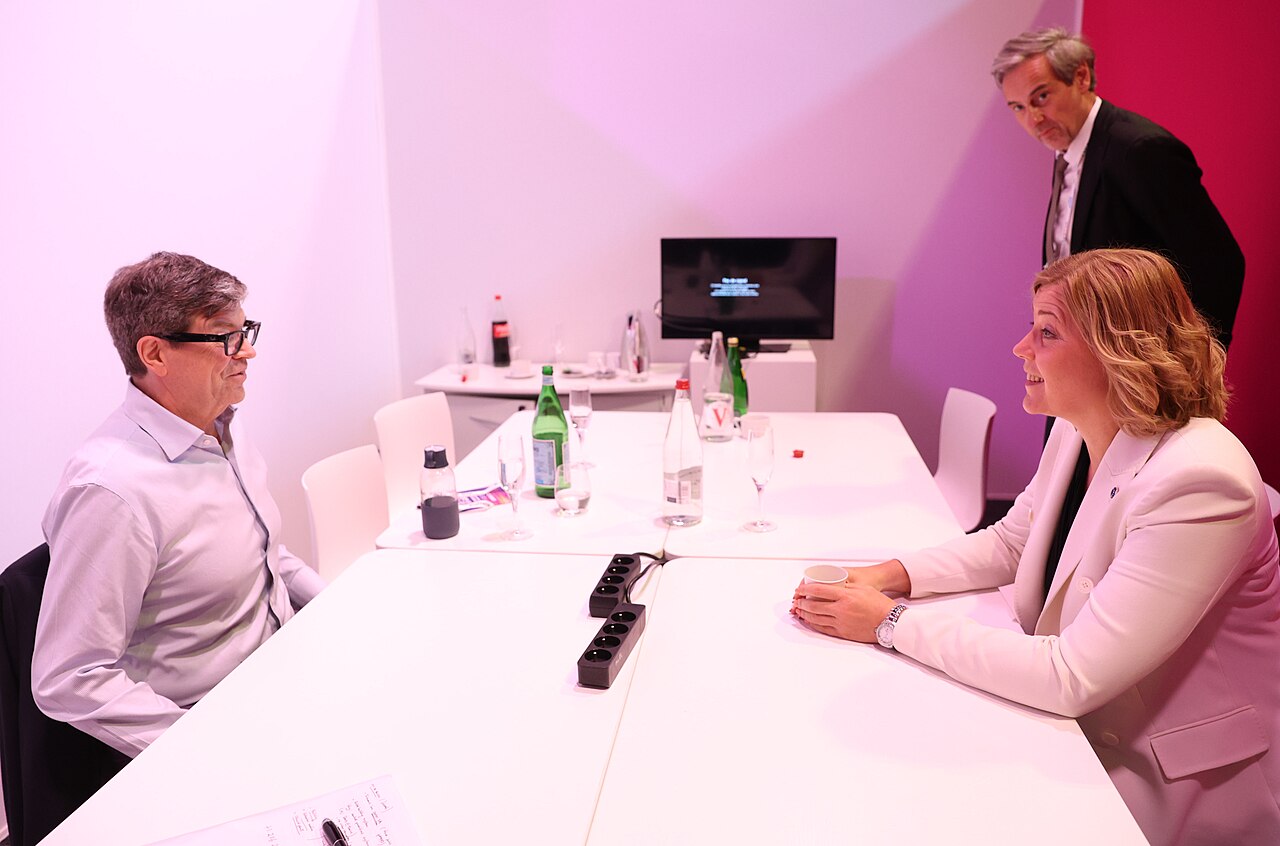
Event image: © European Union, 2026, licensed under CC BY 4.0.