SEO Agency USA built itself an AI agent, and the agent got the judgment wrong. According to the company’s account, the same model, given the same facts under three prompts, produced three different triage answers. The fix was wonderfully unglamorous: put the deciding test first, as a checklist. Which filings actually touched the business’s footprint? Answer that before ranking anything.
- Enterprise SEO and AI visibility for technical B2B businesses.
- A free GEO Grader turns brand recognition into a diagnostic.
- Custom scopes, mandatory setup, and named people responsible for the work.
That small admission makes a useful entrance to this company. SEO Agency USA sells visibility in systems that increasingly answer questions for people. It also builds workflows that act on information. Both businesses depend on the same awkward distinction: a machine can produce an answer before anyone has established whether it is useful.
The shortlist is the sale before the sale
Founded in 2020 by Jason Langella, now its founder and chairman, the independently owned agency currently concentrates on technical B2B markets. Energy, utilities, engineering, construction, manufacturing, and data centers sit near the center of its offer. These are businesses whose products usually require considerably more explanation than a checkout button.
Consider the engineering firm. Its buyer wants evidence of relevant disciplines, licenses, and comparable projects. SEO Agency USA’s engineering practice proposes discipline pages, project experience, credential information, and structured data. The aim is to make qualifications legible during research, before a request for qualifications reaches the firm. A handsome website with vague service descriptions leaves too much work to the buyer.
The agency’s differentiator is the attempt to carry that information into both conventional search and AI-generated answers. Technical SEO handles whether pages can be discovered and understood. Content strategy gives those pages substance and connections. Generative engine optimization, or GEO, adds citation audits, clearer factual passages, consistent entity information, and monitoring of how answer engines describe the company.
- 01Be foundTechnical foundation
- 02Be understoodSpecific, useful evidence
- 03Be consideredSearch + AI discovery
- 04Be chosenQualified inquiry
A score is a door opener
The accessible version of this proposition is GEO Grader, introduced in an April 2026 announcement. Enter a brand and the tool promises a proprietary Entity Confidence score from zero to 100. Its published description says it queries ChatGPT, Claude, Gemini, Perplexity, and Grok to assess recognition and the accuracy of the resulting descriptions.
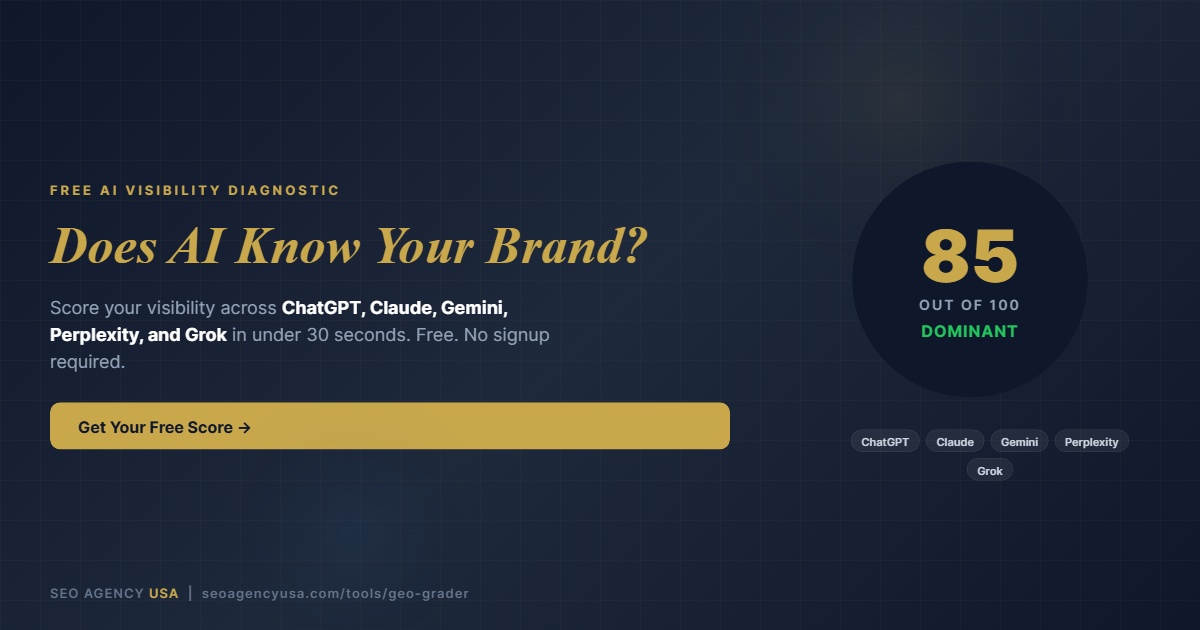
The diagnostic is free. The commercial opportunity is what follows: identifying muddled descriptions, missing evidence, or competitors appearing where the brand expected to be. A score offers a convenient way to start that conversation. It should be read as the agency’s diagnostic, rather than a universal measurement of brand strength or a promise of future recommendations.
That difference matters. Recognition is upstream of a purchase, and several steps separate being mentioned from winning a contract. SEO Agency USA’s broader offer includes conversion work, paid search, website development, local search, and reporting. The free tool brings someone to the door; the paid engagement is supposed to connect discovery with a functioning commercial funnel.
The price starts with the problem
The current pricing page describes a custom scope built from six variables: competitive density, site size and technical debt, markets and locations, content velocity, AI visibility coverage, and service breadth. Every engagement begins with a mandatory setup phase covering the audit, competitive mapping, keyword research, account architecture, and baseline reporting.
That is the business model: ongoing search and visibility retainers, preceded by paid setup. AI agents, automation, training, and strategy receive separate scopes. Qualification establishes a minimum investment threshold. Prospects need executive access and a time horizon suited to sustained search work. The agency explicitly screens for that fit before scheduling discovery.
“The agent stops here. Reply RELEASE or HOLD.”Review instruction documented in the agency’s own monitoring workflow
Its market position is therefore closer to an outside specialist team than a self-service SEO subscription. Alternatives include an internal search department, a specialist agency, or a broader marketing firm. SEO Agency USA’s stated case rests on a senior strategy lead, technical depth, and integrated search and AI work. Those are engagement commitments a buyer can put into a scope and evaluate.
Its hiring page gives that staffing promise a concrete shape. Candidates are assessed for technical fluency, strategic reasoning, clear communication, and operational maturity. The agency says an impressive audit is insufficient if its author cannot explain the findings to an executive. For the customer, the useful question is who will translate a technical recommendation into a decision the business can make.
The free SEO ROI Calculator provides another translation exercise. It applies a modeled 2.5x traffic scenario to the visitor’s own inputs. That makes it useful for testing assumptions; the resulting revenue figure remains a scenario. A buying committee should examine conversion quality and deal value before letting a larger traffic number settle the budget.
Copy the test, then check the handoff
The internal monitoring build shows what that evaluation might look like. The agency describes a ten-module Make.com workflow using Claude Haiku 4.5. It reads public notices, removes duplicates, ranks the remaining items, and sends important ones for review. Its prompt experiment changed the instructions: the business-specific decision checklist had to come before the model’s classification.
A second problem appeared after the review email. The first workflow could ask for a decision without knowing whether anyone replied. The agency says it added another workflow to poll replies every 15 minutes, record RELEASE or HOLD, and manage the handoff. That is a useful detail because an unanswered approval request can quietly defeat an otherwise capable automation.
The transferable lesson is specific. Define a wrong answer using examples from your own business. Write the deciding test down. Name the person who can approve, correct, or stop the output. Without relevant source material, a maintained workflow, and someone empowered to act, the exercise loses its connection to the work it was meant to improve.
The energy focus takes this proposition into a particular room. SEO Agency USA announced sponsorship of all six 2026 LDC Gas Forums, and the Southeast organizer’s agenda lists Langella on a technology panel. For a search agency, it is a revealing place to show up: among the people whose technical vocabulary and purchasing decisions its content must understand. Getting the answer right begins there.