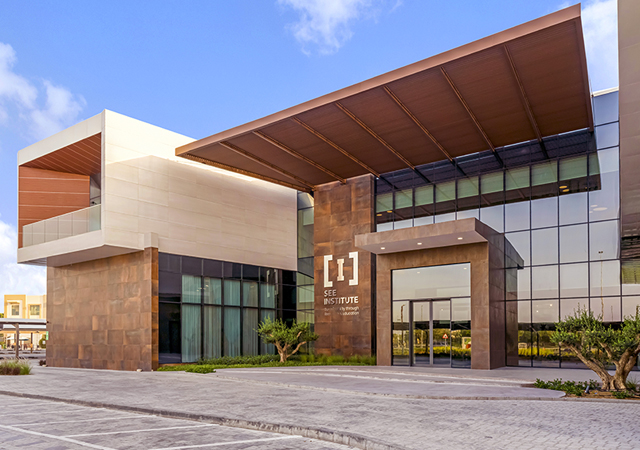
A building can be a rather expensive way to make a point. At SEE Institute, in Dubai’s Sustainable City, that is part of the proposition. The institute reports solar generation equal to three times its annual operational energy needs. A sustainability lecture delivered beneath that roof comes with an unusually large visual aid. Yet the electricity figure is only the beginning of the lesson.
- The offer: research, professional learning, advisory work, venture building and events.
- The advantage: access to a functioning community for approved pilots.
- The useful distinction: annual energy surplus and whole-life carbon neutrality require different accounting.
The roof has a surplus.
The concrete has a history.
Electricity is the visible problem: cooling rooms, lighting halls, running equipment. Embodied carbon is less obliging. It arrives with the concrete, steel and other materials, before the first student takes a seat. Switching on a solar array does not undo those emissions. SEE’s stated ambition is to offset the building’s embodied emissions by 2030, alongside addressing operational emissions. The date belongs in the story.
Think of two accounts. One records the energy required to operate the place each year. The other records the carbon spent creating it. A surplus in the first may help repay the second over time, under the project’s accounting approach. That explains why an apparently simple claim about a solar-powered building becomes a discussion about materials, measurement and time. Annual balance also leaves open what happens at any particular hour.
Reported annual generation relative to energy needs. A yearly surplus does not establish round-the-clock independence from the grid.
Procurement, with consequences
The material choices are more instructive than a green slogan. A 2023 study by SEE researchers Jacinta Dsilva, Saniya Zarmukhambetova and Jasmina Locke used life-cycle assessment to examine the institute building. It reported a 26% reduction in embodied carbon against its conventional construction baseline. This was a particular project comparison, with a defined assessment scope; it is not a promise attached to every building carrying a sustainability label.
The team considered materials before construction, including concrete and recycled steel. Its broader decarbonisation study describes selecting walls and façades against insulation, acoustics, material use and cost. The buying decision had several jobs to do. A wall that looks virtuous in a materials spreadsheet still needs to keep the room comfortable.
The lesson is portable: bring assessment into procurement while choices remain open. Trade coverage also describes glazing, insulation and building controls that manage energy demand. Together these details suggest a sequence worth copying: reduce what the building needs, then decide how to supply it. The practical qualifications are equally plain. Solar collection area, local climate, occupancy and maintenance will affect the result.
A classroom with neighbours
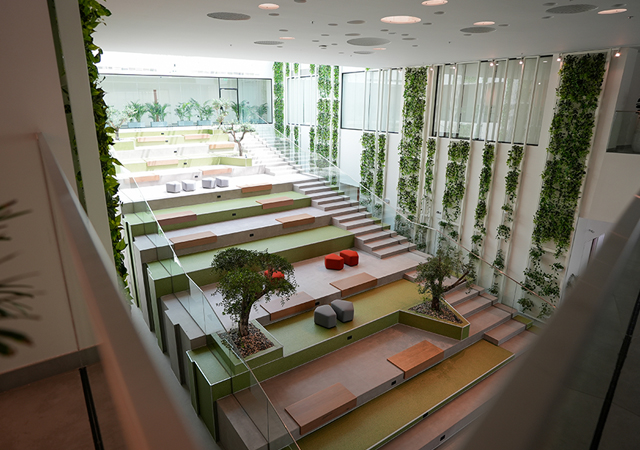
SEE Institute’s founder and chairman, Faris Saeed, comes from the development business behind The Sustainable City. The institute sits inside that community, where people live and businesses operate. This gives its education and research work a setting beyond the seminar room. Energy, water, mobility and resident services are also everyday operating questions.
“Try ideas before assuming they work.”
SEE Institute / Build + Experiment
Its Living Lab advertises controlled testing for selected technologies, services and ventures. A researcher can study behaviour in context; a company can pilot a product with prospective users. The published process starts with definition and approval, then moves through testing, measurement, learning and improvement. It ends with a decision to scale or stop. That final option deserves its place.
- 01Define + approve
- 02Test + measure
- 03Learn + improve
- 04Scale or stop
Habitat supplies a concrete example of the connection. SEE describes the resident-services product as live in The Sustainable City, bringing maintenance, amenities, events and communication together. The promise of a living lab is feedback from use. The qualification follows naturally: a pilot requires permissions and suitable participants, and one community cannot stand in for every eventual market.
The business beyond the lecture
For customers, there are several entrances. Working professionals can seek short courses. Organisations can commission learning around their teams. Researchers and founders can enquire about projects and pilots. Event organisers can hire spaces. SEE also links to sustainability advisory work. The commercial offer spans services and programmes, giving the institute several ways to put its knowledge and premises to work.
The current learning portfolio reaches into AI: agents, internal tools, workflows, marketing and governance. SEE Academy says participants should leave with something built. Tangents, its technology and venture-building arm, connects that emphasis with products and experiments. Its advertised projects include City Factory, a real estate assessment workflow combining sustainability with financial modelling. The connection to the original built-environment mission is easy to see.
SEE’s competitive position comes from this combination. A university course can supply theory; a consultancy can address a client problem; an accelerator can help a founder. SEE puts those kinds of activity beside operating infrastructure and potential users. That makes it a plausible choice for an organisation wanting learning tied to a practical question. Whether the programme fits still depends on the question, the people and the proposed work.
From a steel beam to Saturn
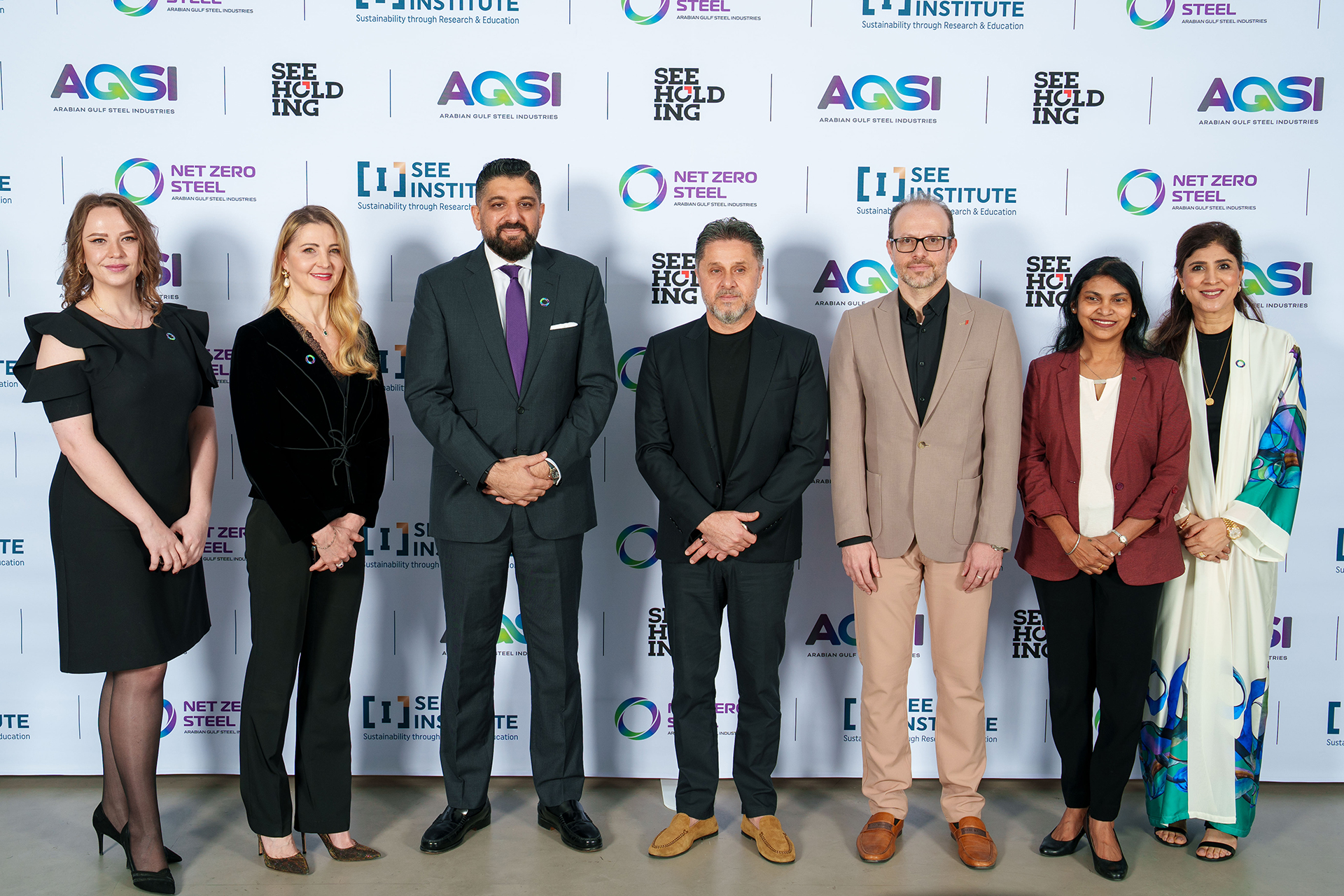
The partnerships show how broadly SEE interprets education. Its January 2025 agreement with Arabian Gulf Steel Industries included plans to train construction professionals in low-carbon steel. The Cardano Foundation partnership connects sustainability with blockchain education. The inaugural 2024 sustainability summit reviewed 75 academic papers from 35 universities and paired the conference with a startup bootcamp.
There is room for a less solemn invitation, too. Dubai Astronomy Group’s 2026 collaboration advertises planetarium experiences, telescope observations and school programmes. A planned October screening of The Martian adds food-production activities to a story about surviving on another planet. Food, water, energy and habitats return to the conversation through cinema. SEE’s most useful idea may be this: give people a setting where a large subject becomes something they can examine, practise and question.