Dubai’s Office of the Future looks as though someone rounded off a spaceship and gave it meeting rooms. Opened in 2016 for Dubai Future Foundation, the building used 17 printed modules. There is a less glamorous detail beneath the white curves: its substructure was conventional concrete. Even tomorrow needs foundations.
That combination of spectacle and practical compromise is a useful introduction to the foundation behind it. Dubai Future Foundation, or DFF, brings public agencies, entrepreneurs, researchers and businesses together to work on technologies and services the city might adopt. Its portfolio stretches from robotics research and government accelerators to professional education and the Museum of the Future.
The attraction for a founder is unusually concrete. An official responsible for a public service can help define a problem, assess a proposed solution and consider a pilot. DFF supplies programmes through which those conversations can happen. A city becomes a place to test an idea, with potential users and decision-makers involved.
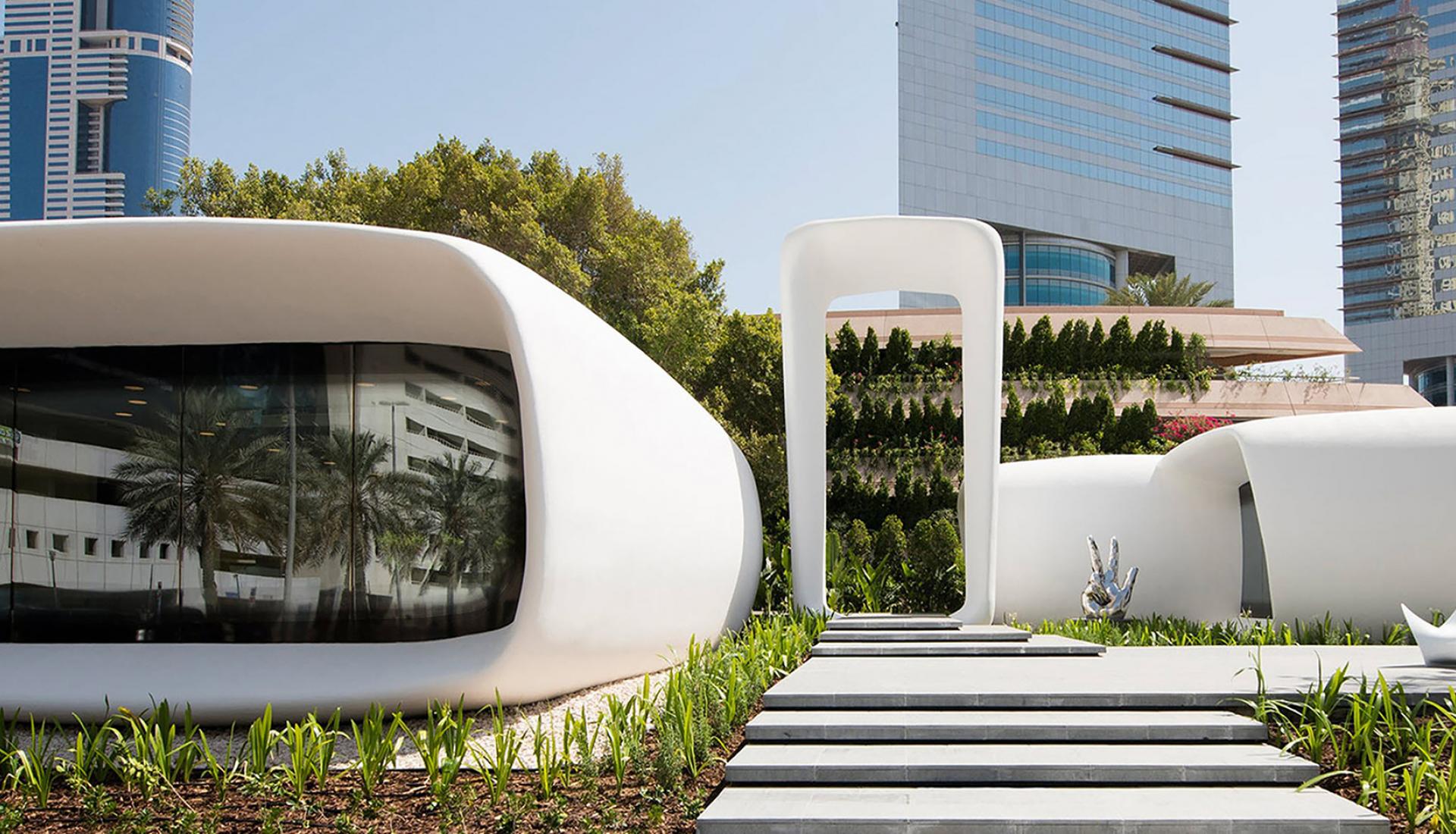
The printer met the building inspector
The office’s engineering account rewards a closer look. Thornton Tomasetti describes 17 days of printing and two days of on-site assembly. Those are specific stages, rather than a complete design-to-occupancy schedule. The project brought together Gensler, Killa Design, Syska Hennessy Group, Thornton Tomasetti and e.construct, among others.
The modules were printed in China and shipped to Dubai. Printer and shipping constraints affected how the pieces were divided. With no dedicated design codes for the printed structures, e.construct used performance-based engineering. Its engineers tested the printed elements under equivalent design loads. The final design was adjusted to reflect measured strength and behaviour.
Here is a documented answer to what changed the team’s mind: evidence from the actual components changed the design. Treating that revision as a dramatic failure would miss the point. Testing was part of making an unfamiliar construction method usable.
Engineering News-Record reported an approximately $140,000 construction cost, attributed to DFF, and reported labour savings of 70 percent. Read that as the project’s reported building figure, with its particular scope. It is not a universal price for printed offices. The publication also described early meetings with building authorities as important to getting approval.
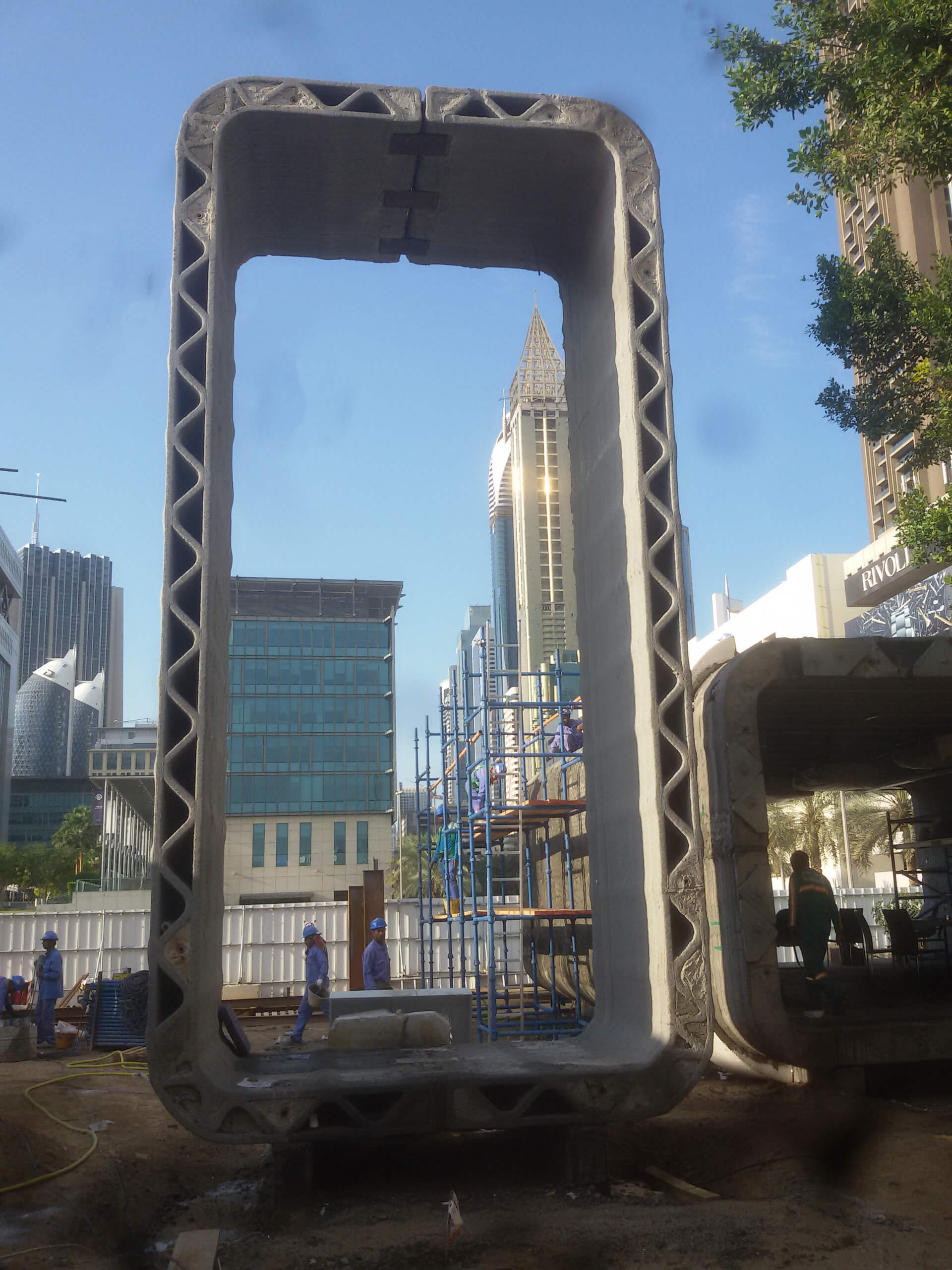
Start with the department’s problem
Sheikh Mohammed bin Rashid Al Maktoum launched DFF under its current name in April 2016, alongside the Dubai Future Agenda. The foundation’s official history uses 2016 as its founding year. Its remit joined work on people, organisations and economic sectors under an institution intended to help shape Dubai’s development.
Dubai Future Accelerators made that remit tangible. Government and private partners set challenges; startups and scale-ups apply with solutions. Selected participants work with a partner to define a pilot and pitch it to decision-makers. The programme advertises zero equity and paid flights and accommodation for up to two team members.
For a small company, that can remove an expensive guessing game. The organisation that experiences the problem participates in specifying the work. The intended destination is a commercial agreement to scale a selected solution, but selection for the programme is only an early step in that process.
The first cohort paired 30 companies with seven government partners, including Dubai Police, the Roads and Transport Authority, Dubai Health Authority and the education regulator KHDA. DFF records 19 agreements to continue work. In December 2016, it announced AED120 million allocated to 19 projects across sectors including health, transport, education and energy.
Agreements to continue work. These figures do not measure completed deployments or company survival.
The distinction matters. An agreement is evidence that a relationship advanced. It does not, by itself, establish recurring revenue, citywide adoption or a lasting improvement in public services. Equally, subtracting 19 from 30 does not produce a defensible count of failed companies. This is a record of a programme stage, with a clearly defined denominator.
Permission is part of the product
A promising prototype can still run into a rulebook written for something else. Sandbox Dubai addresses that problem through supervised, real-world trials. Its stated model offers temporary regulatory relief during experimentation while allowing regulators to gather evidence. The permission is bounded; the trial is supposed to teach both sides something.
In October 2024, DFF launched Gig Economy and PropTech sandboxes. The former subsequently added Emirates Airline, Amazon, Careem and GEMS Education as partners exploring seasonal employment. The latter focuses on technologies affecting real estate. These are business-model questions as much as software questions: how an activity should work, who can participate and which rules fit.
That helps explain DFF’s position in the innovation market. An independent accelerator, university laboratory, consulting firm or venture fund can overlap with a piece of its work. DFF’s institutional advantage is the combination of a government mandate, programme coordination and access to organisations that can test or adopt a solution.
- 01Find a problem
A partner defines the need. - 02Design a trial
Agree scope and evidence. - 03Resolve permissions
Bring in relevant regulators. - 04Decide what follows
Revise, stop or pursue adoption.
An editorial guide to the work, not a promise of acceptance or a single mandatory programme sequence.
A billion dirhams needs a label
DFF’s economics require some careful separation. It is a government-backed institution serving public innovation and economic development. Its users include agencies seeking solutions, businesses seeking trials, researchers, students and audiences for its public programmes. Those relationships cannot all be reduced to a conventional customer subscription.
The Dubai Future District Fund is a related investment vehicle with a different job. Its formal launch announcement in November 2021 described an initial AED1 billion. DFF and the Dubai International Financial Centre anchor the evergreen fund, which invests in venture funds and startups directly. Its mandate combines investment returns with economic diversification and job creation.
That capital is not DFF’s annual revenue. Nor should it be added casually to a separate AED1 billion investment pipeline announced for accelerator projects in 2016 and presented as money raised by the foundation. Commitments, allocations and operating income answer different questions. For founders, the practical implication is simple: a pilot programme and an investment application are different routes.
The government has homework, too
The foundation’s work also reaches inside public institutions. Dubai 10X, first presented in 2017, asks government to rethink how it operates. Its third phase emphasises a project led by a responsible official and delivered by a team drawn from multiple entities. The programme page lists 42 projects, including Digital DEWA and Dubai REST.
The management lesson is more transferable than the slogan about being ten years ahead. When a service crosses departmental boundaries, putting those departments on a joint team can make the assignment explicit. Calling something innovative does not settle who owns the next decision; the design of the team has to address that.
Dubai Future Academy, launched in 2017, works on the skills behind such decisions. Its areas include futures literacy, emerging technologies and foresight methods such as scenario building and systems thinking. Dubai Future Labs takes another route into capability: applied robotics and AI research intended to address gaps in economic sectors.
DFF’s stated culture values risk-taking, agility and people from different disciplines. The programmes give that language some practical expression through training, experiments and joint teams. The Dubai Centre for Artificial Intelligence adds support for government AI adoption and evaluation. Its published targets should be read as targets, rather than automatic proof of productivity gains.
The museum gets the photograph
The Museum of the Future is the foundation’s public-facing attraction. It opened on February 22, 2022, bringing possible futures into an exhibition setting. Dubai Media Office said in February 2026 that it was approaching five million cumulative visitors. The scale shows how much wider DFF’s audience is than the startups in an accelerator cohort.
For readers planning a visit, the current detail matters: as checked on September 9, 2026, the museum’s website says its exhibitions are temporarily closed while it prepares its next chapter. Its online shop and selected experiences remain available. Check the museum’s own updates before making plans.
The museum also houses the Global Futures Society. The 2025 Dubai Future Forum outcomes report recorded 31 additional organisations joining that network and a collaboration with The Explorers Club. Bringing those organisations together gives DFF another way to circulate ideas and partnerships beyond an individual technology pilot.
Tomorrow now has a follow-up appointment
In July 2026, DFF published the fifth edition of its Global 50 foresight report. This edition revisited 50 opportunities identified in previous reports, examining progress and routes to implementation. Its preparation included engagement with more than 180 experts. Financing, collaboration and the systems needed to make an opportunity usable received explicit attention.
That is a useful editorial shift: an attractive possibility gets a follow-up question about execution. The same month, DFF and Amazon UAE announced co-sponsored scholarships for Emirati students aged 13 to 17 to join TKS Dubai. The ten-month programme combines emerging-technology learning, projects and mentorship. Building future capability starts well before a procurement meeting.
“The actual prints were fully tested to a design load equivalent”
e.construct, on the Office of the Future
For a founder, the entry point is a relevant challenge with a plausible solution. For a public manager, the copyable move is to name the problem’s owner, involve the people who can approve a trial and agree what evidence would justify continuing. For a researcher, the academy, reports and applied labs offer different ways into the work.
Those moves depend on real authority, available partners and a route beyond demonstration. Without them, a pilot can end at the presentation. DFF’s printed office leaves a more useful closing image: components were tested, the design was adjusted and people assembled the result. The interesting part of imagining tomorrow is what happens when somebody has to build it.