A crushed bottle is an awkward thing to build a company around. It has lost its shape, acquired some dirt and arrived in the company of objects that look almost like it. Matanya Horowitz saw an opening there. A machine that could recognize the bottle in that condition might make recycling a better business. First, though, he had to persuade a robot to survive the recycling plant.
In early 2016, AMP’s first installation went into a facility sorting food and beverage cartons. It broke almost immediately. Suction systems clogged. Conveyor-belt cleats damaged the machinery. A doctorate offered little protection against a conveyor belt. Horowitz remembers the experience plainly: “It was a nightmare.” The following year brought a daily supply of faults to fix, along with doubts about whether he was the person who could fix them.
That is a useful place to begin with AMP’s founder and chief technology officer. The elegant idea came before the reliable machine. Building the company required him to keep returning to the distance between the two.
Science fiction had promised rather more
Horowitz grew up mostly in Colorado, with Transformers, Voltron and Isaac Asimov supplying a generous view of what robots ought to do. The household vacuum cleaner was having trouble keeping up with the publicity. When he entered the University of Colorado Boulder in 2006, he already wanted to work in robotics. The Roomba impressed him as a product, but seemed a modest answer to science fiction’s promises.
His response was to study the problem from several directions. He earned four bachelor’s degrees, covering electrical engineering, computer science, applied mathematics and economics, alongside a master’s in electrical engineering. The five qualifications took four years. He believed different disciplines might each contain a piece of the answer to making better robots.
At Caltech, he worked with Joel Burdick and John Doyle, studying control and dynamical systems. Robotic path planning asks how a machine should move through the physical world. Computer vision asks what is there to move toward. His eventual business would need both. Before AMP, he was already involved in DARPA robotics challenges with a JPL team and gave a 2013 TEDxCaltech talk called The Form of a Robotic Mind.
Electrical engineering, computer science, applied mathematics and economics. All before the Caltech doctorate.
The golem goes to work
There was an older robot in his imagination, too. In Jewish folklore, a golem is made from inanimate matter and brought to life to perform a task. Horowitz has described the story as an influence on his thinking: something a person creates could become useful to a community. The question of artificial intelligence had a practical, almost domestic attraction. What could such a helper actually do?
He approached recycling as an outsider. Facility visits brought conversations about inconsistent material quality and staff turnover. He bought substantial textbooks on the industry, asked questions and tried to understand the business beneath the machinery. The textbooks were, by his account, five inches thick. Even the reading material required a certain commitment to heavy lifting.
One Los Angeles visit was particularly consequential. A friend had suggested recycling, and Horowitz went to Puente Hills, beside a huge landfill. He had been examining applications in agriculture, manufacturing and drones. Here was a problem with an immediately visible scale: a mountain of discarded material, and sorting work that still depended heavily on people around conveyor belts.
He founded AMP in 2014. Government grants, including support through the National Science Foundation’s small-business program, helped get the work moving. Recycling became the place where his interest in intelligence could meet an identifiable customer need.
A date with the training data
Teaching a machine to recognize waste requires examples of waste. Horowitz collected bottles, cartons and cardboard from bins, turning the things other people discarded into material for the vision system. On one outing, he and his wife, Kelsey, went dumpster diving together. They brought the haul back and spread it across his office floor.
The cleaning staff had understandable questions. A janitor called to ask what sort of party had taken place. Horowitz had to persuade him to leave the rubbish alone. For once, tidying the office would have damaged the research.
There was another gap in his preparation. Despite his doctoral work on the mathematics of robotics, Horowitz had never built a physical robot before completing his PhD. In AMP’s earliest work, even connecting the machine to the computer was unfamiliar territory. He had assumed the company-building part would be easier than computer vision. Experience gave him reason to reconsider.
The early software effort also had a family connection: Horowitz and his brother wrote many of the prototypes. His undergraduate roommate James Bailey joined the founding effort. The work called for people who could move between an ambitious idea and whatever needed attention that afternoon. A machine’s refusal to cooperate can make job descriptions seem rather decorative.
“I thought that would be the easy part.”
Matanya Horowitz, on starting a company after studying computer vision
The bottle has a price. So does finding it.
Recycling’s technical difficulty is bound up with its economics. A factory can arrange to encounter the same object in the same position repeatedly. A recycling line receives objects crushed, folded, dirty and mixed together. Reliable recognition has to survive those variations. Deep learning offered Horowitz a way to train a system on examples rather than demand that every discarded package present itself politely.
In a 2021 explanation, he used deliberately simple numbers. Materials might be worth $50 or $100 a ton, while running the recycling facility could cost $80 a ton. At one end of that range, the arithmetic is punishing. Even at the other, there is limited room for mistakes. Lower sorting costs and cleaner output can change what a facility can afford to recover.
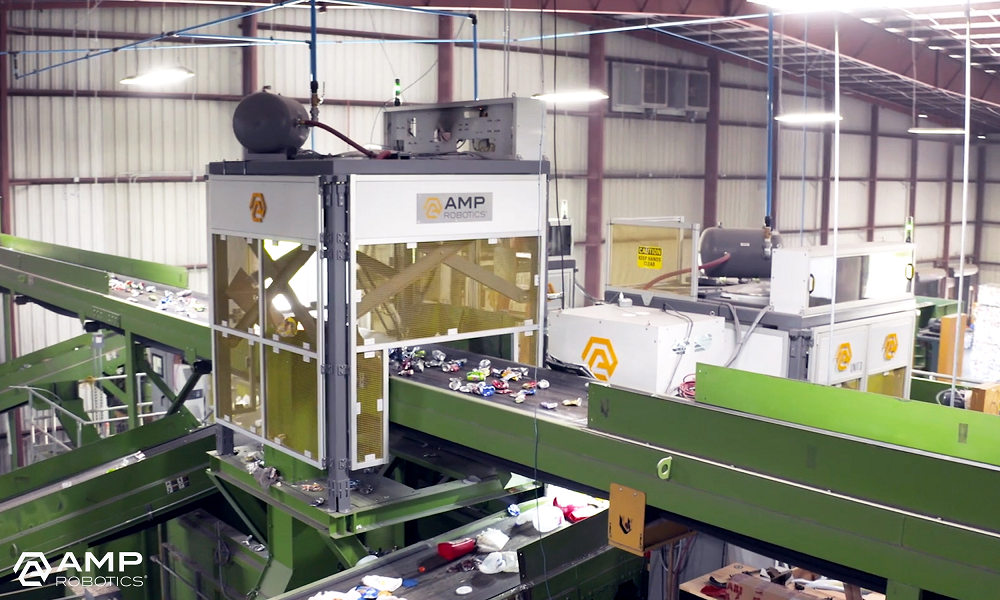
AMP’s vision system used a color camera and a graphics processor to identify materials. That information could direct a sorting robot toward the right item and destination. The early Cortex system was designed to fit into existing facilities, taking roughly the space of a person at the line. For an operator, installation was part of the proposition: a useful machine had to fit the business already running around it.
The wider ambition follows the same arithmetic. If more materials can be recovered profitably, more material becomes worth collecting. Horowitz’s environmental hopes depend on making that chain economically attractive enough for other people to extend.
Learning the customer’s language
The business advanced through successive encounters with working plants. By 2017, AMP had sold five robots, begun supplying its AI to a Canadian recycling company and raised venture funding. Recognition followed: Waste360 named Horowitz its 2019 Innovator of the Year; Fast Company included him among its Most Creative People in Business in 2020; an EY regional entrepreneur award followed in 2021.
The awards make a tidy sequence. The underlying work is less tidy. Identifying a package, picking it successfully and helping an operator earn money from it are related tasks, each with its own opportunities to go wrong. His technical background gave him a starting point. Customers supplied the questions that made the starting point useful.
In a later conversation about building AMP, Horowitz described changing his view of hiring. Intelligence and drive had initially seemed the essential qualifications. Over time, he put greater weight on a shared understanding of the company’s culture. A team needs some agreement about how to work when the machinery and the market keep providing fresh objections.
His public manner leaves room for embarrassment and revision. He can describe an early installation as a nightmare, admit a practical skill he lacked and reconsider what matters in a colleague. Those admissions give the account of AMP more texture than an uninterrupted procession of milestones could.
From one robot to the whole plant
In 2024, AMP dropped “Robotics” from its brand as its work expanded toward complete sorting systems and facilities. The change reflected a larger unit of responsibility. Supplying a robot addresses a task on a line. Designing a facility means considering how the tasks work together, how material moves between them and how the resulting operation earns its keep.
That November, Tim Stuart, formerly chief operating officer of Republic Services, became CEO. Horowitz moved into the chief technology officer role after a decade leading the company. Stuart brought experience operating in the waste industry; Horowitz continued with the technology he had developed and commercialized.
Horowitz also serves as a venture partner at Growth Warrior Capital, helping investigate companies and supporting founders with technical, operational and market questions. It is a further application of an education that now includes building machines, finding customers and discovering how many separate problems can hide inside a promising business.
- 2014Found AMP
- 2016Put the first robot to work
- 2024Move from CEO to CTO
- 2026Finance more infrastructure
The next test is measured in tons
On September 30, 2026, AMP announced $70 million in project debt financing led by Galvanize. The money supports a new sorting facility and an organics processing system in Portsmouth, Virginia, within AMP’s 20-year partnership with the Southeastern Public Service Authority. At full scale, the regional system is designed to process more than half a million tons of municipal waste annually and divert at least half from landfill.
Those are plans and design targets, with a second Portsmouth sorting facility expected online in early 2028. They put a different sort of demand on the original idea. A regional waste system needs years of dependable operation. The crushed bottle has acquired contracts, construction schedules and financing.
Horowitz has called himself a techno-optimist. His version of that outlook gives technology a specific job: make recovering material sufficiently useful and affordable that people have a reason to do more of it. The ambition reaches beyond the robot. It extends to what somebody else might build once recycling becomes a better business. There is still a bottle on the belt, waiting to be recognized.
Read, watch, follow
- Horowitz at AMP · AMP’s company profile
- LinkedIn · Twitter / X · Growth Warrior Capital
- Watch: The Form of a Robotic Mind, TEDxCaltech
- Listen: Watt It Takes with Emily Kirsch · Impact Podcast with John Shegerian
- The economics of recycling, in conversation · Sorting It Out
- Early days at AMP · Robotics, folklore and material recovery
- Inside AMP’s engineering · Horowitz before AMP · The CEO transition
- September 2026 project financing