A restaurant dream looks different when someone has to wash the plates. For years, hub.brussels offered a useful way to discover that difference: take the keys to an equipped restaurant, serve paying customers and find out whether the business worked. Its Kokotte incubator advertised rent of €1,000 a month, with utilities and coaching covered. The aspiring restaurateur still had to run the place. The experiment came with a real kitchen and real consequences.
That arrangement captures what makes the Brussels Agency for Entrepreneurship interesting. Much of its work sits in the awkward space between having an idea and being ready to bet a livelihood on it. Advice, introductions and supervised experiments can make that space less expensive to cross. A public agency can supply some of the expertise a first-time business owner would otherwise have to buy, borrow or discover painfully.
But the experiment has acquired an uncomfortable second meaning. Kokotte’s service page announces that its hospitality incubators would close at the end of June 2026 because of budget constraints. Overseas offices are also being cut. For an agency built to help businesses navigate uncertainty, uncertainty has arrived at its own front door.
Three agencies, one front door
hub.brussels began on January 1, 2018, when Atrium.brussels, impulse.brussels and Brussels Invest & Export merged. The combination brought retail support, business development and international activity into one organisation. The regional government gave the combined organisation a broad economic-development remit.
There was, however, a rather bureaucratic cliffhanger. The agency’s first activity report says it spent eight months without its two appointed leaders. Isabelle Grippa and Annelore Isaac became managing director and deputy managing director on September 1, 2018. Integration was still unfinished when that report appeared in 2019, although services had continued. The early difficulty was assembling the organisation while keeping it useful.
Today its audience spans someone considering self-employment, an established neighbourhood shop, an innovative SME and a foreign company considering Brussels. Its market position follows from that breadth: a regional business-support agency connecting local operating questions with international opportunities. The beneficiary does not need to resemble a venture-backed technology founder to belong in the picture.
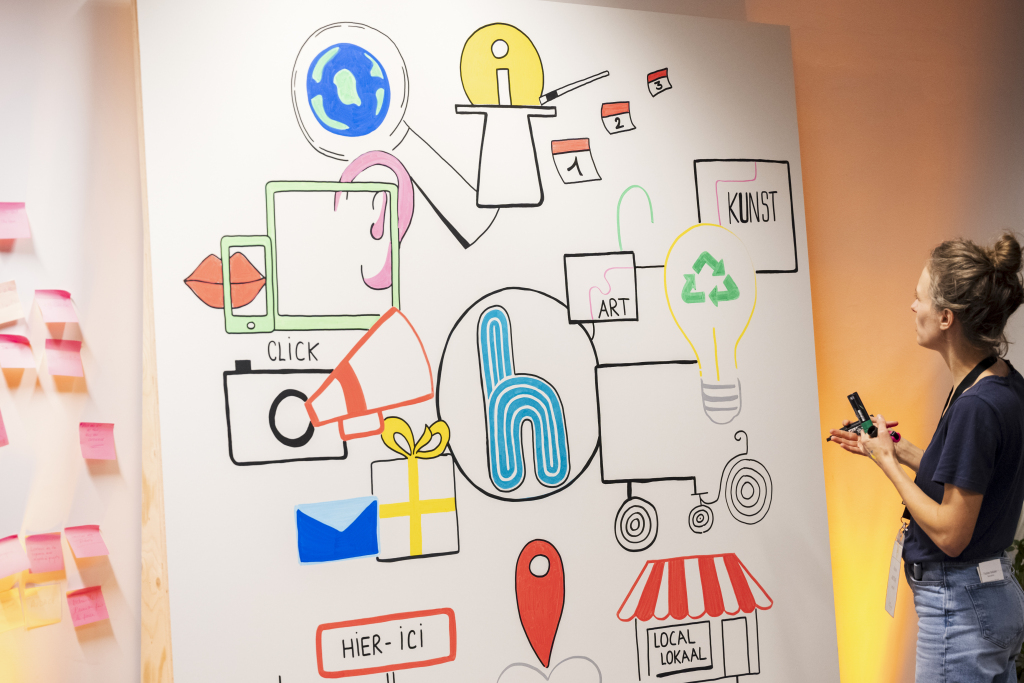
For a first encounter, hub.info is the practical entrance. Its information and referral service connects entrepreneurs to a much larger field of public and private support. The appeal is simple: describe the problem before learning the organisational chart.
The shop is the experiment
L’Auberge Espagnole applies that thinking to retail. The programme lets prospective shopkeepers test a concept in equipped premises for three months, with personalised support. The revealing detail is the duration. A few months behind the counter can expose questions that a polished business plan leaves comfortably unanswered: who comes in, what they buy and how much attention running the shop consumes.
The 2025 report records 71 projects incubated since the concept began in 2016, with 27 leading to permanent shops. Those figures describe a route into trading, not a survival rate. They do not establish that every other project failed. An experiment can also produce a sensible decision to revise, delay or stop.
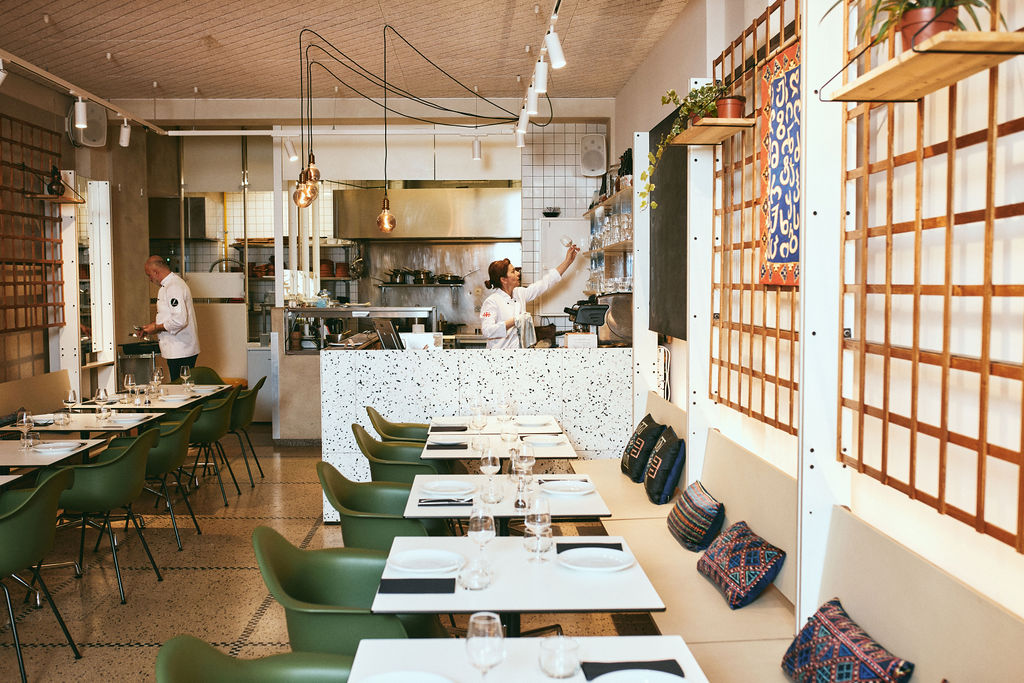
Kokotte took the same logic into hospitality. Its published final offer described five months of incubation and up to 60 hours of coaching. At the stated rent, five months meant €5,000 for premises, before the entrepreneur’s other operating costs. Support covered subjects as concrete as restaurant management, financial planning and dining-room layout. Knowing how to cook was only part of the assignment.
The founders of Kawa Gosto supplied a particularly useful verdict: “We realised just how challenging this business is, and how much work goes into it.” That is a more informative advertisement for incubation than a photograph of someone holding oversized scissors.
Free advice has a public price
hub.brussels operates through public funding and programme financing, with some participant payments. Its 2025 accounts presentation lists a €42.007 million public allocation. Adding the other displayed receipt categories produces €47.276 million; displayed expenditure totals €43.675 million. These are agency finances, not a valuation or a startup funding round.
The spending mix explains the service. Personnel accounted for €31.382 million, roughly 72% of the reported expenditure categories. Expertise is the principal operating resource. A conversation may be free to the entrepreneur because someone else is paying for the adviser’s time.
Charges vary by programme. Greenlab’s 2026 circular-industry accelerator is free, but requires a €500 deposit, refundable when the participant attends at least 80% of group training and individual coaching. Its group sessions take place on site. The financial barrier is deliberately low; the commitment of time is substantial.
Funding advice is another service entirely. Specialists can challenge a financial plan, identify potential subsidies, help prepare applications and arrange introductions to financing bodies. Credit mediation helps reopen dialogue with lenders. For research and innovation, the agency’s National Contact Point function helps Brussels companies navigate European funding. Finding an appropriate application route and winning the money remain separate steps.
- People
- €31.382m
- Corporate operations + investment
- €5.883m
- Action costs
- €4.998m
- Rent
- €1.412m
The customer changed, then the plan
Greenlab offers a compact answer to what entrepreneurs can actually change after coaching. In a testimonial, Odd Paper’s Natasia says the programme helped the company revisit assumptions and refine its strategy, “ultimately choosing a B2B approach to achieve profitability.” The reported change was the choice of customer. That is a decision another founder can examine without pretending to copy somebody else’s business.
The programme itself has become more specific. The 2026 offer targets circular industrial production and commercial development: making, transforming, repairing and reusing. Its four-month schedule runs from August 31 to December 18. Earlier-stage applicants without a prototype are directed toward BEARTH. Separating the idea from the sales challenge makes the support easier to match to the business.
The January 2026 project showcase supplies some welcome texture. Garden Stack grew from Daniel Matthews Ferrero’s experience watering more than 30 plants during a pandemic stay in Spain. With Marta Matrakova, he developed a modular terracotta planter with automatic irrigation, produced through their Brussels 3D-printing operation. Greenlab’s stated task was to help strengthen the circular business model.
The transferable lesson is to name the assumption being tested. Is it the buyer, the price, the production process or the sales channel? Coaching becomes easier to use when the entrepreneur brings a decision that evidence could change. Enthusiasm is helpful company; it is a poor measurement instrument.
The reported change was the choice of customer.ODD PAPER’S GREENLAB EXPERIENCE
A network with a smaller map
International expansion is part of the agency’s original design. Businesses can seek market guidance, partner introductions, collective trade-show participation and economic missions. Through Enterprise Europe Network Brussels, which hub.brussels manages with BECI, that support also includes innovation cooperation and technological partnerships.
The network’s published eligibility language is unusually useful: Brussels-based economic and academic actors must be willing and able to internationalise, revisit their business model and innovate. A list of foreign contacts cannot supply missing production capacity or the time to follow up. Readiness matters as much as ambition.
On May 6, 2026, hub.brussels announced that its international footprint would shrink from 33 overseas offices to 21 maintained locations. Twelve offices, including Geneva, San Francisco, Shanghai and Vancouver, were scheduled to cease operations by year-end. The Hague, Lille and Luxembourg would be managed from Brussels; Singapore would relocate to Kuala Lumpur.
The agency said its action plan would concentrate more on Europe, with B2B missions and stronger individual support, particularly for first-time exporters. Budget decisions by the regional government prompted the change. It should not be misread as evidence that those export markets had stopped mattering. A business planning expansion now needs to establish which people and formats will actually support its target market.
The counter, the phone and the people behind them
The agency’s 2025 totals put its everyday workload in perspective: 3,100 companies supported, 5,645 support files and 8,611 individual pieces of advice. Those are different units. A business can generate multiple files and conversations. Turning them into a single grand total of companies helped would make a better slogan and a worse description.
The culture hub.brussels describes is built around listening, accessibility and attention to beneficiaries. Employees are called “hubsters,” a small linguistic escape from administrative solemnity. Its identity page ties staff well-being and tailored support to service quality. These are the agency’s stated working principles, rather than an independent employee-satisfaction finding.
There is a concrete example of adaptation. In 2020, the information service’s call volume rose fivefold to 45,000. Around 30 colleagues temporarily joined the response, hours expanded and advisers received training in psychosocial risks. In 2021, an infobus took guidance into underserved neighbourhoods because some people still were not reaching the service. The operational lesson is that opening a help desk does not guarantee everyone can use it.
2025 activity. Different units, not numbers to add together.
Bring a question that can change your next move
For an entrepreneur, the sensible starting point is a specific obstacle: choosing premises, testing retail demand, revising a financial plan, preparing exports or improving digital operations. The agency’s diagnostic platform offers assessments covering sustainability, export readiness, retail and digital maturity. These can help turn a general wish to improve into a more focused conversation.
Private consultants, chambers of commerce and incubators offer overlapping forms of help. hub.brussels’s distinction is the combination of a public regional remit, sector expertise and connections across local and international business support. BECI illustrates why “competitor” is often the wrong label: it is also a delivery partner. The useful question is which organisation has the expertise and format for the next decision.
This approach works best when the business has a Brussels connection, fits the programme’s criteria and can commit to testing and follow-through. It becomes less useful when the applicant wants an immediate cheque, guaranteed customers or someone else to make every operating decision. A subsidised test still needs customers whose behaviour can teach something about the eventual business.
For other cities, the most copyable feature is the combination of advice with a bounded trial: define a period, provide the necessary setting and review what happened with the entrepreneur. For founders, it is the habit of doing that before the expensive commitment. The most valuable result may be an opening day. It may also be a changed plan, reached while changing it is still affordable.
Start with the next question
Explore hub.brussels, ask for guidance through hub.info, or try the business diagnostic tools. Read the international service update and browse the agency newsroom.
Follow on LinkedIn, Instagram and Facebook. The YouTube channel includes practical explainers on bank credit mediation and business administration.