At Paisley Park on October 1, 2026, Dale Nitschke told a room of marketing leaders about a time when his own experience had become a limitation. He had been put in charge of Target.com. He understood stores. So he ran the website like one. The business grew, but a colleague thought he was asking the wrong questions.
There is something pleasing about that admission from a founder whose business now depends on helping other executives reconsider their numbers. A conventional success story gives the chief executive the decisive insight. Nitschke’s version leaves room for someone else to walk in and disturb the furniture. For a leader selling a different way to judge marketing, it is a useful place to begin.
The company he founded in 2009, Ovative Group, works in media, measurement, and creative services. Its particular preoccupation is what marketing contributes to the whole business. Nitschke arrived at that question after more than two decades at Target, including eight years leading its online operation. His career has followed the customer from the shop floor to the browser, then into the difficult accounting between the two.
The storekeeper learns another language
Nitschke graduated from the Wisconsin School of Business with a BBA in 1984. By 1999, he was developing Target.com, the online business he would serve as president for more than eight years. That puts him among the retail executives who had to build e-commerce while a great deal of retail still revolved around buildings, shelves, and the weekly business of getting people through doors.
A store offers a satisfying physical order. Customers enter, browse, and pay. A website introduces more uncertain journeys: people arrive from different places, look without buying, and return later. Some eventually make their purchase somewhere else. The familiar experience of running a retail business remains valuable, but the relationship between an advertisement and a sale becomes harder to see.
In his 2026 retelling, the colleague who challenged him pushed attention toward unit profit-and-loss statements, the returns media spending needed to achieve, and incrementality. The underlying question was practical: how much additional business did an action produce? A manager could keep watching the same reassuring numbers, or examine whether those numbers actually answered the commercial question.
Nitschke credits the team’s changed approach with three consecutive years of triple-digit growth and reaching $1 billion in revenue within seven years. The detail to hold onto is the sequence. An established retailer brought experience to a new business. Someone questioned the operating assumptions. The leader listened. His later company would make a business out of examining assumptions that can otherwise pass for common sense.
- 1984Earns his Wisconsin business degree.
- 1999Develops Target.com.
- 2009Founds Ovative Group.
- 2024Ovative launches EMRge.
A company name for 99 cents
Starting Ovative in 2009 meant starting during the Great Recession. Nitschke saw an opening for data and analytics to improve digital marketing. It was a fairly specific wager: businesses would need help understanding what their advertising accomplished, even as the channels available to them multiplied.
The name began on a bar napkin. Nitschke took inspiration from “innovative,” then found another encouraging piece of evidence: the web address cost 99 cents. Founders can spend a remarkable amount of energy making a name sound inevitable. His account includes the price tag. A little retail arithmetic survived the move into entrepreneurship.
Ovative remained privately owned and self-funded as it developed its services and technology. That history matters because the work involved building capabilities, rather than merely giving familiar services a new name. Measurement needs people who understand a client’s business, people who can handle its data, and systems that can connect the results. A persuasive presentation gets only so far when the next conversation concerns a budget.
By 2016, Ovative had reported revenue of $16.2 million, up 53 percent from the previous year. Its clients included General Mills and Select Comfort. Those early figures give the story some proportion: before there were hundreds of colleagues and several offices, there was a smaller Minneapolis firm finding customers for a difficult, technical service.
The purchase that escapes the dashboard
Consider a familiar shopping journey. Someone sees an advertisement, researches an item online, and buys it in a store. That is an illustration of the measurement problem, rather than a claim about a particular Ovative client. If the digital report only values purchases completed online, part of the advertisement’s possible effect falls outside the frame.
There is a second complication. A purchase appearing after an advertisement does not, by itself, establish that the advertisement caused it. The customer may have intended to buy anyway. This is why the word “incremental” keeps returning in Nitschke’s work. Businesses want to know what their spending added, as well as what happened nearby.
Ovative’s Enterprise Marketing Return approach brings together online and offline revenue, customer value, margins, and the incremental effects of marketing activity. Those are related questions with different consequences. Revenue can rise while the economics disappoint. A campaign can reach existing customers while doing little to bring in new ones. A narrow report can look tidy while leaving the larger business question unanswered.
A conceptual guide to the questions behind Enterprise Marketing Return, not a calculation or a performance claim.
In October 2024, Ovative launched EMRge, its unified marketing technology offering. The platform connects planning, operations, data syndication, testing, media mix modeling, and reporting. The distinction is useful: EMR describes the approach to evaluating marketing; EMRge supplies technology for putting connected media and measurement work into practice.
At launch, the company said a quarter of its team was dedicated to building and delivering products and that it had tripled its technology investment. Those commitments show the organizational weight behind the product. For Nitschke, the proposition had expanded from advising businesses about their marketing to supporting the machinery through which they make decisions.
The founder still makes the rounds
There is a more sociable side to this preoccupation with outcomes. Nitschke walks through the office to talk with colleagues. He also gathers people to watch the sunset. The habits make an interesting pairing with his technical work: an executive concerned with connecting business information also spends time connecting with the people producing it.
When Wisconsin MBA students visited Ovative in November 2025, they heard Nitschke discuss the company’s values, employee development, and three-year plan. One visitor recorded a particularly demanding commitment: he said he personally interviewed every candidate who wanted to join the company. At a growing firm, that is a substantial claim on the founder’s calendar.
It also makes recruiting part of the job he chooses to keep close. Growth can move a chief executive further from the people being hired. An interview creates a direct encounter before a new colleague becomes a name in an organizational chart. The habit fits the walking rounds: both give the founder a way to hear people without waiting for information to climb through layers of management.
Ovative’s Elevate development platform gives a more formal structure to that attention. It organizes development around values, mindsets, and skills, with expectations people can use to assess themselves and coach others. In June 2026, the firm marked its eleventh consecutive appearance on the Top Workplaces list, placing 38th among large companies. The recognition offers one measure of how employees experience the organization.
Whose potential gets a chance?
For Nitschke’s company, access to the industry has become a practical undertaking. Ovative’s partnership with The BrandLab includes internships, full-time roles, mentoring, and scholarships. The relationship gives a concrete meaning to the language of developing people: a route into the profession, someone to ask for advice, and financial help with education.
In 2024, Ovative employees raised $35,000 for five BrandLab scholarship recipients. By that announcement, their scholarship fundraising since 2019 had reached $80,000. These were team-funded awards. Keeping that distinction matters; a company’s community work belongs to the employees who contribute to it as well as to the executive who speaks about it.
The efforts sit within Champions of Change, the social-impact program Ovative formalized in 2020. Its work includes charitable giving, pro bono services, and efforts to broaden opportunity. A measurement business invites the question of what its principles produce outside a client account. Scholarships and entry-level opportunities provide specific answers, with people at the receiving end.
More room, more questions
By its fifteenth anniversary in 2024, Ovative had more than 500 people across Minneapolis, New York, and Chicago. In March 2026, its Chicago expansion brought a 31,000-square-foot office at 111 North Canal and a local team that had reached 100. Nitschke described the investment in terms of people working together across disciplines, clients, and industries.
That emphasis carries the story back to the colleague who challenged his thinking at Target.com. Gathering people has value when their different experience changes a decision. More square footage is easy to count. Whether a conversation improves the work is the harder, more interesting test.
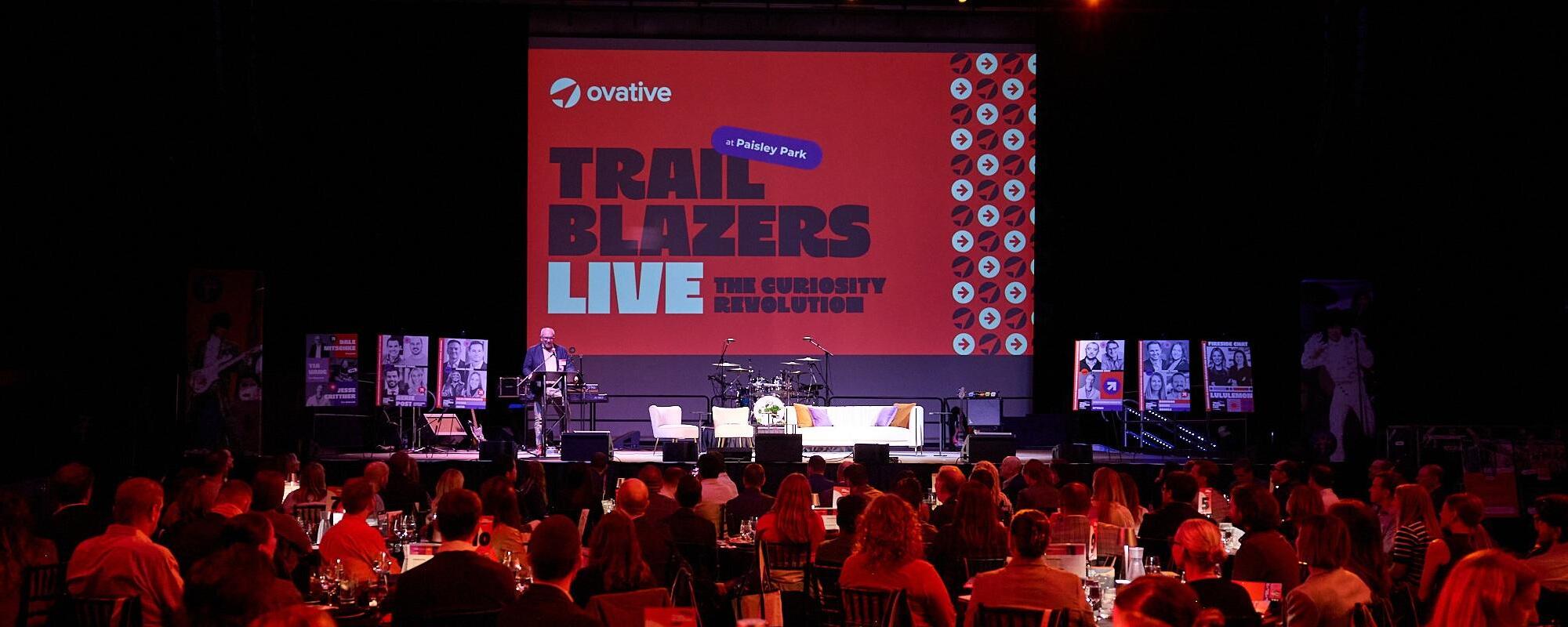
At Paisley Park, he framed curiosity as something that must lead to action. A question earns its place by changing what happens next.
“Curiosity that drives real change is hard. But winning is worth that pain.”Dale Nitschke · October 2026
Away from work, his pleasures include golf with family, time at the family cabin, and cheering for the Wisconsin Badgers. The outline is recognizably Midwestern. So is the founder’s fondness for getting people together. His business has grown around a less comfortable social skill: being willing to hear that the familiar way of doing things needs another look.