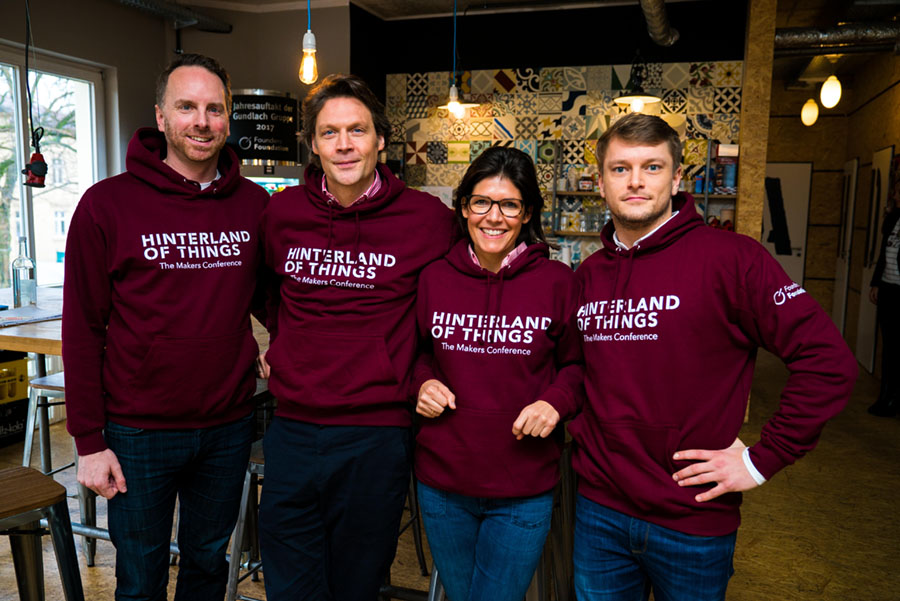
In the photograph, the four organisers are wearing matching burgundy hoodies. Behind them are hanging bulbs, patterned tiles and the ordinary furniture of a place where people might actually talk. Sebastian Borek stands second from the left. Across his chest, in white lettering, is a proposition with a geographical joke attached: Hinterland of Things. The hinterland has ordered merchandise. It intends to be taken seriously.
The picture belongs to the early life of the Bielefeld conference Borek helped create. Its premise was practical. Germany’s industrial companies and its young technology businesses had reasons to meet, yet they inhabited different professional circles. Putting them in the same room required someone prepared to issue the invitations. Borek had spent enough of his career on both sides to see the value of the guest list.
That instinct has carried him from building companies to teaching founders and, more recently, into public-private venture capital. Since October 2025, he has led Digital Tech as a managing director at High-Tech Gründerfonds, or HTGF. It is a different seat at the table. The question occupying him is familiar: how does a promising technology find its way into an established business?
A family name, a New York education
Borek grew up in an entrepreneurial family and earned a bachelor’s degree at New York University. He later completed an MBA at the University of St. Gallen. The combination put an American education alongside a European business qualification, but the more revealing education lay in the kinds of organisations he chose to enter.
In 2000, he founded a print ecommerce business operating in the United States and Europe. His working life also took him through Pixelpark in New York, ProSiebenSat.1 and Bertelsmann. These experiences gave him a view of digital businesses from several positions: the young company trying to establish itself, the media organisation looking for new opportunities, and the investor assessing what might come next.
By 2003, the family connection had become a job description. Borek was taking responsibility for strategic business development at Borek Kommunikation in Osterwieck, with plans to expand consulting and project management. The family company’s established services offered a different setting from New York’s startup world. Here, innovation had to fit an operating business with customers already expecting work to be delivered.
He later took a leadership role in Borek Media, preparing the family service business for digital change. By 2015, another assignment had put him alongside Hakan Özal at the head of financeAds International, a joint venture involving FinLeap and financeAds. Its business was performance marketing for financial services, with international expansion built into the brief. The work kept returning him to the commercial question of finding customers.
The customers were already in the neighbourhood
In February 2016, Borek and Dominik Gross founded the Founders Foundation with Bertelsmann Stiftung. They chose Bielefeld, in East Westphalia-Lippe, a region with an established industrial economy. The place supplied a particular opportunity: founders developing business technology could get close to the companies that might use it. Industrial experience and startup ambition could become neighbours.
By 2020, the foundation was running a three-month Lab and a six-month Accelerator. Participants worked on financing, marketing and legal questions, developed their business plans and met investors. Some found their future co-founders during the programmes. These were fairly intimate changes in a person’s working life: someone to build with, a clearer plan, a first serious conversation about money.
The workplace had table football and table tennis, along with ginger juice at breakfast. Those details are charming, though nobody has yet solved distribution by winning at table football. Borek’s argument for the region was more grounded. Local companies wanted help with digital change, and founders had room to concentrate. The task was to turn those advantages into relationships that could survive beyond an introduction.
Start close to the problem.
A hoodie with a business plan
Hinterland of Things gave that relationship a public stage. In its early conference plans, Borek described bringing together people such as Dr. Oetker’s Albert Christmann, Christoph Mohn, Max Viessmann, Lars Hinrichs and Christian Miele. Each name represented a different route into business: a family company, a technology venture, an investment network. The gathering made those routes cross in Bielefeld.
There was a certain wit in the name. Calling a technology conference Hinterland of Things acknowledged the metropolitan prejudice before anyone else could bring it up. It also gave the organisers a memorable answer. The companies outside the usual startup capitals had factories, technical knowledge and problems worth solving. A founder selling to industry had good reasons to pay attention.
The matching hoodies make the enterprise look pleasantly uncomplicated. Organising the encounter was harder. A conference needs people willing to attend; a useful relationship needs reasons to continue. Across the foundation and the event, Borek’s contribution was to make a repeated occasion for contact. Familiarity could grow alongside the technology, giving each side a chance to understand how the other worked.
Leaving a chair occupied
On 30 September 2021, Borek stepped down as CEO of the Founders Foundation. Gross, his co-founder and CFO, became sole managing director the following day. Borek wanted to pursue new entrepreneurial work and planned to remain connected to the foundation and Hinterland. His phrase for the move was biological: “Wachstum erfordert Zellteilung im gleichen Ökosystem.” Growth requires cell division within the same ecosystem.
The organisation he was leaving had trained more than 350 entrepreneurial talents and taken more than 50 startups through its programmes. Successful participating teams had raised over €27 million in venture capital by the July 2021 announcement. Those figures belong to the collective work of the foundation and its founders, staff and startup teams. They give a sense of what had been built before the handover.
The succession is an important part of his story. A founder who creates an institution also creates the question of what happens when he leaves. Gross taking responsibility gave the work a continuing operator. In February 2026, the foundation marked its tenth anniversary. Borek’s executive tenure had ended years earlier; the organisation was still building on the relationships and education it had begun with.
The conversation travels to Lisbon
Portugal became another chapter. In a May 2023 podcast appearance, Borek discussed moving there with his wife and four children, integrating into another country and the idea of a culture in which people help one another rise. The conversation also made room for food, wine, surfing and fishing. Even an ecosystem builder is allowed a subject that does not require a pitch deck.
He has taken the interviewer’s chair himself. On Disrupting Minds, he spoke with entrepreneur and investor Verena Pausder; in another episode, Sandra von Au interviewed him about family entrepreneurship, Lisbon and taking breaks from digital life. It is a useful glimpse of his work beyond formal management titles. Much of it involves asking people what they want to build and what might help them get there.
His coaching profile emphasises teams, sales and fundraising, while explicitly including people and emotions in the work of business. That is a self-description, but a consistent one. On his own website he calls himself a “Bridge Maker by DNA.” The phrase is a little grand; the underlying activity can be as ordinary as knowing whom to call when a founder gets stuck.
“I am a Bridge Maker by DNA.”
Sebastian Borek · on his work
The same problem, with capital attached
HTGF appointed Borek to its management team on 13 October 2025. Alongside Romy Schnelle and Dr. Achim Plum, he became part of a three-person leadership group with responsibilities divided by investment area. His remit was Digital Tech. The appointment brought his experience of company building and industrial connections into an organisation whose daily decisions determine which young businesses receive early backing.
The scope expanded on 1 February 2026, when the same three executives assumed management of DeepTech & Climate Fonds Management GmbH. The teams began working together on an integrated public-private venture capital platform. Education, introductions, seed investment and growth finance sit at different points in a company’s life. Borek’s recent roles place him closer to the financial links between those stages.
In August 2026, HTGF launched fundraising for its fifth seed fund, with a first closing planned for mid-2027. Industry and Mittelstand investors were part of the proposed public-private mix. Borek’s accompanying argument focused on turning AI’s technical momentum into European applications, digital infrastructure and lasting economic value. He stressed investment expertise and support extending beyond the next financing round.
That makes the old Bielefeld question larger. A foundation can help somebody decide to start a company. A fund must decide which companies to finance and how to stay useful as their needs change. Putting capital next to industrial knowledge offers a route forward, but the practical work remains demanding. A shared objective must eventually become a product, a customer relationship and a business able to keep going.
- Co-founds Founders Foundation
- Hands executive leadership to Dominik Gross
- Joins HTGF · Digital Tech
- Also assumes DTCF management
An introduction is only the beginning
Borek’s career has repeatedly brought him back to the distance between people who could use one another’s help. Family businesses carry experience accumulated over generations. Founders bring new approaches and the urgency of needing something to work soon. His projects create places for those experiences to meet: a training programme, a conference, a coaching conversation, an investment platform.
The burgundy hoodies now look like a small early expression of that habit. Before a region can have a startup reputation, someone has to persuade people to show up. Before an investor’s vision for Europe becomes tangible, companies have to build something other people will buy. Borek has spent much of his working life arranging the encounter. The next part begins when the introductions are over.