Before the desks, the demo days and the industrial introductions, there was a pig roast. In a 2021 recollection, co-founder Dominik Gross described an early gathering in a Bielefeld bar courtyard: January, roughly two degrees Celsius, hot slivovitz and about 25 people. Getting a startup scene together initially meant getting a few people to stand outside in the cold.
Today, Founders Foundation gGmbH offers a more comfortable invitation. The nonprofit teaches aspiring entrepreneurs, helps teams test business ideas and connects young technology companies with established businesses. Its home territory is Ostwestfalen-Lippe, usually shortened to OWL, in North Rhine-Westphalia. The proposition is unusually concrete: build business software and technology near businesses that might buy it.
That makes this an education company with a regional economic purpose. Its beneficiaries are prospective founders and young teams; its wider constituency includes employers, investors and the industrial companies of Germany’s Mittelstand. The interesting question is whether proximity can become a commercial advantage. A nearby factory is useful only if somebody there will take your call.
The first shortage was people
Gross’s thinking was shaped by an international research trip in 2015. An incubator in Yeruham, in Israel’s Negev desert, particularly stuck with him. If entrepreneurship could take hold there, he reasoned, geography did not disqualify Bielefeld. He and Sebastian Borek built the Founders Foundation with Bertelsmann Stiftung in 2016. The institution supplied the backing; the founders set about finding participants.
The foundation’s tenth-anniversary account identifies activating talent as the early difficulty. Local industrial strength did not automatically produce a queue of startup founders. This was the first gap the organization had to close: people needed to see entrepreneurship as a plausible career and meet others willing to try it.
Its response was practical and social. Organize encounters, introduce experienced entrepreneurs, teach the basics and give new teams somewhere to work. The culture it describes is founder-centered and deliberately hands-on. A motto from its early years captures the impatience with presentation theater: “Make things not slides!”
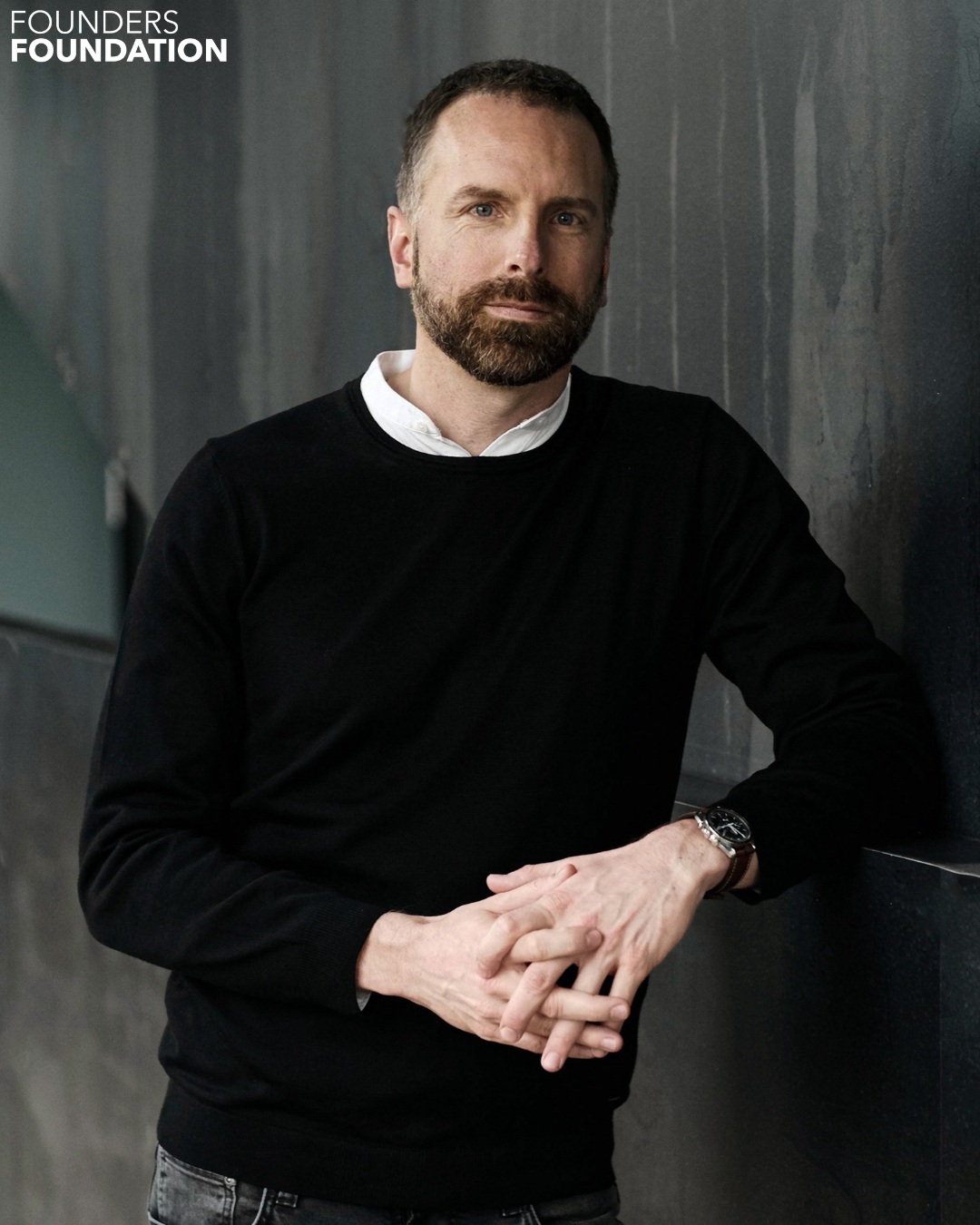
“Make things not slides!”
An early motto, recalled by Dominik Gross in 2021
Free to join has a substantial backer
The financial architecture explains much of the offer. Founders Foundation is wholly owned by Bertelsmann Stiftung and does not take shares in the startups it supports. The parent’s 2020 annual report described a ten-year pilot with initial funding of €17.5 million. That figure describes institutional backing, rather than money distributed as investments to participating companies.
The parent’s 2025 annual report lists a €3 million contribution to Founders Foundation for that year, with 2025 figures marked preliminary as of March 4, 2026. This is a useful measure of the support behind the mission, although it is not the foundation’s complete operating cost. Institutional funding allows the organization to provide education without depending on a future startup exit.
Participant prices depend on the offer. Startup School is advertised as free. Eligible Lab teams can receive a free three-month scholarship. The accelerator publishes a no-fee, no-equity policy. Paying for those services through a sponsor removes an immediate cash demand on founders; it does not pay every cost of developing their company.
Other services have price tags. A full-time coworking desk is listed at €250 net per month. A historical 2020 Product Masterclass brochure advertised nine weeks of executive education for €1,195 per person. Those are different purchases from a startup scholarship. Time belongs in the calculation too: Startup School describes roughly 20 hours of work each week.
Bertelsmann Stiftung’s reported 2025 contribution
Institutional support. Preliminary 2025 figure, as of March 4, 2026.A school with customers on the syllabus
The training sequence follows the questions a founder faces. Startup School accepts individuals and early teams, combines online sessions with meetings in Bielefeld, and helps participants find complementary co-founders and test an idea. Its ten-week format is designed around employment or study. The published autumn 2026 intake runs from October 9 to December 16, with applications due September 20.
For a team with a defined B2B technology hypothesis, the Lab concentrates on validation. Participants build a minimum viable product, seek customer feedback and examine whether their proposed solution addresses a real problem. Scholarships run for three months, with continued participation subject to another assessment. The structure makes progress reviewable: a team has to return with evidence, not merely renewed enthusiasm.
The accelerator serves teams further along, with a scalable B2B proposition and initial customer evidence. Its stated work covers product, sales and marketing, people and organization, and funding. Mentors and a corporate sounding board help founders understand how an established company evaluates and buys a new solution. A good demonstration still has to survive a purchasing process.
Education technology has its own doorway. The EdTech Academy offers a ten-week program for people developing education businesses, including team matching and contact with experienced mentors. The broader EdTech Next initiative began in 2022 with Founders Foundation and EDUvation, supported by the state. Its sector focus reflects a specific difficulty: building a learning product and getting it into an institution are separate jobs.
- 01 / SCHOOLWho will build it?Find a team. Test an idea.
- 02 / LABDoes it solve a problem?Build an MVP. Hear from customers.
- 03 / ACCELERATORWill the market buy?Work on sales, product and funding.
Separate selection applies. This is a progression of needs, not an automatic admissions route.
The industrial neighbor is the point
A startup’s first useful contact may be someone who knows why a purchasing department rejected the last pilot. That kind of knowledge is central to the foundation’s positioning. Through the Hinterland of Things conference and associated network, it brings founders into contact with established companies and investors. The conference began in 2018; the surrounding relationships are intended to continue between events.
The foundation names Miele, Goldbeck, Dr. Oetker and Dr. Wolff among the companies in the Hinterland Allianz. Their relevance is not simply the prestige of a familiar logo. They represent potential conversations about manufacturing, procurement, data and organizational change. An introduction can shorten the distance to a buyer, even though it cannot make that buyer need the product.
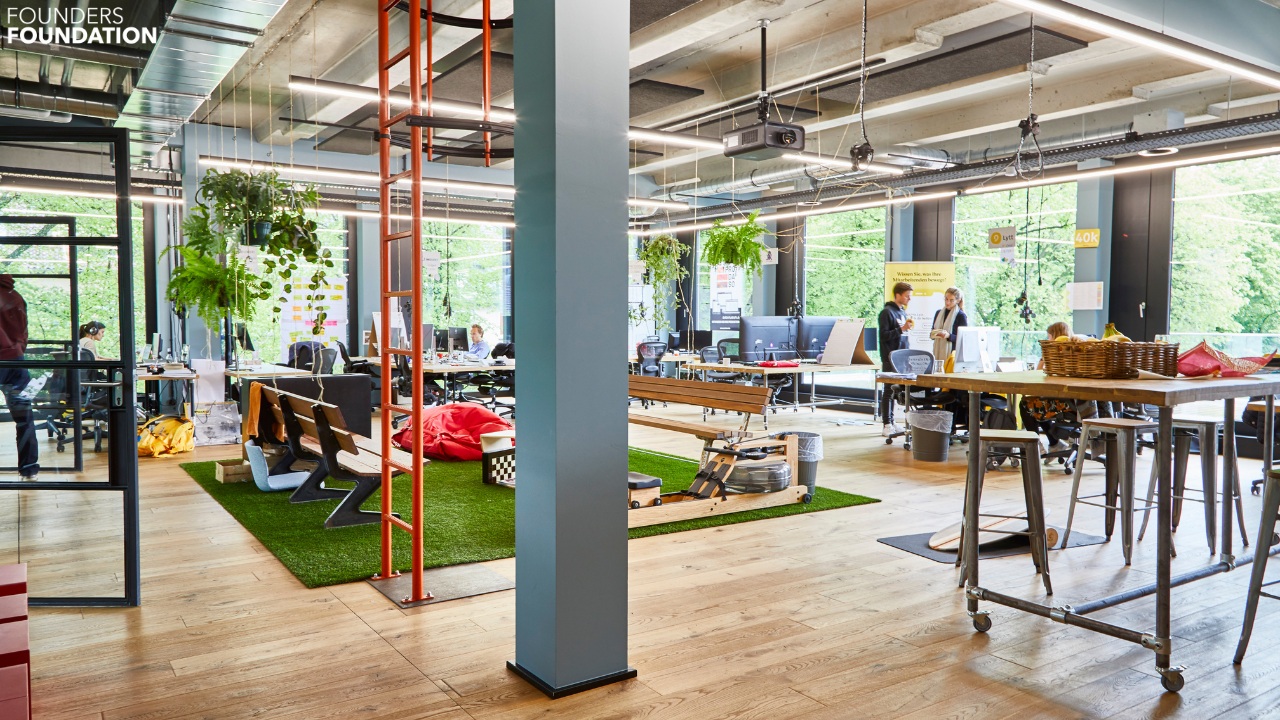
Physical space supports that approach. The Founders Home offers working areas and meeting facilities; the event business advertises five different rooms and equipment for streamed gatherings. A shared address creates repeated opportunities to compare notes, ask for help and meet people outside one’s own team. It also gives the organization a place to bring visitors who would otherwise remain names in an email thread.
Founders have alternatives. Y Combinator’s free online Startup School makes introductory knowledge widely accessible. Campus Founders in Heilbronn offers an equity-free B2B accelerator focused on deep technology. Against those options, Bielefeld’s case depends on the combination of local industry access, staged education and a continuing community. Free instruction alone is already available elsewhere.
Count the outcomes carefully
At its tenth anniversary in February 2026, the foundation reported 1,300 program participants, 180 startups supported in advanced programs and more than €130 million raised by alumni. These are the organization’s reported totals. The alumni funding figure belongs to the companies, not to the foundation’s balance sheet; participation is not a measure of survival or profitability.
A recent example makes the distinction tangible. In July 2026, the foundation published a funding announcement for alumnus Tentris, a University of Paderborn spinout developing graph databases for enterprise AI. The roughly €2 million total combined a €925,000 pre-seed round with about €1 million in public innovation support. Describing all of that as venture capital would erase an important part of the financing.
Tentris also appeared on the January 2026 Accelerator Demo Day lineup. The six featured businesses included Assemblean in manufacturing, Catego in procurement, Finokapi in financial management, Credular in work instructions and Puraite in medical research workflows. The list gives the B2B label some texture: these are attempts to solve particular operational problems.
The longer-term prize is repeat participation. Alumni who return as mentors or investors can provide the next cohort with knowledge the first cohort had to borrow from elsewhere. In that sense, the community’s output includes people who know how to help another founder. Counting that contribution requires attention beyond the size of a funding announcement.
Cumulative organization-reported figures. Alumni capital is not foundation revenue.
Borrow the sequence, then do the difficult part
There is a useful lesson here for anyone building a regional startup program: begin with people and an identifiable market. The foundation’s own early reflection emphasized repeated gatherings, experienced founders and patient development. The sensible adaptation is to recruit prospective builders, introduce them to likely customers and organize teaching around the problems those conversations reveal.
For an individual founder, the sequence is equally usable. Find collaborators whose skills fill your gaps. State the assumption your business depends on. Show a small version to a potential customer. Record what happens. Return to a mentor with the result and a specific decision to make. This is an editorial reading of the education model, not a promise that following it produces a company.
The conditions matter. A founder with a consumer entertainment idea may find less relevant customer access in an industrial B2B network. A team that needs laboratory infrastructure or immediate investment must assess those requirements separately. And a region trying to copy Bielefeld needs employers willing to engage and an institution prepared to support work whose benefits take years to develop.
Education markets add another constraint. The EdTech Next report discusses barriers to reaching schools and the value of testing products with educational institutions. Mentoring can improve a product and its pitch; it cannot, by itself, remove an institution’s adoption hurdles. A useful network needs people close enough to those decisions to explain what a workable pilot would require.
Borek left the executive role in 2021, and Gross took sole management that October. The work has continued into a second decade with a proposition that is straightforward to state and laborious to deliver: help people build companies, bring them close to customers and stay involved long enough for experience to circulate. The first gathering needed hot drinks. The durable version needs patience, money and another customer conversation.

Step into the conversation
Explore the programs, follow the community and hear its founders discuss the work.