Plywood is difficult to dislike. It is cheap enough, familiar enough and stacked in nearly every lumber aisle. It has spent more than a century becoming less a product than a reflex. Sean Petterson has decided that reflex can be interrupted. In a Phoenix factory, his company Supersede extrudes recycled polypropylene into structural panels meant to do a plywood job without behaving like wood. They do not drink water, rot, splinter or demand a new ritual from the person holding the saw.
That last detail contains Petterson’s commercial philosophy. He is not asking a boatbuilder to admire a moonshot. He is offering a sheet with familiar geometry, handled by familiar tools, inside a familiar production line. The material is new; the working day is not. For a founder selling into industries where an experiment can become a warranty claim, this may be the most practical form of imagination.
Petterson calls the governing principle removing every possible reason for someone to say no. The sentence is sales advice disguised as engineering, or perhaps the reverse. It explains why Supersede begins with performance data and only then arrives at the circular-economy story. It also connects a recycled-plastic panel in Arizona to an exoskeleton built by a college student in Rochester more than a decade earlier.
The dock came first
Petterson grew up on Long Island, where boats were not lifestyle decoration but working objects. He boated, spearfished and spent time around marinas. His first job was dockmaster. Later, he bought and flipped boats, which meant learning their interiors with the intimacy reserved for things that routinely break. Floors, kickboards and transoms were not abstractions. They were the hidden anatomy of a vessel.
The family tree had its own industrial logic. His grandfather was a railroad engineer, his mother a special agent and his father a contractor. Petterson worked alongside his father in construction. When his father died on a job site, the loss focused his attention on the people doing physical work and on the tools built for them. At Rochester Institute of Technology, where he studied industrial design, that attention found a prototype.
Petterson and fellow student Justin Hillery saw workers on campus struggling to lift large stones. Their response became a form-fitting support garment with load-bearing straps, an early ErgoSkeleton. The idea collected business-plan prizes, including the 2012 New York State competition, and moved through RIT’s student-innovation pipeline. By graduation in 2013, StrongArm Technologies was no longer merely a clever class project. It had a company wrapped around it.
“Your value as an entrepreneur and as an individual leader is your ability to synthesize.”Sean Petterson, Startup Junkies podcast
Hardware learns to listen
StrongArm began with wearable hardware that encouraged safer movement. Then the business learned something inconvenient and useful: hardware alone could not carry the whole argument. The larger opportunity was in data. Sensors and software could identify risky movement in real time, translate a shift into evidence and help managers change workflows before a small problem became an expensive one.
The evolution from garment to analytics platform taught Petterson to separate the invention from the outcome. Customers did not wake up wanting an exoskeleton. They wanted a safer, more predictable operation. StrongArm’s system eventually reached large employers, including Walmart and Toyota. In 2021, Walmart said its rollout covered 6,000 workers across 18 buildings and reported a steep decline in ergonomic incidents among participating workers.
Recognition followed. 3M took a minority stake in 2015. Forbes put Petterson on its 30 Under 30 list for Manufacturing & Industry in 2017. StrongArm raised substantial venture backing, and in 2023 it was acquired as part of a private-equity rollup. The buyer and price were not disclosed. The useful fact is less cinematic: Petterson had spent more than a decade persuading large industrial organizations to adopt something unfamiliar.
A sheet of second chances
Supersede’s origin brought together three complementary histories. Co-founder Jordan Darling had built Free Form Factory, which manufactured watercraft from plastic. Shane Kenyon had led mechanical-design teams in the electric-vehicle industry. Petterson arrived after Darling and Kenyon had spent a year on patents and full-scale production samples. This was not a material that could be settled with a charming tabletop prototype. The machine had to make the sheet at useful scale.
The resulting Marine Board is extruded from recycled polypropylene with proprietary additives used to calibrate performance. Supersede sources post-industrial material from U.S. suppliers and brokers, then feeds its own trimmings back into production. Customers can return offcuts through a buyback program. A scrap produced while cutting one panel can become part of another, a modest loop with large ambitions.
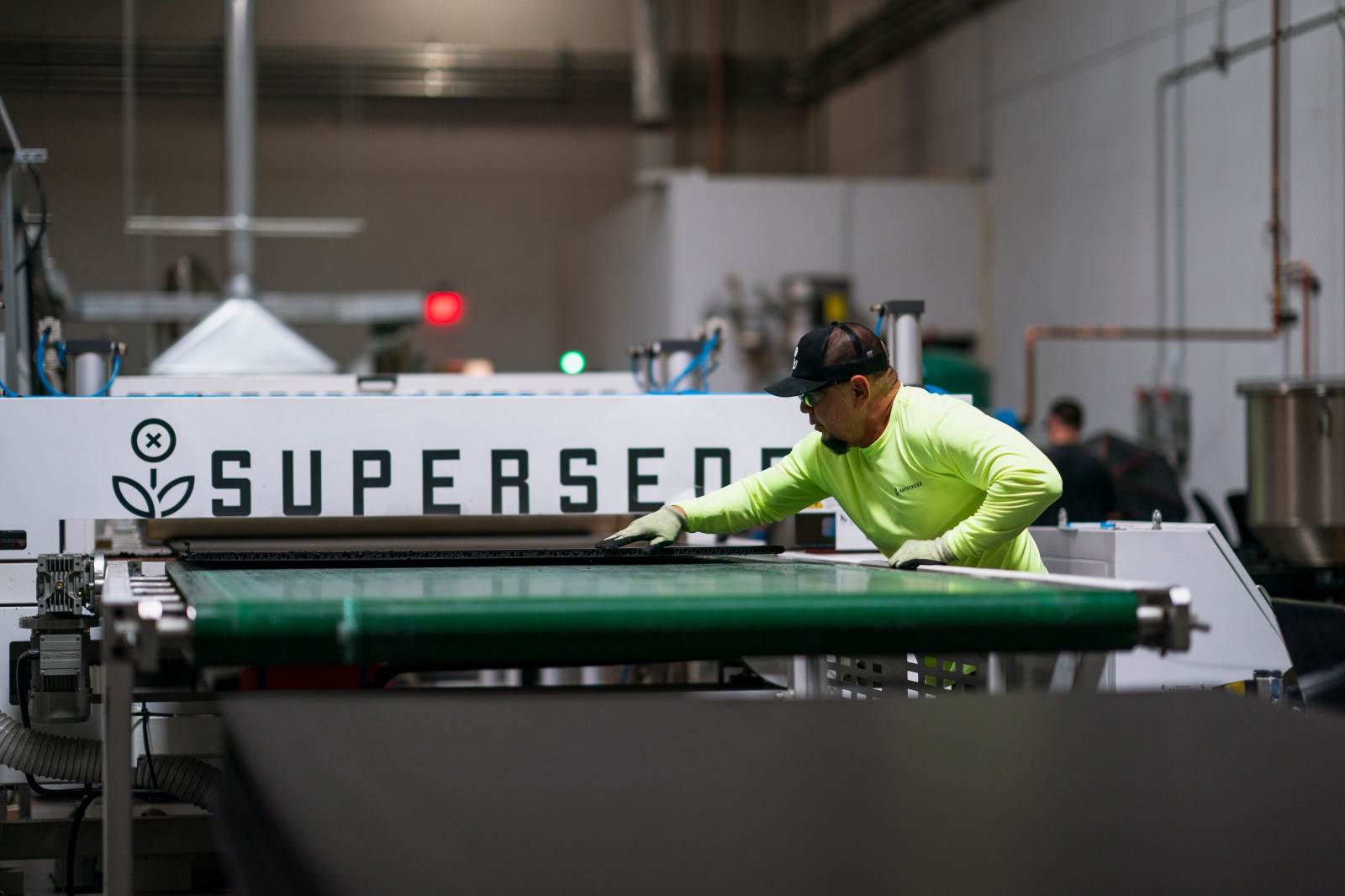
For every 100 three-quarter-inch sheets, Petterson says the process uses roughly 2,500 pounds of recycled polypropylene. The claimed product qualities read like a list of plywood’s small indignities: waterproof, rot-proof, mold-proof, consistent from batch to batch, and free of sanding or sealing before installation. Custom lengths, widths and thicknesses come from the extrusion process rather than from a tree’s dimensions.
The offcut loop
The trick is to look boring
Industrial adoption punishes unnecessary novelty. A different tool means training. A different fastener means inventory. A different installation sequence means time studies, revised documentation and another place for the line to stumble. Supersede was designed to cut, drill and install like the material it hopes to replace. Its radical proposition arrives in the shape of an ordinary sheet.
Petterson learned at StrongArm that resistance softened when technology felt familiar and frictionless. At Supersede, he pushed that lesson upstream into the product itself. Before the team contacted a production builder, it assembled an extensive benchmark catalog for existing marine boards, including the natural variation found in wood. The sales conversation could begin with measured comparisons rather than a request for faith.
“First, build your validation process before your sales process.”Sean Petterson, on entering conservative industries
This is a particularly unromantic kind of founder craft. Benchmarking does not photograph as well as a prototype reveal. Yet it is the work that turns novelty into a procurement decision. Independent recognition helped: an IBEX Innovation Award at the 2024 launch, BuiltWorlds demo wins, a Fast Company World Changing Ideas honor and a DAME Design Award for manufacturing and materials. Awards open doors; test results keep them open.
Start where failure gets wet
Marine was a deliberate beachhead. Boats put structural materials into wet, demanding environments, and production builders carry liability long after a hull leaves the factory. A successful installation therefore becomes unusually portable proof. Thunder Jet’s adoption of Supersede for flooring, kickboards and transom boards across its 2026 model range gave the young material a reference customer with little incentive to indulge experiments.
RVs sit next on the map because their factory logic and structural requirements resemble boatbuilding. Construction and modular housing offer a much larger opportunity, but they bring broader distribution, relationships with architects and contractors, and certification paths that do not appear in marine. The sequence matters: win credibility in the harsh environment, translate it to an adjacent line, then approach the larger market with more than a laboratory result.
Capital is being arranged around that sequence. Supersede announced a $10 million seed round in 2025. In May 2026, Closed Loop Partners followed with a $5 million catalytic loan to finance manufacturing equipment for expanded capacity and a Midwest facility. Phoenix established the production base; the Midwest shortens the distance to customers concentrated around marine and RV manufacturing.
Performance gets the first sentence
Petterson is unusually plain about the hierarchy of the pitch: “Performance leads, always.” A buyer running a line is balancing labor, warranty exposure, availability and margin. Sustainability can strengthen the case, but it cannot ask those concerns to take the afternoon off. If the greener material requires a workflow penalty, the mission has become a surcharge.
Supersede instead treats environmental benefit as a consequence of the manufacturing design. Recycled feedstock receives a long-lived structural use. Offcuts return. A panel that does not swell avoids a familiar failure mode. Localized manufacturing can reduce supply-chain distance and exposure to volatile imported lumber. The green story survives because it has been made operational, not ornamental.
There is a faintly mischievous quality to all this. Plywood, with its vast installed base and cultural invisibility, appears an absurd thing for a 13-person company to challenge. Petterson’s answer is to make the challenge smaller: one boat floor, one factory line, one measured comparison, one less reason to refuse. He is not trying to win an argument with history in a single afternoon.
What the second act remembers
The distance from wearable sensors to structural sheathing is shorter than it looks. Both businesses serve people whose work is physical, repetitive and intolerant of cleverness that gets in the way. Both translate engineering into a quieter promise: tomorrow’s shift should be more predictable than today’s. Petterson’s industrial-design education lives in that attention to use, while his founder education lives in the proof surrounding it.
Outside the factory, old profiles describe him as a boxer and motorcycle builder. The hobbies fit the public picture without completing it: motion, mechanisms, an appetite for objects that answer plainly when assembled badly. More revealing is his insistence on synthesis. Listen widely, accept and reject advice, then form a view that belongs to you. The founder’s job, in his telling, is not simply conviction. It is edited conviction.
His stated five-year picture for Supersede is a multifacility American manufacturer serving marine, RV, specialty vehicles, modular housing and construction. The product line would gain finishes and application-specific configurations; the offcut network would scale alongside sales. It is an expansive destination reached by a deliberately narrow road.
Plywood will not be embarrassed out of existence. It must be displaced sheet by sheet, purchase order by purchase order. Petterson seems comfortable with the indignity of that pace. His career has taught him that the future rarely announces itself on a factory floor. More often, it fits the old saw, arrives on time and gives the operator no fresh reason to swear.