There is a small comic problem at the center of Sean McGinty’s working life: taxes are serious, but nobody wishes to spend more time thinking about them. The chief marketing officer of TaxSlayer must earn attention in a category where attention often arrives as dread. His latest accomplice is Calvin Culator, an eager talking calculator who delights in deductions and does the arithmetic humans postpone. Calvin is a joke with a job. He turns a product function into a character and gives a complicated annual task a friendly voice.
The character is memorable because the machinery beneath him is sober. McGinty’s career has been an education in what makes marketing reliable when conditions are not. He has worked the keyword bid, built a startup’s marketing function alone, managed product portfolios, integrated technology across acquisitions and turned changing data into daily decisions. At TaxSlayer, he calls the result he wants a “Marketing Machine.” The phrase sounds metallic. His stated premise is decidedly human: good marketing lives where rigorous analysis meets genuine understanding.
First, learn to count
McGinty graduated from the University of Virginia in 2011 with a degree in economics. He began at RKG, the Charlottesville paid-search shop later acquired by Merkle. Search marketing was a useful apprenticeship for an operator: every elegant theory eventually met a bid, a click and a result. McGinty advanced from analyst to senior manager during five years there, learning to manage enterprise accounts while “data-driven marketing” was still becoming ordinary business language.
Then he changed vantage point. At SnapCap, a small-business lender, McGinty became the sole marketer. He built acquisition, retention and analytics across search, social, programmatic and lifecycle channels. With few hands, there was little room for ceremonial work. The company was acquired by LendingTree in 2017. McGinty took from that chapter a durable conviction: focus lets a small team build more than its headcount suggests.
Paid search
Sole marketer
Product + ops
Operations
CMO
LendingTree supplied scale. Across four years and three senior roles, he led product marketing for small-business lending and then a six-product consumer portfolio that included credit cards, personal loans and business lending. His own account says the small-business product grew from less than $25 million to $75 million in annual recurring revenue. Later, in marketing operations, he helped connect 13 acquisitions to a unified marketing-technology and revenue stack. The work shifted his curiosity from the visible campaign to the infrastructure that makes hundreds of decisions possible.
When the calendar stopped helping
A defining test came in early 2020. McGinty was in the middle of running that consumer portfolio when category revenues fell between 80 and 87 percent in a single quarter. Ordinary planning cycles had been designed for a world that still existed on last month’s spreadsheet. His group replaced them with a daily performance-trading cadence, moving budgets and channels as new evidence arrived. They protected unit economics and kept partner relationships intact.
He describes the period as his hardest professional chapter and deeply instructive. The experience helps explain why “persistence” appears in his advice to other marketing leaders. He does not frame progress as a heroic leap. It is the repeated application of judgment while the evidence changes, tied to goals that people can understand. Persistence without information is stubbornness. Information without the authority to act is a dashboard. His operating style tries to join the two.
A brief stop as RateQuote’s vice president of operations widened the lens again. McGinty oversaw product strategy, technology selection and team building for an insurance comparison platform. By the time he joined TaxSlayer in 2022 as head of digital marketing, he was no longer simply a marketer who understood operations. He had become an operator who happened to express strategy through marketing.
The plumbing becomes the brief
TaxSlayer is a challenger in a market crowded by brands with larger media budgets. It also operates downstream of policy. Every filing season changes, while customers still expect the software to be accurate, affordable and calm. McGinty moved into the CMO role in 2023 and now leads 23 people across brand, creative, digital, lifecycle and product marketing. His task is to make that group quick enough for the season and disciplined enough for financial software.
His “Marketing Machine” includes a Snowflake-based single source of truth, multi-touch attribution and incrementality measurement. Those terms can wilt a lunch conversation, but their purpose is plain: let people agree on what happened, learn what caused it and change the customer experience sooner. In an Optimizely interview, McGinty argued that marketers should be able to create and publish without managing a slow relay race of internal projects. Better tooling gives them control. Trusted data lets them test with confidence.
The machine is a loop, not a monument
That emphasis also shapes how he approaches artificial intelligence. McGinty says he spends free time researching, learning and tinkering, interested in where AI creates leverage and where the excitement outruns the reality. It is the old paid-search instinct in a new costume: remain curious, then ask the result to show itself.
Enter the calculator
Systems alone do not make anyone smile. TaxSlayer’s national “File Fearlessly” campaign, created with Party Land, has run for multiple seasons. In December 2025, its fifth installment placed Calvin Culator under the lights. Calvin is hyper-efficient, proudly nerdy and far more emotionally invested in tax arithmetic than any reasonable person. The campaign debuted around the TaxSlayer Gator Bowl and expanded across video, audio and brand channels.
McGinty’s description of the character is revealing. Calvin takes the clarity of the product and gives it a friendly, memorable voice. That is a clean piece of positioning disguised as comic casting. The product promise does not sit behind the joke; it generates the joke. A calculator loves calculations. A filer gets to feel that someone, or something, is delighted to handle them.
The campaign also folds together two halves of McGinty’s biography. The analyst knows a character must improve a business outcome. The humanist knows that numbers require a story before most people will invite them inside. Calvin may be the visible eccentric in the room, but the more unusual achievement is the connection between creative work and measurement beneath it.
A sponsorship should do some work
The Gator Bowl is more than a launch stage in this story. TaxSlayer has been its title sponsor for 15 games, and McGinty says his team has worked to increase the return of sponsorship events. The 2025 matchup supplied a personal coincidence: Virginia, his alma mater, played Missouri. He called the chance to sponsor a game featuring the Cavaliers a career milestone, then promptly shared the credit with Gator Bowl Sports and his marketing colleagues. The fan got his evening. The operator kept the partnership in view.
A similar pattern appeared when TaxSlayer sponsored the Credit One Charleston Open in 2026. McGinty highlighted both the brand’s presence around the tournament and its record $2.5 million purse, a step toward equal prize money in women’s tennis. These are local and national stages at once, one in Jacksonville and one near his Charleston home. For a challenger brand, the useful question is not merely where a logo can appear. It is how the occasion, the audience and the company’s character reinforce one another, then how the team learns whether the association traveled beyond the venue.
Curiosity with an address
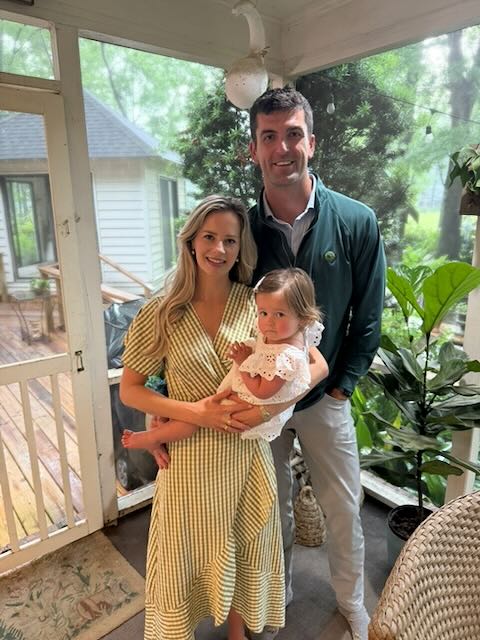
McGinty lives in Mount Pleasant, South Carolina, with his wife Hannah, daughter Jane, two dogs named Bubba and Honey, and a cat named Fern. Weekends tend toward the water near Charleston. His reading shelf favors adventure, pressure and large personalities: Alfred Lansing’s Endurance, Candice Millard’s The River of Doubt, Ron Chernow’s Titan, Annie Duke’s Thinking in Bets and two novels by Pat Conroy sit on his list.
There is a theme hiding among the explorers, industrialists and gamblers. McGinty likes stories about people making consequential decisions with incomplete information. Marketing, once the budgets become large enough and the calendar turns hostile, offers a less cinematic version of the same puzzle. What do you know? What can you test? Which relationship must survive the quarter? When should the plan yield to the evidence?
His ambition at TaxSlayer is practical: keep making the organization more capable of answering those questions. Personalization and faster analysis are on the horizon. So is the continuing work of separating useful AI from decorative AI. The aspiration is not a finished machine. It is an organization that learns while the season is still moving.
And then, once the trusted data is flowing and the team can act, perhaps the right answer really is a talking calculator. Marketing has always needed both sorts of nerve: the discipline to make the system honest and the playfulness to make anyone care.