The forgotten password is a small humiliation with excellent distribution. Somewhere, someone is pressing “reset” again, waiting for an email, or wondering whether a website has quietly decided to retire. Kees Wolters has spent years paying attention to these moments. In a 2018 conversation about customer feedback, he singled out login trouble as a recurring surprise: such an essential part of a website, and still so often a source of frustration.
It is a revealing choice of subject for a software founder. A login screen offers little glamour. Nobody throws a launch party for a password email that arrives. Yet this is where a company’s intentions meet a customer’s afternoon, and where the distance between the two becomes painfully clear. Wolters helped build Mopinion around that distance.
His route into the business passed through web design, digital marketing and user experience, with agency work and digital marketing positions at Philips and USG Marketing along the way. At Mopinion, he brought marketing and product into the same remit. The pairing makes sense: one side makes a promise; the other has to make it work.
A customer asked the awkward question
The origin of Mopinion begins with work for other people. Wolters, Udesh Jadnanansing and Floris Snuif were developing websites and apps together before customer feedback became their main business. Their clients could see activity in their analytics. Understanding the person behind that activity was harder.
Jadnanansing has recalled customers raising the subject around 2010, after the founders began working together in 2009. People were already expressing opinions through social channels. Giving those same people a straightforward route back to the business itself remained an opportunity. The founders began exploring it.
Wolters also supplied a connection within the founding team: Jadnanansing met the technically focused Snuif through him. It is a modest detail, but a useful one. Companies are often described as if a product idea assembled its own staff. Here, the relationships came first, followed by experiments with a problem their customers recognised.
The name Mopinion comes from “my opinion”. It is a small piece of branding with a clear point of view: the person using the service ought to get a turn in the conversation.
First, find somebody who wants it
Building the software did not settle the question of selling it. In the early years, the founders ran into a problem that customer research cannot politely wish away: people were not yet searching for what they offered. A self-service product needs customers who already understand why they might want to serve themselves.
The team changed its approach and sold directly to enterprise customers. That brought revenue and a more immediate connection to organisations with a reason to buy. Later, as the market became more familiar with feedback software, Mopinion returned to self-service.
There was a cost to the detour. While the founders concentrated on direct selling, newer competitors could arrive looking like the fresh names in a market Mopinion had helped explore. The company had to rebuild awareness. In July 2016, it raised €500,000 from Capital Mills.
For Wolters’s subsequent marketing work, the episode offers useful context. Explaining a category, choosing a customer and choosing a sales method are separate jobs. A tidy sign-up page cannot do all three. Sometimes the first product a founder has to deliver is an explanation.
Rotterdam, with a little football bias
Wolters’s account of building a company also has a geography. Mopinion started in the Maas Silo, among startups, media businesses and freelancers. It moved to ZOHO, then established itself near Station Blaak. His description follows the company through actual working spaces, rather than treating its city as a line beneath a logo.
Asked for a comment about Rotterdam in 2024, he supplied enough enthusiasm for a full essay. He praised its international character, connections and opportunities to recruit. These were a founder’s observations about a place that had supported his business, with the affection left in.
He also made room for Feyenoord. His judgement of the football club came with an admission of bias, which is usually the most dependable part of any football judgement.
The guitar gets a mention in his company biography, too. Between the football allegiance, the music and the sequence of Rotterdam offices, a more recognisable person emerges from the executive titles. His professional story has remained connected to a particular city even as the software travelled further.
The answer you weren’t looking for
Wolters’s advice about feedback begins with timing. Ask a relevant question when the experience is happening. Then examine the replies, decide what needs attention and check whether the resulting change helps. The survey itself occupies only the beginning of that sequence.
He also allows for the inconvenient answer. Customers do not reliably restrict themselves to the question a business hoped to ask. That can make analysis untidy. It can also expose the problem a team has stopped noticing.
A single report can matter, in his view, when it identifies something specific, such as a failure involving a particular browser and platform. Waiting for a large chorus would be an odd way to decide whether to investigate a broken function.
This makes his interest in password resets easier to understand. The point of listening is to discover where the experience comes apart. A customer struggling at the door may offer a more useful piece of information than a comfortable average score.
“It’s all about focusing on quality over quantity when it comes to selecting a team.”
Kees Wolters, on hiring
A shortlist with room for potential
Inside Mopinion, Wolters applied a similarly practical test to recruitment. He described looking for initiative and the ability to finish the job, giving potential more weight than a candidate’s previous titles. A startup, in that account, needs people who can move when the instructions run out.
He favoured a smaller, adaptable team with a broad range of capabilities. He also saw a benefit for employees: work that stretches beyond a narrow function can give people room to develop. The preference was for flexibility, rather than collecting impressive job histories.
The hiring process still had structure. Managers and team leads agreed requirements, prepared descriptions and searched their networks before distributing vacancies more widely. Candidate evaluations helped organise decisions, while recruitment software handled scheduling and other administrative tasks.
There is something pleasingly consistent about a feedback company asking interviewers to make their assessments explicit. Instinct gets a seat at the table, but it has to explain itself. Wolters’s account of hiring places responsibility on both sides: candidates need initiative, and the company needs a considered way to recognise it.
Give the machine a specific job
In December 2024, Wolters introduced Smart Recaps in a product article. The problem was familiar to anyone facing an inbox full of customer comments: collecting opinions can happen much faster than understanding them.
The feature used AI to summarise feedback, group recurring topics and show sentiment within the existing Mopinion environment. Users could move from a summary into the underlying comments. It was designed to reduce the work between receiving a response and deciding what deserved attention.
The implementation mattered. A shared recap gave colleagues a common view, and the functionality sat inside the workspace where they already handled feedback. The product’s proposition was specific enough to inspect: help teams work through what customers had actually said.
That is a more demanding brief than simply adding an AI button. A summary has to remain connected to the material it describes. Otherwise, the organisation has acquired another interpretation to debate, while the customer is still waiting for somebody to fix the form.
The designer still wants a conversation
Wolters’s interest in digital design reaches back to childhood, when he drew on an old Apple Macintosh belonging to a friend. The friend’s uncle worked in desktop publishing and taught at an art school. Drawing through a graphical interface opened up a possibility that stayed with him.
By 2024, his work involved teams using collaborative design tools and experimenting with generative AI. His enthusiasm came with qualifications. Tools could help develop ideas and make variations, but a specific product interface still required specific judgement.
His advice to aspiring designers returned to fundamentals: typography, colour, composition and collaboration. He valued the conversation around a design, including the ability to defend a choice. There is continuity between the child discovering a screen and the executive assessing software. The machine makes something possible; people still have to decide whether it makes sense.
A bigger table, and a new name
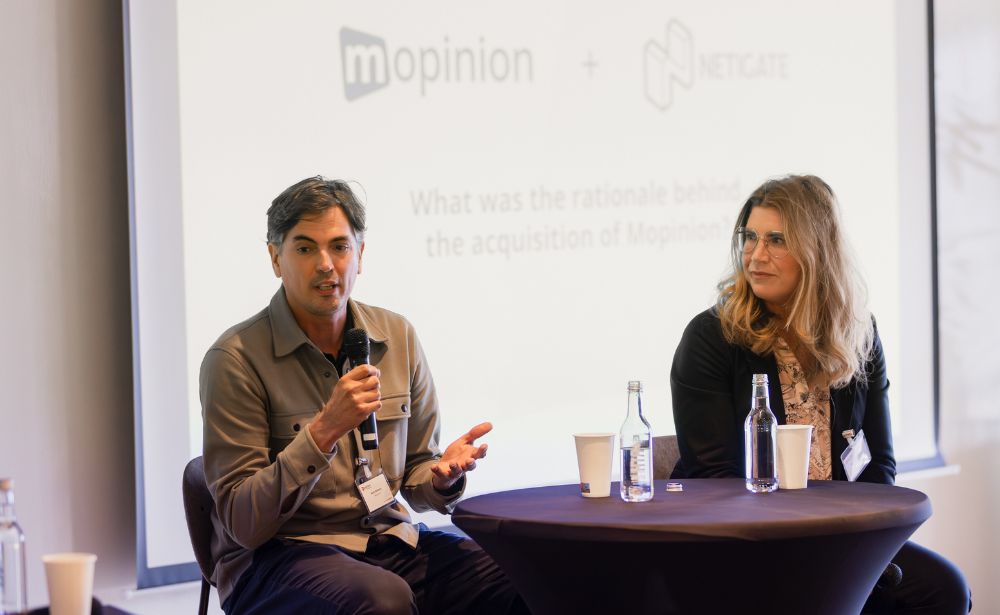
On 23 September 2025, Netigate announced its acquisition of Mopinion. The combination brought digital feedback from websites, apps and email into a broader experience management business. Wolters described the ambition in European terms, bringing complementary capabilities together across a fragmented software market.
The following month, he joined Netigate CEO Maria Börjesson at Mopinion Connects in Rotterdam to discuss the shared product vision. The event put a public conversation around the transaction: what would these connected capabilities mean for customers?
In March 2026, Wolters became Netigate’s Group Chief Marketing Officer, responsible for global marketing strategy and strengthening the positioning of its expanding portfolio. His remit now stretches beyond the company he helped found.
His explanation of the challenge remained grounded. Better technology could produce insights, he argued, but organisations also needed connected data and people able to carry improvements across departmental boundaries. Software could help an internal advocate make a case; somebody still had to act on it.
On 14 October 2026, Mopinion officially became Netigate Digital. The new identity arrived alongside closer integration with Netigate Insights, allowing digital feedback to be examined with other experience data, including historical responses.
The name over the door has changed. Wolters’s work still circles the same encounter: a business offers an experience, a person tries to use it, and something gets lost between intention and reality. The useful question comes next. Who is paying attention closely enough to do something about it?