In wealth management, the loudest clock is usually the quarter. Returns arrive in tidy columns. Markets revise the mood before lunch. Scott Wood prefers a clock with a much slower hand. He calls the practice “decading” - looking at a choice through a ten-year window, then deciding whether today’s excitement will still make sense when the calendar has done its work.
It is an unusually useful word for his career. In 2000, Wood and Mark Gehlbach started True North Advisors in Dallas with one declared goal: reduce conflicts of interest between adviser and client. They had worked inside traditional money-management businesses where advice could arrive attached to a product. Their new firm would reverse the order. Understand the family first. Open the financial toolbox second.
A quarter-century later, Wood remains True North’s chief executive, the architect of its vision, strategy and culture, and a voting member of its Investment Policy Committee. The firm has expanded its Texas footprint, built a substantial alternatives business, welcomed strategic minority investors and crossed state lines through acquisitions. Yet the original proposition remains disarmingly human: before capital can be allocated well, a person has to feel understood.
“We recognize that you can’t serve a client and their family in a vacuum.”Scott Wood
The business before the products
Wood’s public vocabulary contains more verbs about people than about markets. Listen. Understand. Serve. Fulfill. In a 2022 conversation about what clients seek, he described an adviser who could make sense of an entire financial picture and act as a strategic partner. The point was not to make finance sound simple. It was to give complexity a proper address.
That approach became the logic behind True North’s “Fulfilling Lives” mission. A portfolio is necessary, but it is not the life. The client may be preparing to sell a business, pass assets between generations, organize philanthropy or turn a complicated balance sheet into a coherent plan. The arithmetic matters. So does the reason anyone is doing the arithmetic.
Wood’s formal training gives that softer vocabulary a hard frame. He earned a Bachelor of Business Administration at Baylor University, then the Certified Investment Management Analyst and Certified Private Wealth Advisor designations. His job joins the two halves: shape the institution and participate in investment policy. Culture and capital allocation sit at the same table.
A compass with three points
True North’s biography of Wood says he filters everything through faith, family and relationships. It is less a ranking than a compass. He and his wife have three daughters. Away from work, his interests spill enthusiastically outdoors: skiing, cycling, running, golf, surfing and boating. The list reads like someone reluctant to choose only one way to move through fresh air.
The relationships extend into Dallas civic life. Wood joined the Salesmanship Club of Dallas in 2009, chaired the Momentous Institute board and was elected the club’s 104th president for 2023-24. He has also served as treasurer of the Tom Landry FCA Foundation and on a long-term planning committee at Park Cities Baptist Church, while participating in two YPO Gold groups.
There is a visible rhyme between those commitments and his work. Wealth advice deals in stewardship: what can be preserved, prepared and passed forward. Civic boards ask a version of the same question without a brokerage statement. When elected president of the Salesmanship Club, Wood spoke about the collective effort behind the Byron Nelson golf tournament and its support for children and families through Momentous Institute. The scorecard was the point only because of what it funded.
The decade test
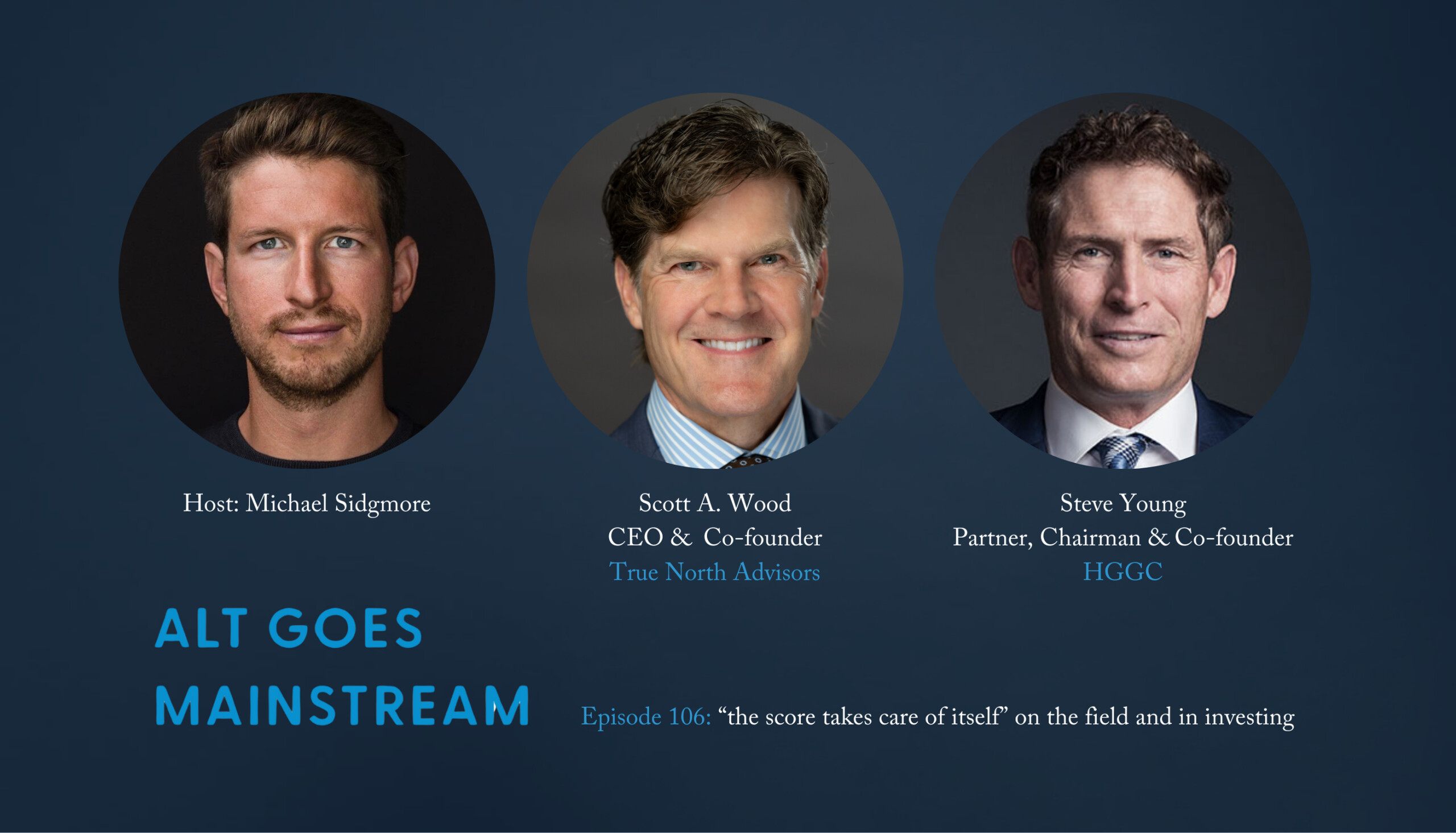
Wood’s conversation with former NFL quarterback and HGGC co-founder Steve Young supplied the clearest shorthand for his method. Their 2024 Alt Goes Mainstream episode examined True North’s partnership with HGGC and Wealth Partners Capital Group, alternative investments and the awkward art of combining firms without confusing growth for progress.
“Decading” was the memorable device. A ten-year horizon changes the quality of a question. A transaction is no longer merely accretive; it must still be culturally legible after the people who negotiated it have moved on. A hire is not simply a vacancy filled; it is a possible future leader. An allocation is not only an entry price; it is a relationship between patience, access and risk.
The 2024 partnership was not a sale of the whole enterprise. True North’s regulatory brochure described a minority investment made through entities affiliated with HGGC and Wealth Partners Capital Group. The distinction matters because Wood and Young kept circling alignment: define the relationship before depending on it. Patient capital is useful only when it does not demand that the company forget itself.
Alternatives belong to the same long view. By the time of the podcast, True North reported $4.4 billion in assets under management and more than $812 million allocated to alternatives. Those numbers belong to a moment, not a promise. The lasting point is strategic: the firm spent years building access beyond conventional public stock-and-bond portfolios, looking for diversification and opportunities suited to sophisticated clients.
“We want to be around for a long time and provide continuity to the families we serve.”Scott Wood
Growth with a memory
A long horizon does not produce a stationary company. True North acquired Clear Rock Advisors in 2024, adding offices in Austin and Kerrville along with a reported $470 million in assets. In 2025 it bought Blue Investment Partners in Danville, California, which reported $353 million in assets under management at the end of that June. The firm also marked its 25th anniversary.
Every acquisition carries a small identity puzzle. The buyer wants capability, talent and relationships. The acquired team wants continuity, autonomy and proof that “culture” means more than the paragraph between the deal announcement and the legal disclaimer. Wood’s public comments return to cultural fit because scale cannot solve that puzzle after the fact. It can only make the pieces more expensive.
Wood and Gehlbach co-found True North Advisors.
Wood becomes the 104th president of the Salesmanship Club of Dallas.
A minority investment and the Clear Rock acquisition widen the platform.
True North turns 25 and expands to California through Blue Investment Partners.
His stated aspiration makes the puzzle explicit: build a multigenerational firm capable of outlasting its founders. Many founders want a legacy. Fewer are eager to build the leadership systems that make their own indispensability temporary. Wood’s version of continuity depends on developing leaders across generations, deepening client relationships and keeping values operational as the cap table and office map evolve.
Recognition has followed. True North has appeared in national and regional RIA rankings, and Wood has been a repeat honoree in D CEO’s Dallas 500, including the 2026 edition announced in November 2025. His own response to an earlier firm honor was characteristically resistant to the trophy case: the work was not done for recognition, he said, but to affect stakeholders’ lives. Outside validation was simply nice to receive now and again.
What builders can borrow
- Remove the structural conflict first. A better promise is fragile if the business model quietly argues with it.
- Put the human question before the toolbox. Tools become useful after the objective is understood.
- Test a partnership at ten years. Alignment that lasts is more valuable than enthusiasm that closes.
- Treat culture as operating infrastructure. It belongs in hiring, succession and acquisitions, not merely in language.
- Design for your own eventual absence. Continuity becomes real when the next generation can lead.
What remains true
Wood’s story offers no clever prediction about the next market cycle. It offers something sturdier: a method for deciding what not to surrender while conditions change. The firm can add cities, strategies and shareholders. The client still needs to be understood. The portfolio can become more sophisticated. The adviser still has to explain why it exists. The founder can remain ambitious while building an institution that will not always need him.
That last task may be the purest expression of decading. Imagine the company ten years from now, then work backward toward the leaders, systems and relationships it will require. It is patient work, though not passive work. In finance, as on a bicycle or a surfboard, balance is not achieved by standing perfectly still.
The metaphor hidden in the company’s name has survived 25 years because a compass does not tell you how fast to travel. It tells you whether motion still points in the intended direction. Scott Wood has spent his career checking both.