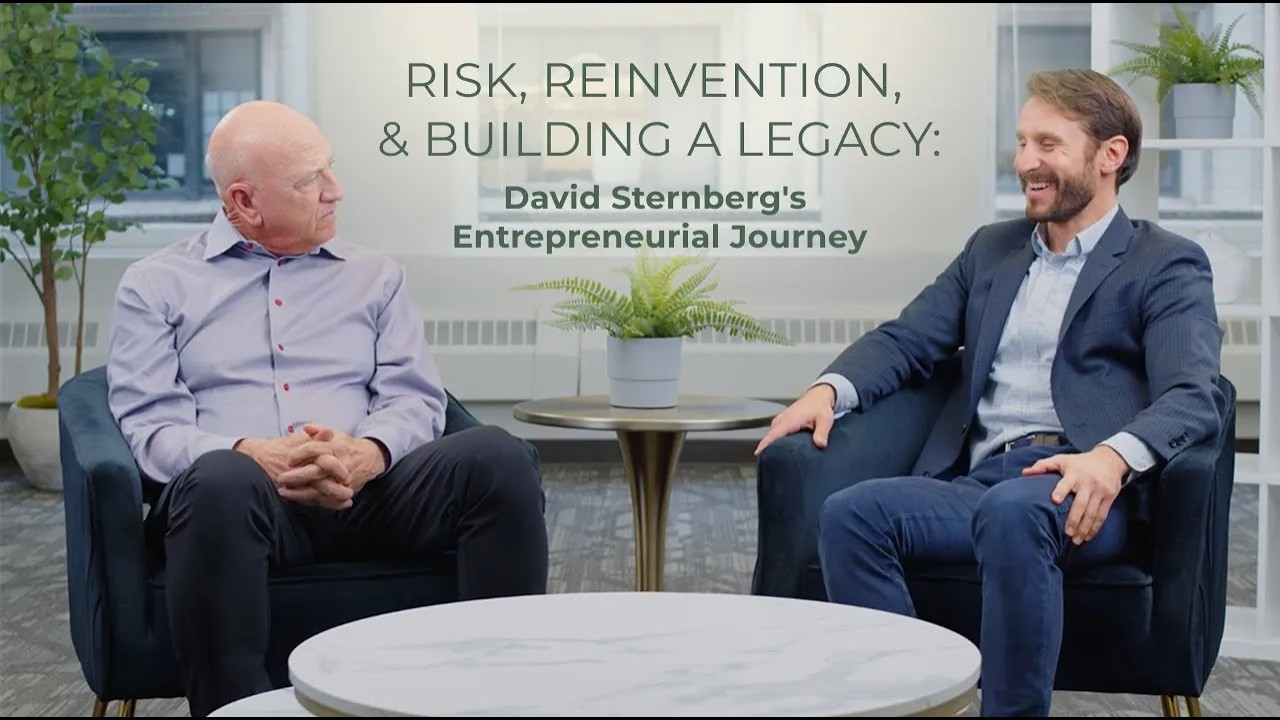
David Sternberg arrived at the Chicago Board Options Exchange by accident. He had graduated from the University of Iowa in 1981 with a marketing degree, earned an Illinois real-estate license, and expected property to be his lane. Then, at his sister's house, one of her friends mentioned that he traded options. Sternberg had never known a trader. The friend invited him downtown to see the floors. The visit supplied an immediate answer to a question Sternberg had not realized he was asking.
The floor was loud, compressed, physical. Price moved through hand signals, voices, and quick arithmetic. Sternberg began as a runner and moved into market-making, specializing in spread trading. He also acquired the sort of nickname that belonged to that place. His trading acronym was meant to nod toward Best Kosher Sausage Company, his family's business. Irv Kessler, a trader Sternberg would remain connected to for decades, started calling him “Beast.” The name stuck so well that former floor traders still send greetings to Beast through Vivaldi clients.
01 / The expensive little hedgeProtection before prediction
The nickname implies aggression. The career underneath it was organized around restraint. Sternberg insisted that his traders stay hedged, including with far out-of-the-money options whose cost could feel pointless. Those contracts were cheap for a reason: the event required to make them valuable looked remote. To a trader watching premiums expire, protection could resemble a ritual of throwing away money.
“Because you never know.”David Sternberg, explaining why his traders bought unlikely protection
On October 19, 1987, the unlikely stopped being theoretical. Sternberg had 20 traders on the floor when the crash hit. Markets began unraveling around the open. He remembers mass craziness, but his group had protection and made money that day. His account matters less as a victory lap than as a demonstration of what insurance is supposed to do. A hedge is easiest to resent when nothing is wrong. Its purpose becomes visible at the precise moment it is hardest to acquire.
Sternberg resists describing the result as extraordinary foresight. Prediction gives too much credit to the forecaster and too little to the structure. He describes a standing practice: examine tail risk, imagine the hundred-year flood, and ask what happens when the plan meets conditions it was not built to expect. The crash made that practice legible. It also became the connective tissue between two careers that look different from the outside.
02 / Enough changes the mathThe 28-year-old who wanted bonds
There was a personal version of the same discipline. At 28, after doing well at a young age, Sternberg sat with Harris Associates, the Chicago manager that handled his money. Their conventional answer was sensible for someone his age: perhaps 75 percent stocks and 25 percent bonds. Sternberg wanted the proportions reversed. He knew he might earn less. He also knew that he did not need the additional risk and did not want the stock market dictating what happened in his life.
The preference grew partly from home. Both of his parents worked, unusual enough in his childhood to register. Family vacations were scarce. His father was careful not to extend the household beyond what it could afford. When Sternberg bought his first condominium in 1986, he chose a price far below what his earnings might have supported. Trading felt to him like an athletic career: finite, physically and mentally demanding, and unlikely to care what a former participant needed after the music stopped. He wanted to put enough away while the opportunity existed.
He left active trading in 1996 at 37. Retirement lasted roughly six months. Sternberg shared an office with a friend and looked for a business to buy, but leisure was not the missing piece. “I needed to be mentally challenged,” he later said. The line is less a confession of workaholism than a useful description of his operating system. Removing market risk from his day did not remove his appetite for puzzles.
03 / A second actLearning the world beyond stocks and bonds
Managing his own and his family's capital provided the next puzzle. Sternberg began investigating hedge funds, private equity funds, and real-estate funds. The vehicles were new to him; the questions were not. He assessed managers with instincts developed on the floor: where can the strategy break, what is hidden by normal conditions, and does the return justify the exposure?
That work led to Iron Partners, which he co-founded in September 1999. The firm managed a fund of funds and was sold to the founders of a private-equity firm in 2007. Regulatory records place Sternberg next at FGMK/Preservation Capital Partners from 2009 to 2011. But clients, friends, and family kept asking for something broader. They wanted someone to manage the whole portfolio, not merely an alternatives sleeve.
Sternberg took the prompt to Randal Golden. His formulation was plain: “Let's marry wealth management, traditional wealth management with the alt world.” Vivaldi Capital Management, registered with the SEC in 2012, grew from that bridge. Traditional investments and financial planning sat beside hedge funds, private equity, private credit, and real estate, with alternatives treated as components of a household portfolio rather than exotic ornaments.
04 / The last mileA moat made of subscription documents
The idea required a deeply unromantic execution layer. Alternative managers commonly asked for minimum commitments of $1 million, $5 million, or $10 million. Sternberg asked them to accept client investments closer to $100,000 or $250,000. Vivaldi would bring investors one by one and act as an unpaid capital-raising channel for the managers. Many agreed.
Then came the paperwork. Vivaldi handled individual subscription documents, at first by the thousands. Sternberg calls that era a royal pain. The process was later automated, but the manual work exposes a useful feature of the business. Access is not created when somebody identifies a good manager. It is created when minimums, diligence, administration, allocation, and financial planning can coexist for an actual client. The bridge was operational before it was technological.
“Let's marry traditional wealth management with the alt world.”The Vivaldi proposition, in Sternberg's words
Vivaldi's filings trace the scale that followed. Regulatory assets under management were about $2.09 billion at the end of 2019, $3.73 billion at the end of 2023, $4.65 billion at the end of 2024, and $5.64 billion at the end of 2025. Those numbers do not reveal investment returns, client experience, or the quality of every decision. They do show a firm adding assets while moving a once-niche proposition toward the center of wealth management.
Vivaldi regulatory assets under management
05 / Scale, with conditionsThe Corient chapter
In April 2026, Corient announced an agreement to acquire Vivaldi and add its $5.6 billion in client assets. The firms said Vivaldi's principals would become Corient partners after closing. By July, Vivaldi's site described the firm as now being Corient. For Sternberg, the stated attraction was an expanded set of wealth-management and family-office capabilities while continuing personalized service. The transaction placed a Chicago firm built around alternatives inside a much larger integrated partnership.
It also set up the kind of tradeoff Sternberg has spent a career studying. Scale can widen access, deepen specialist resources, and spread the cost of technology. It can also distance a client from the people whose judgment earned the relationship. Corient's partnership structure is the mechanism intended to reconcile those forces. Sternberg's history suggests he will evaluate the arrangement the familiar way: not only by what can go right, but by whether the downside has been contained.
He showed little interest in a ceremonial exit before the deal. In the 2025 interview, at 65, he said he still woke around 3 a.m., a residue of the trading years. He played golf and pickleball, traveled, and worked remotely, but retirement was not on the agenda. His explanation returned to obligation. Friends, relatives, and clients had trusted him and the firm with their money. Walking away did not feel compatible with that responsibility.
The career began with motion: a runner crossing a trading floor, learning its language fast enough to become Beast. Its durable contribution is more measured. Sternberg took a trader's respect for ruin and applied it to the slower work of preserving family capital. He changed vehicles, companies, and roles. The question stayed put: if the improbable arrives tomorrow, will today's decision still make sense?