A gas utility has an unusual relationship with applause. Its customers are generally happiest when they have no reason to think about it. The furnace starts. Dinner cooks. The bill arrives, ideally without causing anyone to sit down. Scott Doyle has spent his working life inside the machinery that makes this ordinary sequence possible. In 2026, as president and chief executive officer of Spire, he began changing the shape of that machinery on a much larger scale.
On March 31, Spire completed its $2.48 billion purchase of Piedmont Natural Gas’s Tennessee business from Duke Energy. More than 200,000 customers and nearly 3,800 miles of pipelines came with it. Within three months, Spire had also completed the sales of its gas marketing and storage businesses. The company was buying, selling and narrowing its attention at the same time. For Doyle, an engineer whose career began in 1994, the assignment had become deciding which parts belonged together.
A career measured in service territories
Doyle’s route to the executive office runs through places rather than fashionable management theories. His earlier assignments included natural gas operations in Arkansas, Bogalusa in Louisiana, and Victoria and New Braunfels in Texas. These were roles in engineering and operations, close to the places where a utility’s promises become physical work. A service territory is a particular kind of classroom: the pipes, crews and customers all have addresses.
In January 2006, he was named manager of CenterPoint Energy’s Spring Branch Service Center, responsible for an electric distribution system. His work had crossed from gas into electricity. Engineering, installation and maintenance were part of that job. The vocabulary would become familiar throughout his career, even as the number of people and systems under his supervision increased.
His education supplied a technical foundation. Doyle earned a bachelor’s degree in civil engineering at Texas A&M, and the university has identified him as a professional engineer. Later responsibilities added another kind of calculation: regulatory strategy, legislative affairs and public affairs. Building infrastructure and securing the conditions under which it can be built are related tasks, though they seldom require the same meeting agenda.
At CenterPoint, he went on to lead regional natural gas businesses in Texas and Louisiana/Mississippi, then held senior responsibilities across regulatory and public affairs. From April 2019 to January 2022, he was executive vice president of natural gas. His next role, executive vice president of utility operations, put electric and gas businesses serving seven million customers within his remit. The district map had become a multistate map.
Fifteen months to the top job
Spire announced Doyle’s appointment as executive vice president and chief operating officer on January 9, 2024. He started on January 15. His responsibility was the company’s gas utilities, then serving more than 1.7 million customers across Alabama, Missouri and Mississippi. He arrived with experience in both the technical and public-facing sides of a regulated business.
Steve Lindsey, Spire’s CEO at the time, already knew Doyle through the industry. In welcoming him, Lindsey singled out capital deployment, regulatory strategy and operational leadership as relevant to Spire’s ten-year plan. The introduction carried a practical implication: Doyle had been hired to work on systems that would outlast a quarterly results presentation.
On April 24, 2025, Spire’s board appointed him president and CEO, and made him a director. The public announcement followed the next day. He succeeded Lindsey after roughly fifteen months at the company. Chair Rob Jones emphasized Doyle’s ability to work with people alongside his operating experience. The appointment expanded his responsibility from the utilities to the whole enterprise.
Doyle’s own remarks centered on employees and modernization. He praised their “can-do attitude” and described continued work on Spire’s systems for customers’ benefit. It was a modest phrase for a large undertaking. An executive can announce a strategy in a morning; the people responsible for replacing infrastructure have a rather longer afternoon ahead of them.
That emphasis on employees reappeared during the next winter. Opening Spire’s February 2026 earnings call, Doyle thanked teams across the company for their response to Winter Storm Fern. He described collaboration across service territories as extreme weather increased the demands on the system. The acknowledgment put a concrete occasion behind the language of his appointment. A utility CEO talks to investors about future performance, but here he began with work that employees had just completed. It also returned the discussion to a familiar operating problem: serving customers when the conditions become difficult. The transition from district management to corporate leadership had changed his audience and responsibilities. Weather still had a place on the agenda.
The Nashville turn
The Tennessee agreement arrived in July 2025, just months into his tenure as CEO. Spire would acquire Piedmont’s Tennessee local distribution business, concentrated in the Nashville area, for $2.48 billion. The business would become Spire Tennessee. For a company already operating utilities in three states, this was an expansion of the familiar work of delivering natural gas to homes and businesses.
The deal’s scale is easier to grasp in its physical parts. Nearly 3,800 miles of distribution and transmission pipelines came with more than 200,000 customer relationships. More than 200 Piedmont employees were to transition to Spire, with additional support positions being added. An acquisition announcement contains a purchase price; carrying it out means connecting organizations whose employees already have customers to serve.
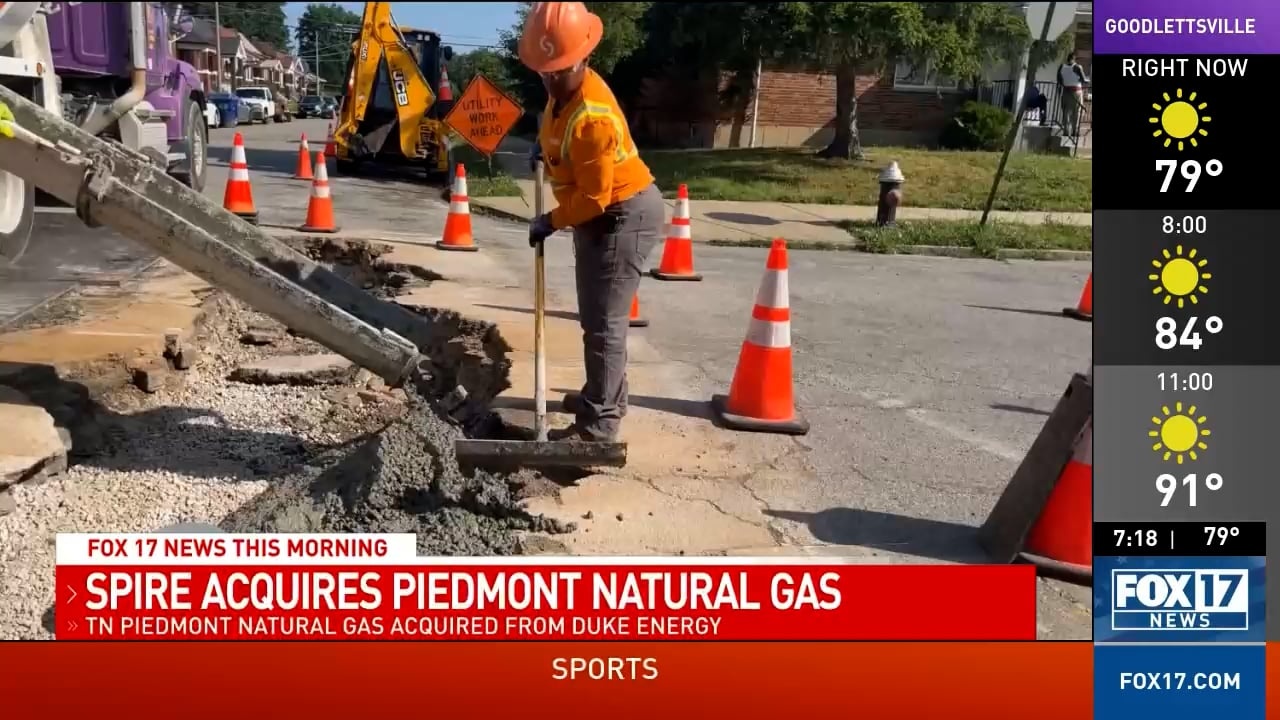
When the transaction closed on March 31, 2026, Spire said Tennessee would account for approximately 20 percent of its capital investment plan through 2030. That makes the new business more than an extra name on an organizational chart. It also gives Doyle a continuing integration task: matching the commitments made at purchase with the money, people and operational attention required afterward.
The customer promise was continuity. Doyle spoke about welcoming the Tennessee employees and customers and continuing reliable delivery. This is the peculiar etiquette of buying a utility: the financial event may be substantial, while a customer’s preferred experience is a thoroughly uneventful Tuesday.
Buying a utility, selling the adjacent businesses
Alongside that expansion, Doyle and Spire were reducing the range of activities inside the company. In March 2026, Spire agreed to sell its gas marketing business to Boardwalk Pipelines for $215 million in cash. The sale closed on April 30. Employees and clients would move into Boardwalk Continuum Marketing, with former Spire Marketing president Pat Strange continuing to lead the organization.
Doyle described the rationale in terms of business mix, risk and the visibility of future earnings. Marketing had contributed to Spire, but the company was concentrating its attention on regulated utility operations. The proceeds helped fund Tennessee and supported general corporate purposes. Growth, in this case, involved giving up a business as well as acquiring one.
“The sale simplifies our business mix”
Scott Doyle, March 2026
On June 30, Spire completed the sale of its Wyoming and Oklahoma storage businesses to I Squared Capital for $650 million. The consideration comprised $600 million at closing and a fixed $50 million payment due in fiscal 2027. Employees and customers would become part of Bear River Midstream. Those proceeds also helped fund the already completed Tennessee acquisition.
Purchase and sales are separate transactions. Consideration is not a measure of profit; the storage total includes a deferred payment.
Taken together, these decisions make the emphasis of his leadership visible: more utility customers, with fewer adjacent businesses. The trade-off is concrete. Spire is putting more weight on the operating and regulatory work Doyle has practiced for years. Its future performance still has to justify those choices; completed transactions establish a direction, rather than settle the question of results.
Another sort of engineering investment
There is a smaller-scale investment in Doyle’s story that deserves room beside the billion-dollar figures. In 2020, Pamela and Scott Doyle established two endowments at Texas A&M: an engineering scholarship and a Dean’s Scholar Award. One supports undergraduate engineering students; the other supports freshmen. The gifts connect the executive’s professional life to students who are still approaching its starting line.
His relationship with the university also includes service on its Engineering Advisory Council. Back in St. Louis, his current board roles include the Regional Business Council, Greater St. Louis and Greater St. Louis Area Scouting, alongside the American Gas Association. The organizations connect his work to business, civic life and the development of younger people.
Those commitments give some texture to an otherwise densely operational résumé. The scholarships are a specific act, with named beneficiaries as a group and a clear educational purpose. They offer a useful counterweight to the scale of his corporate responsibilities: an engineering career can be measured in customers served, and it can also leave room for somebody else’s first semester.
The work after the announcement
By August 2026, Spire had reported that its marketing and storage divestitures were complete. It reaffirmed a long-term adjusted earnings growth target of 5 to 7 percent and described an $11.2 billion capital investment target through fiscal 2035. These are company plans and targets, dependent on execution and future conditions. They set out the horizon against which Doyle’s decisions will be assessed.
The same update reported a quarterly loss from continuing operations. The financial picture contains acquisition costs, financing costs and the effects of a changing business portfolio. A profile of its CEO should leave those complications intact. The corporate reshaping has been real; so is the obligation to turn it into durable operating performance.
Doyle now leads a company serving close to two million homes and businesses across four states. His career has moved from local service areas to that larger network without abandoning its underlying subject. At either scale, someone has to decide where money goes, who does the work and how commitments reach the customer. For the person waiting for the furnace to start, the final test remains pleasantly uncomplicated.
Continue reading & watching
Spire’s corporate channels