Ron Jibson knew which part of an engineering degree his audience might resent. In February 2004, back at Utah State University for Engineering Week, he reminded students of the hours spent in laboratories while friends from other colleges enjoyed themselves on the Quad. He had been there. His reassurance was brief: “But believe me, it’s worth it.” Coming from a utility operations executive, it was a promise with a rather long testing period.
Six years later, he would be running Questar Corporation. Twelve years later, he would retire as its chairman, president and chief executive when the company joined Dominion. Yet the classroom visit offers a useful place to begin. Before the board seats and the banquet speeches, there was an engineering graduate who understood the appeal of being somewhere else on a pleasant afternoon, and who stayed with the work anyway.
Thirty years between the drawing and the desk
A Logan native, Jibson graduated from Utah State in 1978 with a degree in civil engineering. In 1980, he joined the business known then as Mountain Fuel Supply as a design engineer. The work put him inside the machinery of a utility long before he became responsible for explaining that machinery to investors. Engineering, operations and management supplied successive chapters of his working life.
He became director of engineering, operations manager, general manager of operations and vice president of operations. The sequence matters because gas service has several audiences at once: the household waiting for heat, the crew doing the work, the regulator examining the bill and the investor expecting a return. Jibson’s career moved through the practical business of serving those audiences before reaching the corporate office.
Along the way, he added an MBA from Westminster College, graduating in 1991. That date places the business degree inside his utility career, eleven years after he started. The engineer was acquiring another vocabulary while remaining in the same industry. Westminster later recognized him as a distinguished alumnus in 2014; by then, his responsibilities stretched across gas production, transportation and distribution.
In September 2008, Jibson became president and CEO of Questar Gas. In 2010, he took the top job at the parent company. The chairmanship followed in July 2012. It was a progression measured in decades, with a conspicuous amount of operations work in the middle. Anyone hoping for a career shortcut may find this chronology discouraging. It does, however, have the advantage of being legible.
Utah State University
Mountain Fuel Supply
Questar Gas
Questar Corporation
Joins Dominion’s board
A gas company with three moving parts
The company he led had three principal businesses: Questar Gas delivered to retail customers, Questar Pipeline transported gas between markets, and Wexpro developed and produced gas. Those activities shared a fuel but involved different work. Understanding the whole required attention to what happened upstream, what moved through the pipeline and what finally reached a customer.
By the time his retirement was announced in April 2016, Questar Gas served about one million customers in Utah, southern Idaho and southwestern Wyoming. The number gives the job its proper scale. A utility’s daily audience can be larger than the population of many cities, even when most members of that audience have little reason to think about the person in charge.
Jibson also became a national industry representative. He chaired the American Gas Association in 2013 and had chaired the Western Energy Institute. Earlier, as an operations executive, he testified before Congress on pipeline safety on behalf of gas utility associations. His public responsibilities therefore preceded his CEO title. The operational experience was already being carried into arguments about how the industry should work.
There was room for a less predictable energy arrangement at home. In 2012, his mountain house used solar power and operated off the grid, with a backup generator. The gas executive could discuss different kinds of power while living with more than one himself. The detail is appealing because it brings a large industry down to domestic scale: even an energy executive needs a plan for when the lights might go out.
“the opportunity of a lifetime”
Ron Jibson on leading Questar · 2016
The closing that became a departure
The Dominion combination arrived in 2016, the same year Jibson received the Salt Lake Chamber’s Giant in Our City award. In April, Questar announced that he would retire when the merger closed. His departure was tied to the transaction, rather than an arbitrary date on the calendar. A career spent inside one company would end as that company entered a different corporate structure.
He spoke of his years leading Questar with gratitude. In discussing the combination, he credited employees for the business they had built and expressed confidence in the result for customers, workers, shareholders and communities. The emphasis was on the people who would remain after the executive changed his routine.
On September 16, 2016, Dominion completed the combination. Jibson retired and joined Dominion’s board. Craig Wagstaff became president of Dominion Questar, responsible for the western natural gas operations. Questar’s principal operating companies retained their names at closing, and Salt Lake City retained a substantial management presence. For customers, the transaction was accompanied by commitments that reached beyond the sign outside an office.
Those commitments included a $75 million contribution to employee retirement plans and an extra $1 million a year in charitable giving in the service area for at least five years, both at Dominion shareholder expense. They were terms of the combination. They also show how many constituencies sit inside a utility merger: the financial transaction carries consequences for employees, local institutions and the communities around the system.
Retirement acquired a school timetable
Jibson’s interests in education had already produced concrete work. Salt Lake Community College awarded him an honorary doctorate in 2014, recognizing support for scholarships and his role in helping establish an energy grant that benefited students. At Utah State, he chaired the board of trustees. In 2017, he was appointed to the Utah Board of Regents, extending his involvement from one campus to the state’s higher education system.
That same period brought a more contentious assignment. Alongside Gail Miller and Scott Anderson, Jibson co-chaired Our Schools Now, a campaign seeking greater education funding through tax increases. Business leaders were asking residents to pay more for schools. An endorsement of education is easy to applaud; a proposal that changes a household tax bill invites a more detailed conversation.
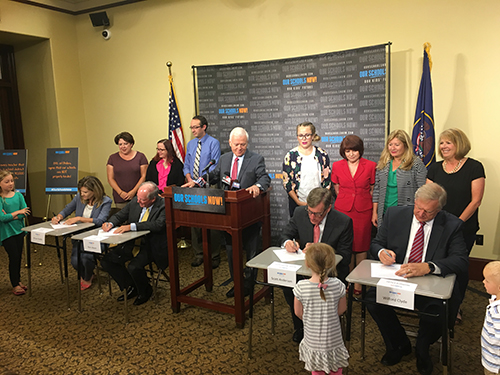
The June 2017 proposal sought phased increases in sales and income tax rates, with backers projecting roughly $700 million in annual school funding when fully implemented. Opponents questioned both the burden on taxpayers and whether additional spending would deliver the promised improvements. The disagreement made the campaign a test of persuasion beyond the circles in which a retired CEO might normally be welcomed.
The campaign changed course. In April 2018, Jibson, Miller and Anderson signed a letter withdrawing the initiative after reaching an agreement with state leaders. It included a Teacher and Student Success Account and plans to seek voter support for a gasoline tax increase. The letter said the campaign had collected more than 150,000 signatures. Its conclusion was a negotiated arrangement, with further political work still ahead.
Education remains part of his public role. Education First Utah lists Jibson as a co-chair alongside Miller and Anderson. The continuity is striking: the former engineering student, the returning campus speaker and the retired executive advocating school funding occupy different positions around the same question of what people need in order to learn and work.
A courtyard, a fishing rod and the next meeting
The cultural side of Jibson’s civic life is equally tangible. He served on the boards of Utah Symphony/Utah Opera and the Utah Shakespearean Festival. At Utah State’s Chase Fine Arts Center, the Ron and Janet Jibson Family Courtyard gives the family name an outdoor address. Designed for gatherings, displays and small concerts, it is a pleasingly sociable counterpart to a career in infrastructure.
His personal interests include golf, fly fishing and time with family at their mountain ranch. His hobbies also include biking and pickleball. He and Janet have three sons. These details supply a little movement around the formal portrait: a river, a court, a family gathering. A list of board appointments cannot be expected to carry the entire personality.
Jibson’s corporate board chapter continued well beyond Questar. He served on Dominion’s board until 2024, and his IDACORP and Idaho Power board service, begun in 2013, ended in 2025. The American Gas Association recognized him with its Distinguished Service Award in 2019. The succession of dates makes retirement look less like a single event than a gradual redistribution of responsibilities.
Back in that engineering classroom, the immediate problem had been how to persuade students that the hours in the laboratory would amount to something. Jibson’s subsequent career supplied one answer: technical work could lead to responsibility for a company, then to responsibility toward the institutions around it. The Quad was still an understandable temptation. He had simply found enough reasons to keep returning to the work.
Follow the connections
Profiles, reporting and conversations from across the years.