At OCA Ventures, the work began with contracts and ended in Excel. Between the two sat a familiar problem: somebody had to read the agreements, enter the numbers, and trust that the previous person had done the same. Controller Fahad Qureshi wanted a firmer foundation. In a 2022 customer case study, his firm described using Aumni to check its closing documents and organize investment terms. The interesting part was what happened before anybody looked at a dashboard: the records themselves received scrutiny.
- Aumni turned signed venture agreements into searchable portfolio data.
- Its advantage combined automation with human review and deal-term benchmarks.
- Services ended March 31, 2026. The problem it addressed remains.
Two lawyers, one very long document
Tony Lewis and Kelsey Chase came from corporate law. They knew that an investment’s important details lived inside its agreements. Ownership was one question. Rights, preferences, and obligations made the answer more complicated. A spreadsheet could preserve a number while losing the conditions attached to it.
Founded in 2018, Aumni approached venture capital through that administrative side door. Its early customers included venture funds, corporate venture investors, and family offices. Later offerings also addressed limited partners, fund administrators, and law firms. These users needed to interrogate investments after the celebratory closing email had disappeared into the inbox.

The contract became the database
Aumni’s starting material was the executed agreement. Its software extracted, structured, and tracked legal and economic terms, with human expertise supporting the process. Finance and investment teams could examine capitalization, securities, investor rights, and financing history together. That connection between the number and its contractual origin was the product’s distinguishing proposition.
Consider the practical question behind a liquidation preference: who gets paid, and in what order, if a company sells? An ownership percentage alone cannot answer it. Aumni brought the relevant security and contractual terms into the same working view. That made it useful to the person preparing a valuation, the lawyer checking rights, and the partner trying to understand the fund’s exposure before a meeting.
Aumni’s audit materials described checking for missing documents and linking data points back to source language. Instead of repeatedly asking a colleague to locate a clause, a user could follow the evidence. The platform also collected company KPIs, supported scenario modeling, and produced reports. Its position was at the intersection of legal records and portfolio operations, where a database of company names alone would leave much of the work unfinished.
“Now, Aumni checks everything.”
Fahad Qureshi · OCA Ventures controller
In Aumni’s 2022 customer case study
Less time on valuation work in OCA’s first quarter using Aumni.
Time index: before = 100. Customer-reported in an Aumni-produced case study, 2022.The price included some homework
Aumni sold a subscription service to institutions. Its provider-supplied pricing description on G2, updated in March 2023, tied bespoke pricing to assets under management and included a dedicated customer-success leader, often a former deal lawyer or fund controller. That sales model suited a product requiring intimate knowledge of a customer’s records.
Implementation demanded effort. A 2023 G2 reviewer described the setup as a lift, while recognizing its usefulness as an audit. Another wanted stronger reporting and calculations, exporting data to Excel for more advanced analysis. Those accounts expose a practical limit: structured data reduces repetitive work, but it does not eliminate reconciliation or every spreadsheet.
For a buyer, the economic question was whether recurring reporting and review work justified both the subscription and the initial cleanup. A small portfolio with simple agreements would offer fewer opportunities to recover that effort. A growing collection of rounds, securities, amendments, and reporting requests gave the system more work to absorb. That is an inference from the workflow, rather than a promised return.
A term sheet with a memory
Aumni also found a way to reach people outside its paying accounts. In 2020, it began collaborating with the National Venture Capital Association on an enhanced model term sheet. The free Word document linked familiar provisions to anonymized market benchmarks. Investors could draft terms and inspect how frequently comparable provisions appeared.
Feedback shaped the next version. Utah Business reported that users wanted more fields, better data points, and faster turnaround; the 2021 edition expanded the analysis. The distribution lesson is unusually concrete: put useful information inside a document your audience already opens. The limitation is equally concrete. Historical frequency needs context. Orrick later cautioned that the enhanced document’s 2021 data could misrepresent a changed financing environment.
Then the facts needed room for assumptions
J.P. Morgan led Aumni’s $50 million Series B in August 2021 and announced its acquisition agreement in March 2023. Subsequent collaborations stretched the data into other jobs: independent valuations with PricingDirect, quarterly market research with Fenwick, and private-security identifiers with CUSIP Global Services.
The revealing product change arrived on October 13, 2025. Aumni introduced Venture Workspace, explaining that firms required more than reference data. Customers could enter and modify transactions, create custom rounds and exits, and add their own tags. Verified documents remained the foundation; internal perspectives could sit beside them.
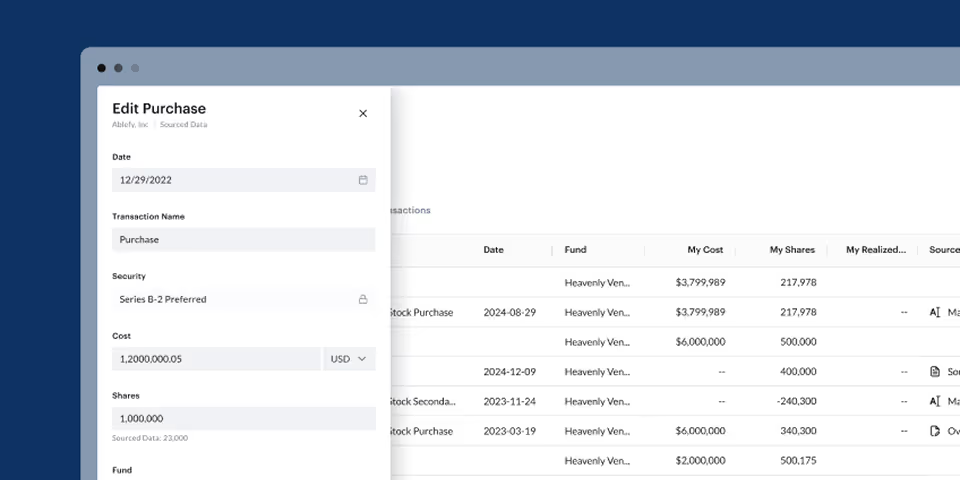
That shift acknowledged an awkward truth about investment software. A completed contract describes an agreement. A team also needs to work on possibilities, provisional transactions, and its own interpretation of the portfolio. Aumni was making space for both.
The records outlasted the service
In December 2025, J.P. Morgan confirmed that it would discontinue Aumni globally following a review of its products and client offerings. Aumni’s official company page records the end of services on March 31, 2026. Standard Metrics and PostSig publicly addressed affected firms’ continuity needs. The bank’s stated rationale was a product review; it does not establish that Aumni’s technology failed.
The useful thing to copy is a discipline: retain the signed originals, connect important fields to their evidence, and reconcile the record before building reports. The closure adds another operational lesson: make exports routine and keep institutional knowledge portable. Those habits still require someone to collect amendments, resolve discrepancies, and own the process. Aumni made that work easier to see. Every fund still has to decide who will do it.