An agency can change its website in an afternoon. Changing who controls it takes a little more commitment. In 2025, leaders at Marcus Thomas bought back majority control after four years with private equity. By then, Scott Chapin was CEO. The executive who had spent years working in digital strategy, analytics and operations was now helping lead a business that had chosen to reconsider its own arrangement.
The decision gives his career an unusual shape. There is the familiar climb through increasingly consequential titles. Then comes a turn toward ownership, where the question becomes who gets to make decisions, and for whose benefit. The 4As’ 2026 management forum pairs Chapin with agency president Jamie Venorsky for a session on succession and that return to independence. Their subject is the relationship between an agency’s legacy and its financial return.
To understand how Chapin reached that conversation, start somewhere less grand: a library website. Before the executive appointments and ownership questions, he was explaining how to make a public institution easier to use. The work had steps. The steps mattered.
A library, a prototype, a useful beginning
On March 18, 2010, Chapin appeared before the Cleveland Public Library board as DigiKnow’s director of consulting services. The library was considering a website redesign. Its web applications manager, Amy Pawlowski, wanted input from patrons, staff, administrators and trustees. Chapin outlined a process: collect information, establish the site architecture, design a prototype, test it and evaluate it.
The sequence has a pleasing lack of glamour. No one gets to skip straight to the attractive screen. First, find out what people need. Then organize it. Then discover whether the proposed answer works. After discussion with the board, Chapin said accessibility in the interaction with technology would be a consideration.
A year later, his name appears again in the library’s work, this time as a DigiKnow partner discussing implementation of an iPad app for its Sports Research Center. The two projects place him at a practical intersection: an institution with material to share, people who want to find it, and software that must connect them. A clever interface has to earn its keep.
A redesign begins before the drawing.
- 01Collect information
- 02Organize the site
- 03Build a prototype
- 04Test and evaluate
The phone becomes part of the job
DigiKnow was the longer apprenticeship. Chapin spent more than twelve years there before moving into Marcus Thomas. His work also included founding Circle44 Mobile. By the 2012 YouToo Social Media Conference, his remit at Marcus Thomas covered digital strategy development and leadership of the analytics group.
The conference biography describes someone already involved in the design and measurement of more than a dozen apps for Android, iPad and iPhone. Nestlé and Rockwell Automation were among the named clients. Design and measurement sit together in that description. An app is an experience someone uses; it is also something whose performance can be examined.
The move into Marcus Thomas followed its October 2011 acquisition of DigiKnow’s U.S. operations. Chapin joined a group of executives that included King Hill, John Katila and Ian Verschuren. The acquiring agency had 120 employees and wanted more capability in analytics, search, mobile marketing and development. DigiKnow had become one of the country’s first fifty Google Analytics Certified Partners in 2010. Buying the business brought people and technical experience into the agency together.
A chart should repay the attention it asks for
In an earlier presentation, titled “Data Visualization Technology,” Chapin moved from spreadsheets and basic charts to more elaborate ways of displaying information. Tag clouds, stream graphs and network graphs appeared in the discussion. The tools were varied; the governing advice was compact: filter out noise and know the audience.
Those instructions are useful precisely because a chart can be so persuasive. Give a number a color and an axis and it begins to look like an answer. Chapin’s presentation instead directs attention to the reader: what can that person recognize, and what is getting in the way? The human capacity to see patterns belongs in the process.
That is a useful lens for his later work. Analytics has an editorial problem as well as a mathematical one. Someone must decide what to show, what to leave out and what decision the display is meant to support. A dashboard that demands endless explanation has become another assignment. The appeal of filtering noise is that it respects the audience’s time.
The Dirt, with numbers attached
One campaign offers a concrete view of that overlap. Chapin appears as senior vice president and digital strategist in the credits for Troy-Bilt’s “The Dirt,” a monthly email newsletter about yard care and gardening. Jamie Venorsky appears alongside him as partner and creative director. The work put search interest into the editorial process, testing topics through Google Keyword Planner and Google Trends.
The campaign’s OMMA finalist entry reported 335,000 readers, subscriber growth of 1,308% and average open rates of 45%. Those are campaign figures, credited to a team that also included search, account, public relations, art, production, analytics and copy specialists. They describe a shared result rather than a personal trophy.
The underlying editorial question is pleasantly ordinary: what gardening information are people actually looking for? There is wit in the newsletter’s name, and discipline behind the choice of subjects. A lawn does not care how fashionable the marketing vocabulary is. A reader with a question about it needs an answer worth opening.
Troy-Bilt newsletter team results, as reported in the OMMA finalist entry. Chapin was credited as SVP / Digital Strategist.
When the rules change underneath the numbers
Measurement also brought Chapin into a discussion about the limits of targeting. In 2018, as Marcus Thomas’s head of analytics and digital strategy, he discussed the arrival of GDPR. The agency was advising global clients while keeping legal counsel outside its service. His comments concentrated on uncertainty and the consequences for marketing.
“The entire industry is in a wait-and-see mode,” he said. He anticipated that narrower message targeting could become harder, potentially making media spending less efficient. He also observed that changes to Google’s DoubleClick user IDs would affect North American marketing as well as Europe.
The episode widens the meaning of an analytics job. Data does not arrive with permanent permission to use it, and a targeting system cannot promise that its surroundings will remain fixed. Chapin was speaking about what might change, rather than presenting certainty for sale. That is a quieter professional skill: being specific about a problem before its outcome is settled.
The specialist takes responsibility for the whole
The titles then changed. In October 2012, Chapin became senior vice president of analytics at Marcus Thomas, a role he held for nearly seven years. He became a partner in 2015 and chief operating officer in 2019. In July 2023, he was promoted to president, working with CEO Nancy Hill.
Hill had joined as CEO in 2022 after previously leading the 4As. Having an operations specialist as her partner would allow her to concentrate more on growing the agency externally. The arrangement gave Chapin a broader responsibility inside a business whose digital work he already knew.
In April 2024, the agency announced that Chapin would succeed Hill as CEO and that Venorsky would add the presidency to his creative leadership role. Their partnership brought two long-serving colleagues into the top positions. Media, client and relationship leadership were part of the announced executive group as well.
Chapin’s current responsibilities include agency operations, financial performance, direction and the operating model. His computer science education adds a technical background to that remit. The progression offers a readable career story: a specialist gradually takes responsibility for the conditions in which other specialists work. The system now includes people, budgets and decisions as well as software.
Independence needs an operating plan
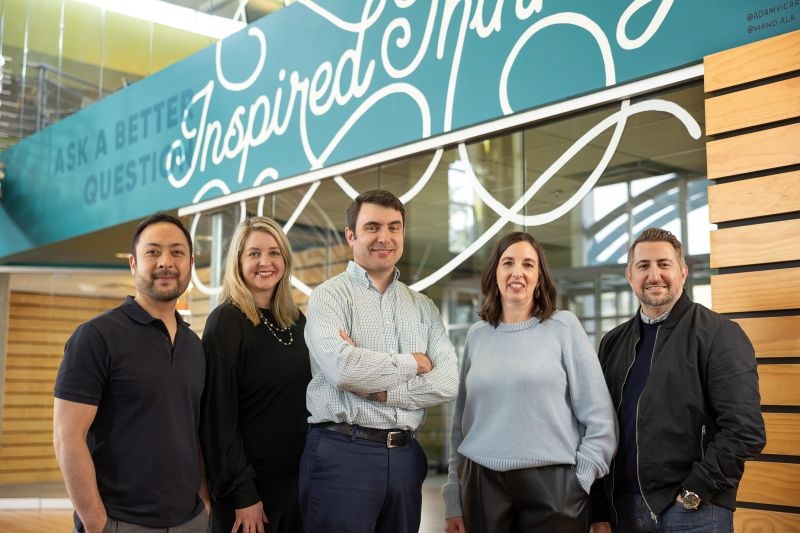
The ownership reversal belongs in that wider picture. Marcus Thomas now describes working in small, senior teams whose members cross disciplines, with a shared profit-and-loss structure. Its own account of buying itself back emphasizes the ability to invest in clients and employees. These are statements of how the agency wants to operate, and the structure gives them something concrete to stand on.
For Chapin, the task ahead is visible in the people being given responsibility. In February 2026, the agency announced Stephanie Burris as chief creative officer, Jill Lewis as chief client officer and Pato Sapir as senior vice president of product innovation. His explanation connected their appointments to helping clients grow and anticipating what comes next.
There is continuity here with the earlier library work. An operating model, like a website, must organize different needs into something usable. The comparison is imperfect, of course; employees are entitled to more opinions than navigation menus. But both jobs require attention to how separate parts meet. A decision about ownership eventually reaches the everyday business of who can decide, who can deliver and who has the resources to do it.
“help our clients grow their business and see around corners”
Scott Chapin, on the agency’s 2026 leadership appointments
Cleveland stays in the picture
Chapin is based in Cleveland, while the agency’s offices extend to Cincinnati, Buenos Aires and Santiago. His public commitments also include a place on the board of Summer on the Cuyahoga, where he is listed with Allegheny College and Marcus Thomas. The organization connects students with paid internships and experiences intended to build lasting ties to Greater Cleveland.
That puts an agency executive in another practical conversation about people and place. A city’s talent pool depends partly on whether newcomers have a reason to stay and a way to begin. Internships, professional networks and shared experiences make that question tangible. Chapin’s board membership places him among the people supporting that work.
There is room for a less solemn kind of connection at the agency, too. Its holiday karaoke project invited clients to change performances in real time. Chapin shared posts promoting the December 2025 event. It is a good advertising joke: take the experience of receiving client feedback, give it a microphone, and allow everyone to recognize themselves.
The thread through his career is the relationship between an idea and the arrangement that lets it work. A library needs a usable path to its collection. A newsletter needs subjects its readers want. A creative business needs an operating model its people can live with. Chapin has moved steadily closer to the decisions that govern those arrangements. Now the agency has bought back control, and the work of making that choice useful belongs to its leaders.
Keep following the questions
Explore Chapin’s professional profile, the agency’s work and the public record of his career.
- Scott Chapin on LinkedIn ↗
- Scott Chapin on Twitter / X (conference-listed account) ↗
- Marcus Thomas: work and leadership ↗
- The 2026 succession conversation ↗
- The DigiKnow acquisition ↗
- The Dirt campaign entry ↗
- Chapin’s data visualization presentation ↗
- The 2026 leadership appointments ↗
- Summer on the Cuyahoga ↗
- The 2010 library project ↗