The marshmallow is an unlikely ambassador for artificial intelligence. In Melissa Higgason’s chemistry classroom at Hobart High School, it helped make gas laws tangible. A teaching assistant called Khanmigo had suggested experiments with everyday objects. The students still had to do the experiment. Higgason still had to teach. That modest division of labor is a useful place to begin the story of School City of Hobart.
- A local public district became a classroom testing partner for Khanmigo.
- Its rollout paired student access with continuing teacher development.
- Early college and preschool programs reveal the same appetite for practical partnerships.
A familiar partner, an unfamiliar tool
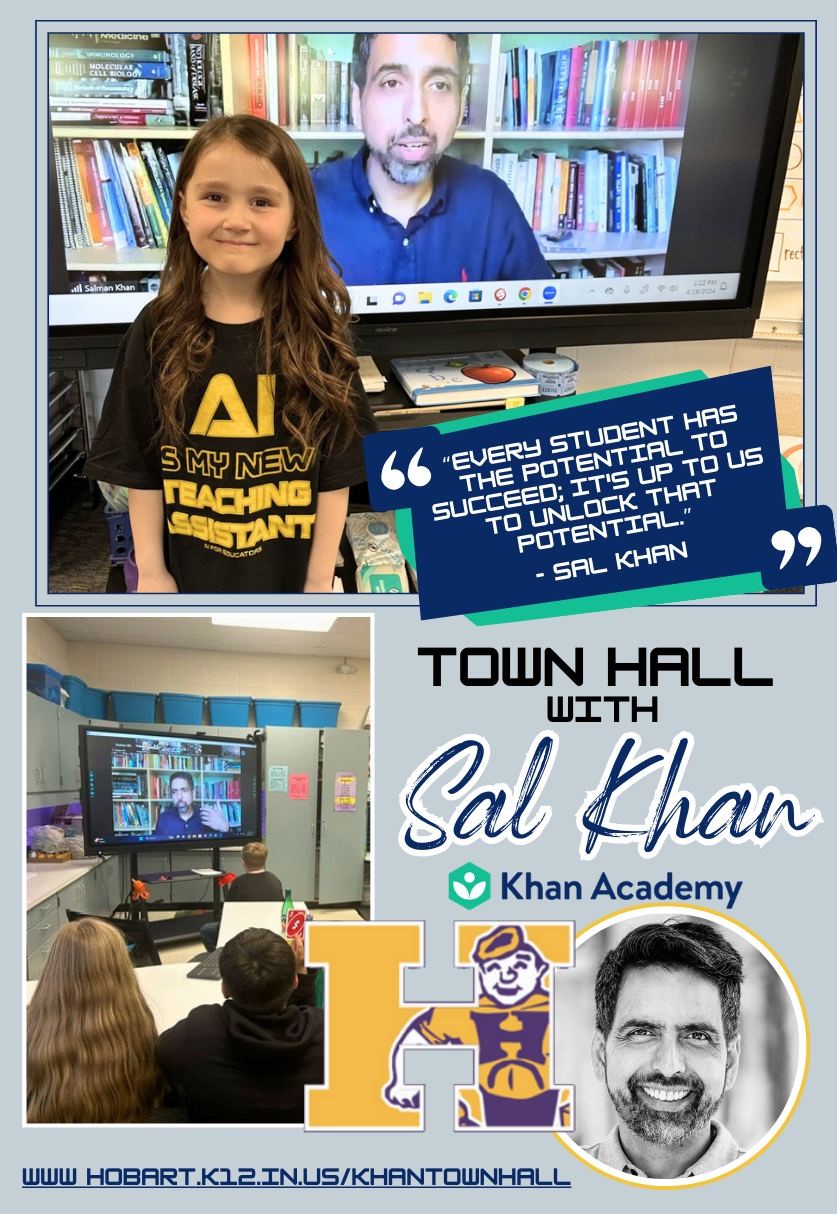
Hobart, Indiana, already knew Khan Academy. The district joined its partner program in 2017. When Sal Khan invited district leaders to preview Khanmigo in 2023, the conversation rested on an existing relationship. A spring pilot followed, despite the awkward timing of introducing something new in the last quarter of school. By the 2023–2024 school year, implementation extended to teachers and students in grades 3–12.
The district’s own retrospective describes a working arrangement with weekly administrative meetings and feedback from classrooms. Researchers and developers came to observe. Teachers received further training as the software changed. This is the part of a technology rollout that rarely makes an exciting photograph: meetings, revisions, another round of professional development. It is also the part another district could actually copy.
district partner
then grades 3–12
joins the work
The first obstacle had a timetable
The initial friction Hobart describes was human: asking teachers to try another tool near the end of the school year. The eventual attraction was equally concrete. Teachers found help with differentiation and lesson preparation; students responded to individual support. The district reports stronger engagement and time on task. Those observations explain enthusiasm. They should be read as implementation experience, rather than a controlled measurement of learning gains.
Stephanie Franco’s experience makes the change of mind easier to understand. The English-learning specialist initially worried about cheating. In Microsoft’s account of Hobart classrooms, adapting assignments for students learning English became a practical reason to use Khanmigo. A useful draft could reduce preparation work. An educator still had to decide whether the result matched the learner. Adoption began to make sense at the level of a task.
A public school with a long to-do list
There is a danger in making the chatbot the main character. Hobart’s actual job is comprehensive public education. Federal school data records 3,978 students in 2024–2025, with six schools and a preschool-through-grade-12 span. The district serves local families through classroom teaching, counseling, special education arrangements, health services, transportation and extracurricular activities. Its market is a community with children to educate, year after year.
Its mission emphasizes curiosity, literacy, critical thinking and responsible citizenship. The current school directory stretches from the Early Learning Center at George Earle through elementary schools, middle school and high school. For a parent, the useful first step is wonderfully ordinary: examine programs, check eligibility and register. The AI work sits inside that larger public obligation.
The funding follows that obligation. State support, local taxes and federal sources sustain the district. Families considering alternatives may look at other eligible public schools, private education or home education. Hobart’s particular proposition combines a local school system with early college routes, early childhood provision and classroom technology supported by its own educators.
College starts down the corridor
Hobart University sounds like somewhere a graduating senior might go next. It is actually a way to begin college while still at Hobart High School. Established in 2018, the early college program works with Ivy Tech Community College. Eligible students can earn free college credit, with pathways toward the Indiana College Core or an associate degree. Credentialed high school faculty teach dual-credit courses in familiar classrooms.
At the other end of the age range, Brickie Kidz Preschool has its own appealing arrangement. Licensed professionals lead classes, supported by high school students pursuing early childhood fields and earning college credit. Preschoolers receive instruction; aspiring educators gain supervised experience. The district connects two educational needs in one room. That is a distinctive service a software subscription cannot supply.
The invoice is only the beginning
For cost context, Khan Academy currently lists its small-district Enterprise Starter plan at $10 per student annually, for up to 1,000 licenses. Larger implementations require a quote. That published price is a comparison point, not a Hobart expenditure. The district’s September 2025 taxpayer notice proposed a total 2026 budget of about $56.8 million, including roughly $31.5 million for education and $9.1 million for operations.
The practical budget question extends to staff time. Hobart’s published instructional rounds include eight educator demonstrations covering discussion, history, rubrics and interventions. Someone must learn each use, evaluate the output and help colleagues apply it. For a district planning a similar project, the transferable investment is a recurring training routine with people responsible for making it useful.
“Think It. Show It. Own It.”
School City of Hobart’s expectation for student AI use.
The student must still explain it
Hobart’s current AI page describes a six-module student Canvas course, estimated at 195–250 minutes. It covers four Brickie AI Levels, permitted prompting, privacy and evidence of thinking. Level 0 work requires students to demonstrate learning independently. The test of success reaches beyond a polished answer: can the student explain the choices that produced it?
For school leaders, the demonstrations offer a sensible way to evaluate the idea before adopting it: choose a specific task, watch a teacher use the tool, then decide what evidence would justify extending access. That makes the conversation about instruction concrete enough for a staff meeting.
That condition matters. An online tutor depends on connectivity; a school still needs alternatives when access is uneven. Hobart’s device guidance explicitly recognizes offline schoolwork. AI-generated material also requires human scrutiny, and permissions must be clear on each assignment. A district unable to provide those supports should expect a harder rollout. Hobart’s experience suggests a useful starting question: which classroom problem is worth the work of solving?