The most interesting thing about Alpha School happens after the laptop closes. On its workshop menu, fourth- and fifth-graders can launch a food truck or run an Airbnb. Younger children tackle a Rubik’s Cube. The proposition is wonderfully concrete: finish the academic work, then do something with the day. A school has turned the afternoon into its sales pitch.
- The offer: personalized academics inside a full school day.
- The trade: software handles lessons; adults coach and run workshops.
- The question: do the results travel beyond the children already thriving?
The waiting problem
Consider the child who understands a lesson before the class finishes. The bell is still twenty minutes away. Or the child who needs another explanation when everyone else has moved on. Both are following somebody else’s clock. Alpha’s appeal begins with that familiar mismatch, rather than with a computer that can talk.
MacKenzie Price and Brian Holtz started the school in Austin in 2014. Price has described her daughter’s boredom in conventional schooling as a reason to build an alternative. Software entrepreneur Joe Liemandt became its principal and major backer. The school’s history predates the current chatbot boom, a useful detail when an institution is so frequently introduced as an AI school.
The premise is individual pacing. A student works on material at the appropriate level, practices, demonstrates understanding and proceeds. Another student can take longer. In principle, the unit of progress becomes the concept understood. That is a recognizable educational idea. Alpha’s unusual move is to build the staffing, schedule and customer promise around it.
A timetable you can buy
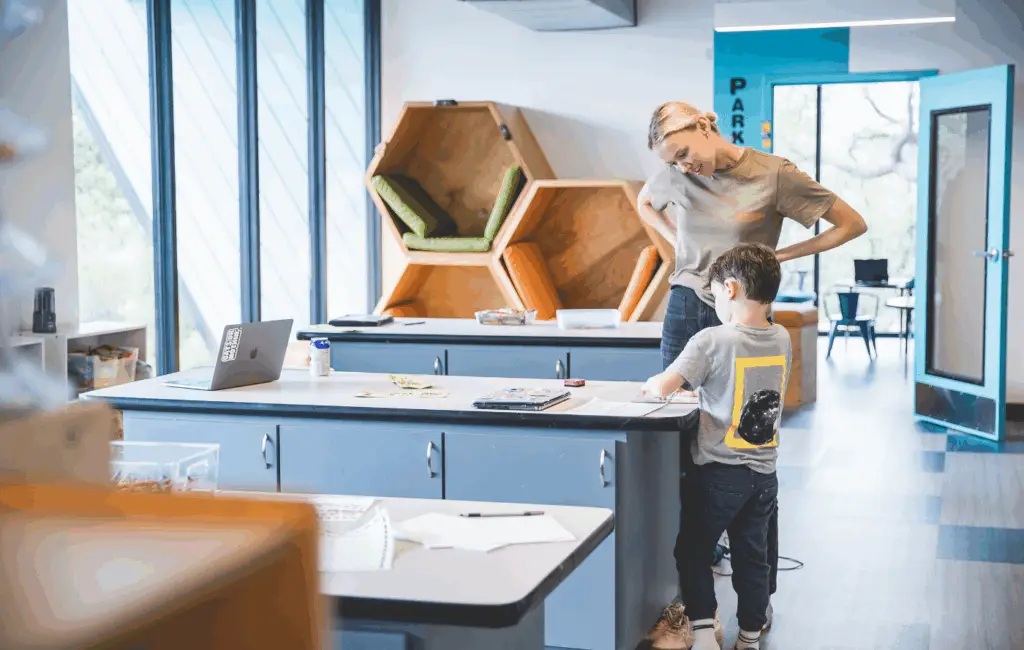
Alpha’s model assigns roughly two hours to core academics using adaptive learning software. Students still attend a full day. Human adults, called guides, work on motivation and emotional support and lead practical activities. The company’s expertise lies in assembling those pieces into a school experience: the learning tools, the feedback and the reason a child might want to keep going.
core academics
A schematic of the model. Schedules vary by campus.
That makes Alpha a substantial alternative to conventional private education and Montessori or microschool programs. Families are choosing a daily environment, rather than simply buying tutoring software. Its likely appeal is strongest for parents frustrated by fixed academic pacing who also want organized time for entrepreneurship, public speaking and collaboration. A child’s enthusiasm for independent work matters as much as a parent’s enthusiasm for technology.
The published prices show how differently that proposition is packaged. Austin lists $40,000 annually; Brownsville lists $10,000. New York lists a $65,000 program fee and describes itself as a homeschool support center. Those distinctions matter. A national brand can contain different prices, grades and legal arrangements.
There is another number behind the operation. An August 2025 Colossus profile reported that Liemandt had directed $1 billion from Trilogy/ESW into developing and incubating AI software at Alpha. That describes backing for the broader technology effort. It does not tell us whether an individual campus makes money. Tuition is the visible customer transaction; software development is a much larger wager.
The transcript changes the plan
One revealing change had little to do with algorithms. According to Cognia’s account, Alpha High initially had no plan to pursue accreditation. Head of school Chris Locke saw a practical problem: students moving into public schools could encounter difficulties with an unaccredited transcript. He persuaded leaders to reconsider.
“It hurt students to have an unaccredited transcript.”Chris Locke, Alpha High, speaking to Cognia
Alpha High earned accreditation in June 2023; system accreditation followed in March 2025. This is an instructive concession to the world outside the campus. However distinctive a school’s internal logic, its students eventually need other institutions to recognize their work. The transcript had supplied feedback the learning software could not.

A score is not an explanation
Alpha promotes rapid academic progress and high national rankings. Such claims deserve a precise question: compared with whom? Strong results among enrolled students do not establish what caused those results. Family resources, prior attainment, selection and departures can all complicate the inference. Accreditation addresses institutional standards; it cannot settle that causal question.
There is counterevidence worth considering. In September 2026, the Texas Tribune and ProPublica reported that state results at Texas Preparatory School, a charter that had partnered with Alpha, did not support the dramatic improvement presented by Alpha leaders. That campus was already struggling before the partnership. The reporting challenges easy generalization; it does not isolate a single cause of failure.
WIRED also reported Brownsville families leaving over academic difficulties and student distress. Alpha disputed its reporting and denied mistreating students. For prospective parents, the practical issue is intervention: when a child stalls, who changes the explanation, the workload or the plan? A schedule built around independent software practice may fit poorly when a student needs sustained direct instruction or individualized support the campus cannot deliver.
The culture makes that question sharper. Alpha links effort to rewards, including its own currency, “Alphas.” An incentive can help a child begin an unappealing task. It can also make finishing the task feel more important than understanding it. Families should ask to see what happens after a wrong answer, rather than only watching a polished account of a successful project. The revealing demonstration is the ordinary difficult morning: a concept that will not stick, a student losing confidence, an adult deciding what to try next.
Borrow the small idea
A parent or educator can try something modest: identify one skill, check what the child understands, adjust the next task and protect time for a project the child chooses. Watch for frustration as carefully as completion. Alpha’s transferable idea is that time deserves deliberate design. The expensive part is entrusting a whole school day to the proposition.