In 1977, the problem was a first-grader named John who cried over his handwriting. His mother, Jan Olsen, was an occupational therapist. She brought her professional training to the problem. When John improved, his teacher asked Olsen to help other children in the class. A household difficulty had become a classroom proposition.
That origin explains something about Learning Without Tears. Its signature objects are almost comically modest: little chalk bits, sponge cubes, wooden curves. They invite an adult to reconsider what a child is being asked to do. Before there is an elegant sentence, there is a hand trying to remember where a line begins. The company has spent decades making that beginning easier to teach.
- Hands-on literacy, from readiness to sentences.
- Books, classroom tools, software and teacher training.
- Clear instruction. Protected practice time.
The alphabet, taken apart
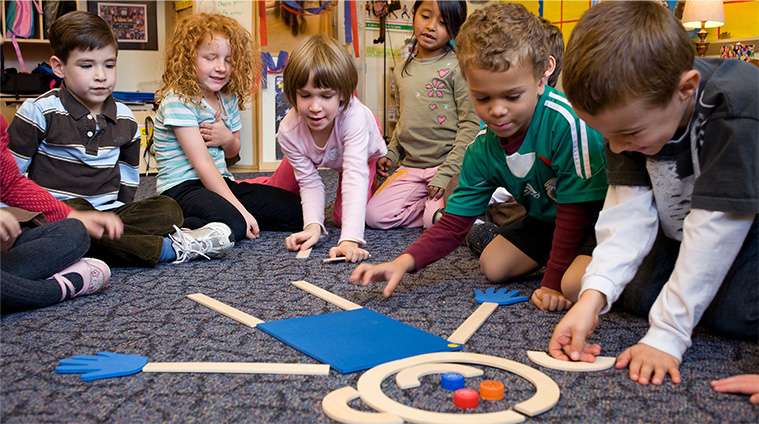
Consider its Wood Pieces. Capital letters can be assembled from four kinds of parts: big lines, little lines, big curves and little curves. A child can build a letter before managing it with a pencil. The same materials help construct Mat Man, a classroom character used to practice body awareness, drawing and sequencing. The alphabet becomes something you can arrange on a carpet.
Wet-Dry-Try applies the same thinking to a chalkboard. The adult demonstrates a letter. The child follows its path with a damp sponge, dries the path with a crumpled paper towel, then writes it with chalk. Repetition gets three different jobs. The small tools also encourage a workable grip. The instructions recommend individual teaching or groups of five or fewer; for a whole class, teachers should prepare the model letters first.
The useful thing to copy is the sequence: demonstrate a manageable action, give guided practice, then ask for independent performance. Buying a workbook alone misses much of the instructional design. This is a curriculum whose equipment makes more sense when somebody shows you what to do with it.
Follow the model
with a sponge.
Retrace the path
with paper towel.
Make the letter
with chalk.
A business built around the teacher
Learning Without Tears sells student books, classroom materials, digital access and professional learning. Schools and districts buy its programs; teachers, occupational therapists and families use them. Its family buying guide explicitly organizes purchases around a child’s developmental stage. The company’s March 2026 announcement says its supplemental programs support more than four million children annually, with educators worldwide using its resources.
The physical entry point can be small. The official store lists an Individual Student Manipulative Pack at $27.95: wood pieces, mat, slate, sponge cubes, chalk and pencils. Twenty packs would cost $559 before shipping and tax. That is equipment arithmetic, not a complete classroom curriculum quote. Teacher guides, student editions, training and any digital licenses need their own budget.
There is an operational lesson behind the classroom business, too. An RSM case study describes a NetSuite implementation begun in 2018. After accounting staff turnover, the company lost system knowledge. When a new finance leader arrived in August 2020, he found insufficient internal capacity to manage the system efficiently. Outside support helped close the gap. Even a business devoted to careful instruction can encounter the cost of knowledge that has not been passed along.
It competes for instructional time as well as purchasing dollars. Zaner-Bloser also offers systematic print and digital handwriting instruction, including multisensory teaching. Hands-on learning alone therefore does not distinguish the company. Learning Without Tears combines its occupational-therapy origins, particular letter-building routines, simple vertical cursive and connected readiness materials. Its expertise lies in translating difficult physical tasks into directions a young child can follow.
The telling number is 54%
The company’s evidence deserves a closer look than an award badge. In a July 2022 evaluation, Johns Hopkins researchers analyzed 804 kindergarten-through-second-grade students across ten schools in two Ohio districts. Learning Without Tears contracted for the study. It used a quasi-experimental comparison rather than random assignment, and measured handwriting with the company’s Screener of Handwriting Proficiency.
Students using the integrated print and digital program made slightly more than three points greater winter-to-spring gains than comparison students, after statistical adjustments. The reported overall effect size was +0.19. Grade-one students and students with individualized education programs showed significant subgroup effects; the other grade-level comparisons did not. Those are handwriting findings in a particular implementation, not a promise about every literacy outcome.
The revealing wrinkle came from the teachers. Among 22 survey respondents, 95% said the program enhanced their ability to teach handwriting. Yet only 54% agreed the professional development prepared them to teach it effectively. Teachers wanted more training and more dedicated classroom time. The practical constraint is plain: materials need an adult who understands the routine and a timetable that allows it. The company now offers onsite, virtual and blended professional learning. The study makes that service look consequential.
“Teachers most recommended more professional development”Johns Hopkins evaluation / July 2022
From a letter to a sentence
The business eventually outgrew its original name. In 2018, Handwriting Without Tears became Learning Without Tears, bringing handwriting, Get Set for School and Keyboarding Without Tears under one identity. Keyboarding serves K-5 students with typing and digital-literacy instruction. There is room in the same company for a chalkboard and a keyboard because each requires skills children must be taught.
Its move into reading added a different kind of tool. In June 2022, Learning Without Tears announced Phonics, Reading, and Me, a supplemental K-3 program, alongside a SoapBox Labs partnership. Children’s speech-recognition technology supported digital reading assessments. The stated problem was familiar: listening to each child read takes teacher time. The product combines print texts and teacher-led instruction with digital practice and assessment.
The 2026 additions return to the question of missing steps. Building Writers: Cornerstones, announced March 10, teaches sentence construction and grammar in context through 10-15-minute lessons for K-3. Its model moves from demonstration to guided practice to independent writing. Its ESSA Level IV rationale is a different evidence claim from the Tier 2 designation the company reports for Handwriting Without Tears; the ratings should not be treated as interchangeable.
Letters & Literacy, announced April 22 for June availability, connects letter sounds, formations, emergent writing and motor development in Pre-K and transitional kindergarten. Its teacher guide spans 36 weeks. Both additions extend an old commercial insight: the step adults assume a child already knows may be precisely the step that needs teaching. For a school considering the programs, the sensible starting question is specific: which step are our students missing, and can we make time to teach it?