A scrapbook is a lovely object with an inconvenient relationship to time. By the time it reaches you, the child in its photographs may already have moved on to another fascination. In 2009, Nathan Li was told he would receive one every couple of months from his daughter’s childcare. Nancy was living those days now. Her father wanted to know about them now, too.
Li and his wife felt disconnected from her preschool life. He wondered why learning stories could not be online. The question became Educa, a platform that began with parent engagement and grew into a wider set of tools for early childhood education. There is a pleasing lack of ceremony about the beginning. A father had encountered a waiting period that made little sense to him. He had the technical background to ask whether it was necessary.
“I started Educa because of love”Nathan Li, March 2015
His explanation of that love was practical. Parents did not know enough about what happened at preschool; teachers did not know enough about what happened at home. Information was missing on both sides. Li worked with the early childhood community, taking recommendations from teachers, parents and academics. The resulting software had to make room for people who knew different parts of the same child’s life.
The distance before the software
Family connection had a history for Li. Born in Harbin, in northeast China, he moved to the countryside to live with his grandparents when he was five. He later left China for New Zealand in 2001 and graduated with a computer science degree in Wellington in 2003. Work in IT followed. So did a family of his own.
At a Wellington talk in August 2014, he connected those experiences of extended family and separation with his decision to start a business. His account also contained a useful admission: he had discovered that he could not do everything himself. Growth required help and specialist skills. The person building a communication company had to become comfortable asking other people to contribute. It is an agreeable complication in a story that begins with one person having an idea.
Before writing the answer in software, Li talked to early childhood teachers and parents facing the same difficulty. What had felt like a private frustration turned out to be shared. That distinction matters. A family can tolerate an awkward arrangement for years because it seems to be how things are done. Discovering that other families also find it awkward gives a programmer something more useful than irritation: a problem with several witnesses.
Teachers had to help write the answer
Educa’s 2013 Emerging Gold finalist entry described a programme developed in consultation with preschool teachers and parents. Stories, photographs and videos could reach families without the chase for a physical profile book. Parents could respond when new material appeared. The appeal was partly administrative: less printing, easier sharing, fewer delays. Anyone who has tried to locate the correct paper object at the correct moment can appreciate the ambition.
Yet the interesting change was in the conversation. A book taken home periodically invites a response on the book’s schedule. An online story opens the possibility of a response while the activity is still fresh. A parent’s observation can return to the teacher, rather than remaining a thought on the journey home. The software provides a place for that exchange; the adults still have to make it worthwhile.
The structure of a Learning Story helps explain what Li’s platform was carrying. Educa’s teacher guide separates the event or activity from reflection on the learning, then connects that reflection to frameworks, values and plans. A picture has a place, but so does the educator’s interpretation. The format asks what the experience might mean and how teaching might respond. It gives families more to discuss than whether a photograph is charming, though preschool photographs have a considerable advantage on that score.
A simplified reading of Educa’s story, learning analysis and framework links.
The same guide distinguishes individual stories from group stories. An individual story is visible to that child’s family. A group story can be added to several children’s profiles while keeping family comments private to each family. These are small design decisions with a human purpose. A classroom is shared; every family’s conversation does not need to be. Communication software has to understand the difference between including people and putting everyone in the same room.
Li also appeared as an Educa trainer in a 2014 professional development programme. The sessions were for kindergarten teams preparing to implement e-portfolios. That is a useful glimpse of the work beyond building a product: helping teachers bring it into their own practice. A new tool has to find a place among the tasks people already do. A training session is where the tidy idea meets the working day.
The language of belonging
By July 2014, Educa had added te reo Māori to software previously available in English and Mandarin. Li said he had wanted a Māori version since the software’s April 2011 launch, having learned as a parent about the language’s place in New Zealand’s education curriculum. To carry out the translation, the company worked with Piripi Walker, whose experience included translating Microsoft Office.
Li wanted someone with translation experience and an understanding of education. Walker brought both. The wording was also checked so the translation would flow. A menu can be translated word by word and still feel like a visitor who has memorised a phrasebook. An education platform has a more demanding job: the language needs to work for people carrying on the everyday business of teaching and talking about children.
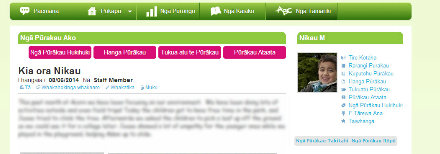
Mana Tamariki, a full-immersion Māori education centre in Palmerston North, gave that work a concrete setting. Li was motivated to translate the tool after hearing about the centre, where children were cared for and taught in te reo Māori. English-only resources presented an obvious limitation. A platform intended to connect home and education needed to fit the language of that connection.
Brenda Soutar, Mana Tamariki’s kaitiaki, described the importance of continuing face-to-face relationships while also engaging with new technology in culturally appropriate ways. That pairing is central to the episode. Uploading a learning story need not end a conversation at the door. It can give the people at the door something more to talk about. The technology has a supporting part, and it is better suited to the role than to playing the entire cast.
A family question, across borders
Educa’s early company profile described a private social learning environment: teachers could capture, organise and digitise learning, then share it securely with parents and wider family. Its team included developer and customer support specialist Alexander James Ogier and Mandarin specialist and developer Lei Liang. Those job descriptions make the work tangible. Someone had to build the system, help people use it and make it accessible in another language.
By August 2014, Educa was reported at more than 400 sites across New Zealand, Australia, Malaysia and China. Two years later, it was second runner-up in the New Zealand Innovation Awards People’s Choice category. The 2016 account described a company incubated at Creative HQ, with more than 100,000 users in 19 countries. These are snapshots of its early expansion, each attached to its own date and unit.
International reach makes a fitting development for an idea concerned with distance. The early platform could share school activities, reports, videos and images with relatives overseas. A grandparent did not have to live nearby to follow a child’s learning. Nor did a parent have to be present at every activity to have a way into the conversation afterward. The ambition was to give those relationships more material to work with.
There is a difference between those two measures. A site describes an educational setting using the service; a user describes a person. Neither number tells us how often a family replied to a story. The scale is visible. The quality of each exchange still rests with the people involved.
What comes back from home
Over time, Educa expanded beyond its original family engagement purpose. Its site setup guide describes community messages, child portfolios, reports, policies and resources, and teacher portfolios. There are also forms, messaging and mentoring tools, with access varying by user. The original question about seeing a child’s day had opened onto the less picturesque business of running an educational service.
That expansion brings the story back to its beginning. Li wanted to understand what Nancy was learning, and he wanted her teachers to understand more about life at home. A portfolio could hold the material. A notification could announce its arrival. The meaningful part would happen when someone read, recognised something and replied. Behind the software sits a familiar parental wish: to have a place in the conversation, even during the hours spent elsewhere.