A house can become more valuable while the person who owns it becomes less able to keep it. Schelton Assoumou has built much of his current work around that awkward possibility. There is equity in the building, but the renovation needs cash. There is a neighborhood becoming more desirable, but the homeowner may be contemplating an exit. The property looks promising to an investor. To the owner, it can look like a very expensive problem.
Assoumou, the CEO of Brownstone NYC, approaches this situation with the vocabulary of a former investment banker. He talks about joint ventures, distressed assets and air rights. The human question underneath those terms is easier to understand: who gets to remain part of a place when its value changes? His proposed answer puts the homeowner inside the development arrangement, with an opportunity to participate in what comes next.
That is an ambition with several constituencies. Investors need a return. Owners need a workable agreement. Buildings need repairs. A neighborhood contains people with interests that will not fit neatly into the same spreadsheet. Assoumou’s story takes place among those competing requirements, where a financial structure must eventually become somewhere somebody can live.
A family investment, with consequences
Brownstone’s beginnings, as Assoumou described them in 2020, were decidedly domestic. His mother, Maureen, used her retirement savings to invest in Brooklyn real estate in 2014. He initially helped as an adviser, then became more involved and took on the managing director role. A business that would speak about generational wealth began with one generation committing its own savings.
The initial strategy was to buy distressed and foreclosed homes in lower-income New York neighborhoods and resell them within a year. Assoumou said the approach changed in late 2017 at his mother’s request, after she became concerned about families and veterans spending long periods in shelters. Brownstone began working with nonprofit housing organizations, including Samaritan Village and the Abyssinian Development Corporation.
There is a useful distinction here between the decision to invest and the decision about whom an investment will serve. The first established a property business. The second changed the account Assoumou gave of its purpose. Both decisions belonged to the same family enterprise.
The left-handed player before the banker
Long before he was discussing Brooklyn property, Assoumou was making opponents adjust on a tennis court. In 1995, he was a first-year student at Stony Brook, arriving from London with experience on Ivory Coast’s junior national team. He played left-handed, an inconvenience for opponents accustomed to seeing the game the other way around.
The young player was described as modest, almost shy, and proficient in French, Spanish and English. He had competed internationally, including a bronze-medal performance in Morocco. Those particulars preserve a person who is easy to lose beneath a later string of job titles. He had already moved between countries and languages before he began moving between financial structures.
His parents brought their own geographical range: his mother came from Trinidad, his father from West Africa. Later accounts place his birth in Oakland, California. At Stony Brook he studied economics and business administration. He subsequently worked at J.P. Morgan and completed an MBA at Harvard Business School in 2005. The route into New York property passed through both formal education and years of finance.
The paperwork underneath the paint
Brownstone presents itself as a family-owned investment and renovation company. Assoumou is its chief executive; his father, Martin, is listed as chief operating officer. Around them is a team whose responsibilities include financing, acquisitions, project management, investor relations and property management. The family connection remains visible inside an organization built to manage several stages of a transaction.
The company’s model brings acquisition, finance, renovation, sales and management under one operating structure. In that arrangement, finding a property is the beginning of the assignment. A project then has to survive its financing, its construction and its eventual use. The more stages the business handles, the more places there are for its judgment to be tested.
Brownstone’s problem-solving practice lists title complications, building violations, litigation, tenant matters and architectural issues. The company says properties often carry more than one such obstacle. A new kitchen is a gratifying thing to photograph. An untangled title is rather less obliging, although the kitchen may depend on it.
That list explains why an investment-banking background has relevance here. Assoumou works on buildings whose difficulties may begin in agreements and obligations, before any contractor arrives. Finance does not put up a wall. It helps determine whether the people who can put up that wall will be able to start.
A homeowner inside the deal
Brownstone’s property-retention approach offers renovation partnerships to owners who cannot fund the work themselves. The company supplies a financial and operational role, with the stated aim of increasing equity and helping an owner stay in the neighborhood. Licensed contractors carry out the renovation. The homeowner’s asset becomes the basis of a shared project.
This makes the terms of participation central to the idea. Ownership, immediate spending money and the opportunity to remain are distinct benefits. A partnership is interesting because it tries to connect them. Its value to an owner depends on how the arrangement actually works, rather than on the attraction of the finished property alone.
The owner contributes an existing asset.
Brownstone arranges capital and renovation.
The aim is shared value and community continuity.
In January 2020, Assoumou took these questions to a workshop with the Pulaski Block Association on Nostrand Avenue. Its subjects were practical: foreclosure, refinancing, home improvement, violations, investor sales and joint ventures. He was bringing the language of a transaction into a setting where people could ask what it meant for their own homes.
The workshop also addressed an information gap. A homeowner may know that a property has appreciated without knowing the available ways to act on that value. Assoumou advocated considering a joint venture. That position puts financial knowledge near the center of his community work: understanding an option comes before deciding whether to use it.
Two Brooklyn addresses, two different puzzles
At 32 Pulaski Street in Bedford-Stuyvesant, Brownstone describes a property entangled in inheritance issues, a reverse mortgage and nearly seven years of foreclosure. The company says it acquired the four-story townhouse through a joint venture in 2020, offering the existing owner the opportunity to stay. Its account of the work includes a gut renovation and basement underpinning.
The details matter because the project had two kinds of repair to attempt. One involved a building. The other involved the circumstances around its ownership. Brownstone’s description connects them through the partnership, rather than treating the existing owner simply as the person who would hand over the keys.
At 1407 Pacific Street in Crown Heights, the company describes a different structure: a seller-financed acquisition in 2021 involving an owner facing foreclosure. Brownstone says it paid off the mortgage and supplied money upfront. Its renovation account includes replacing beams and addressing structural problems before creating a three-family layout.
Neither case can be understood entirely through the attractive room at the end. Brownstone’s published account of 285 Decatur Street makes the point physically: new kitchens and a clawfoot tub accompanied work on beams, plumbing, electrical systems and a deck. The pleasing details sit on top of less decorative decisions.
The record that belongs in the story
Assoumou’s professional history also includes a federal criminal case. In January 2013, he was arrested on bank-fraud and wire-fraud charges concerning an alleged mortgage-fraud scheme tied to earlier real estate activity. Those were allegations at the time of the announcement. On May 16, 2018, he received a sentence of two years of supervised release and a $5,000 fine.
That history belongs alongside his later work and stated goals. His current arguments about homeowner partnerships concern arrangements in which people commit valuable assets and rely on another party’s execution. Accountability is part of that subject. A profile of his development ambitions needs room for the documented record as well as the intentions he now describes.
Back in the room, learning to pitch
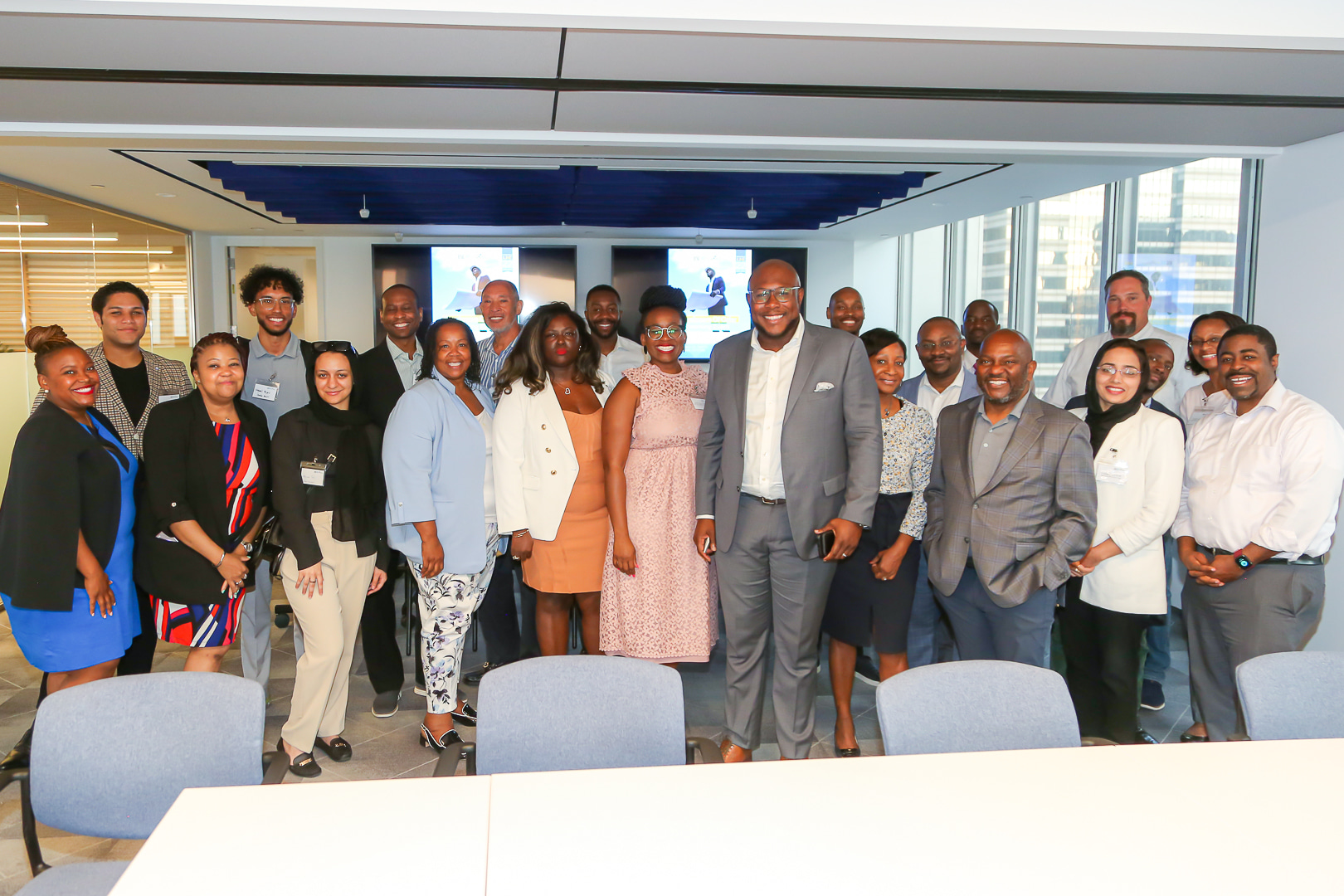
In 2022, Assoumou completed the second cohort of LISC NYC’s Developers of Color training program. Its concluding pitch brought Brownstone’s model to investors, following four weeks of instruction and project assistance. His presentation described homeowner partnerships and the use of development rights to create additional housing.

It was a setting that joined financing with access: access to relationships, project feedback and opportunities for minority developers. Assoumou had spent years in finance, yet here he was participating in another training room. Experience and a need for new connections can coexist quite comfortably.
He has also advocated modular construction, in which components are made away from the site and assembled there. In 2025, he acknowledged New York’s zoning, transportation and adoption challenges. That concession matters. A promising method still needs a route through the city in which he wants to use it.
Somebody to open the door
When Assoumou discusses careers, he makes a distinction between receiving advice and having someone create an opportunity. He credits mentors and sponsors with helping him on Wall Street. His advice to younger professionals is to seek both, and to help someone else once they have made progress.
“My advice would be to get a mentor or sponsor.”
Schelton Assoumou, 2025
The connection to his property work is plain enough: a capable person may still need access to something another person can provide. In a career, that might be an introduction. In a homeowner partnership, it might be renovation funding and the ability to execute the project. The arrangements differ, but each asks who gets to participate.
For Assoumou, the recurring question ends at an ordinary front door. A building can improve. Its value can change. The owner’s future still needs a place in the agreement. Staying put sounds like a modest ambition until one considers how much work it can take.
Follow the work
Projects, conversations and the public record.
- Brownstone NYC
- Homeowner partnerships
- 32 Pulaski Street project
- LinkedIn / Schelton Assoumou
- Instagram / @askschelton
- Brownstone NYC / YouTube
- The 2020 business conversation
- The 2025 career interview
- LISC cohort coverage
- The Stony Brook tennis profile
- 2013 federal case announcement
- 2018 sentencing entry / page 123
- Homeownership writing / Medium
- Watch / Homeowner housing issues
- Watch / Brooklyn renovation project
- Watch / Brownstone NYC hip-hop parade