In 1987, Sasan Mokhtari was working on a problem with little patience for fashionable answers: helping power-system operators decide which generating units to run. With Jagjit Singh and Bruce Wollenberg, he coauthored a paper about an expert system that could combine specialist knowledge with a computer’s rules. The operator answered questions. The program asked another question or reached a conclusion. Nearly four decades before today’s arguments over AI assistants, there was already a person at a console who could use some assistance.
The title, Unit Commitment Expert System, was unlikely to trouble the bestseller lists. Yet it makes a useful opening to Mokhtari’s story. Long before he founded a software company, he was occupied with the awkward meeting between a mathematical model and an operating decision. Electricity requires both to behave. A persuasive presentation cannot arrange tomorrow’s generation schedule.
Today he is the founder, president and CEO of Open Access Technology International, better known as OATI. His business began in 1995, serving an energy industry moving through deregulation. Its work has since expanded into distributed energy management and AI. Through those changes, the operator’s question remains recognizable: given what is happening now, what should I do next?
An engineer before the company
Mokhtari holds a doctorate in electrical engineering, focused on power systems, from the University of Missouri-Columbia. Before OATI, he held several positions in Siemens’ Power System Control Division, including manager of research and development for advanced applications. Those details place him inside the technical work of operating electricity systems before they place him in charge of a business.
His early research was collaborative. The 1987 conference paper brought together Mokhtari, Singh and Wollenberg; a journal article followed in February 1988 in IEEE Transactions on Power Systems. The expert system drew on the knowledge of an experienced operator and a programming expert. Its usefulness depended on translating experience into rules a computer could apply.
There is a revealing modesty to that task. Expertise was already present in the control room. The challenge was to make it available in another form, to help someone adjust inputs and improve a scheduling result. Read alongside his current interest in operator assistance, the work suggests a long-running preoccupation with how practical knowledge travels.
The unusual thing to ask a utility
Founding OATI brought a different problem: getting utilities to accept a new way of buying software. The company offered an application service provider model, using the internet to deliver services. In an industry responsible for continuous operations, asking customers to put consequential work on somebody else’s computers required more than enthusiasm for the internet.
That early business model became part of OATI’s identity as a software-as-a-service provider. The company describes itself today as privately owned and organized around power-system engineering. Its founding opportunity came from a changing market; its continuing challenge was to make software useful within the obligations utilities already carried.
Mokhtari’s recollections of the early cloud proposition underline the difficulty. Utilities were being asked to reconsider where important energy-trading and financial systems lived. A new delivery method could offer advantages, but the person buying it still had to answer for the result. An elegant technical argument leaves that responsibility quite intact.
He has described customer relationships as something earned over time. That view fits a business whose products sit inside continuing operations. A software demonstration has an ending. A customer relationship resumes the following morning, when the system must work again and somebody has another question.
A fellowship, shared with the team
In January 2019, OATI announced that Mokhtari had been named an IEEE Fellow for leadership in energy industry technology solutions. The recognition connected the executive’s work to the technical profession in which he had built his career. It also supplied a milestone that belonged to a much longer stretch of engineering and company building.
His response gave the credit to the OATI team and the years they had spent working together. That is a sensible acknowledgment in power software, where the finished service rests on many kinds of expertise. A founder can set direction; reliable delivery requires people who understand the details well enough to find the exceptions.
The fellowship sits between two phases of his career: the early effort to bring internet-delivered software into energy, and the growing challenge of coordinating a grid with many more participating resources. Across that span, the engineering became attached to an expanding set of business responsibilities.
When the road acquires another direction
The electricity network Mokhtari now describes is increasingly bidirectional. Large generators still matter, but solar panels, batteries and other distributed resources can change what happens nearer the customer. Operators must account for assets that behave differently and for conditions that change while a plan is being carried out.
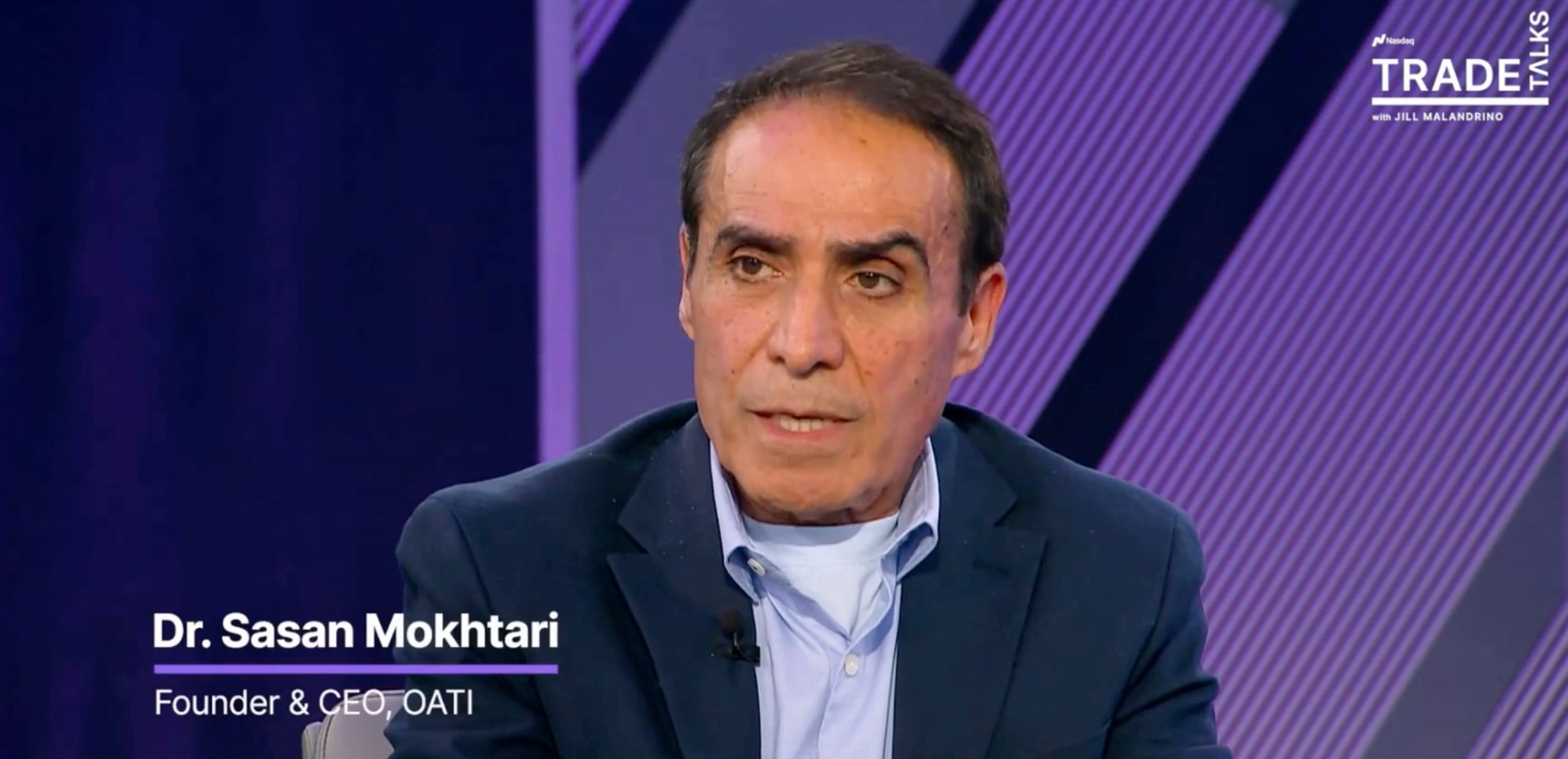
During a March 2026 Nasdaq TradeTalks discussion with host Jill Malandrino and fellow panelists from PA Consulting, Edelman Smithfield and ABB US, he emphasized those operational challenges. Forecasting, uncertainty and the potential to get more from existing infrastructure were central to his remarks. He also pushed back against the idea that utilities lack interest in innovation.
One concrete expression of that work is OATI’s relationship with North Carolina Electric Membership Corporation. In February 2026, the organizations announced an enhancement of an existing distributed energy resource management system, or DERMS, to add real-time orchestration and control. The resources involved include solar, battery storage, demand response and islandable microgrids.
The distinction matters: a forecast describes what may happen; real-time control helps an operator respond to what is happening. The announcement described the project as an enhancement being implemented. Its interest lies in the practical direction of travel: connecting resources already scattered across a system so their usefulness can be coordinated.
AI, with somebody at the controls
A 1997 paper he coauthored with Jeffrey Bann, Guillermo Irisarri, Daniel Kirschen and Bradley Miller tackled another part of the problem: integrating AI applications into an energy management system. The team described a shared environment that handled interfaces and maintained a common power-system model. That arrangement allowed applications to plug into the larger system. The subject sounds less glamorous than an intelligent machine, but it addresses a stubborn question in software: how does a useful new application fit the equipment and programs already doing the work? Mokhtari’s publication record shows him returning to that practical territory well after the first expert-system experiments.
For Mokhtari, AI arrives with a substantial backstory. His current conversations about generative and agentic systems follow decades of work on computer assistance for power operations. The resemblance to the early expert-system research is in the purpose: making specialist knowledge useful when an operator has a decision to make.
His development philosophy moves through research, collaboration with customers and practical application. In discussing it in 2026, he put a limit on technological enthusiasm: “We don’t apply technology for the sake of technology.” Customers help define how a proposed tool fits the business process. The tool must survive contact with the actual job.
“We don’t apply technology for the sake of technology.”Sasan Mokhtari · 2026 interview
His public comments after an EPRI seminar made the human emphasis explicit. He described OATI’s focus as empowering operators and discussed advisory tools, workflow agents and situational awareness. The ambition includes increasingly autonomous capabilities, but his stated starting point is helping people make better decisions with the information available to them.
That makes operator feedback consequential. A feature may look convincing in isolation and still introduce friction into an established workflow. Mokhtari has argued for specific uses and measurable results. For someone whose published research began with questions an operator could answer, the preference has a certain consistency.
Explaining the work behind the switch
In August 2025, Mokhtari joined John Engel for the inaugural episode of OATI’s Critical Path interview series. Their conversation covered the company’s development and his childhood interest in electrical engineering. After years spent building for industry customers, he was participating in a more deliberate account of how that work came about.
He has also described the difficulty of applying a turnkey approach to energy. In a public post marking OATI’s thirtieth year, he emphasized working alongside customers to develop tools. It is an account of company building in which the customer keeps supplying complications. For an engineer, that may be part of the attraction.
By October 2026, his public argument had widened to electricity customers themselves. He was discussing why people need a better understanding of the work required to balance the grid, and why utilities should explain modernization before asking customers to support it. Public awareness, in his telling, affects the room available for practical decisions.
He also made an essential qualification about electricity costs: “affordability is not a perception problem.” Explaining the system cannot substitute for addressing the bill. It can help customers understand what they are paying for and ask whether a different approach might accomplish the same job at a lower cost.
There is a satisfying connection between that argument and the 1987 paper. Both concern making complicated knowledge usable by another person. The audience has expanded from the operator answering a program’s questions to the customer wondering about the electricity system outside the house. Mokhtari’s work still turns on the gap between having information and knowing what to do with it.
He once described the work with a remarkably unceremonious phrase: “This is my hobby.” It is an unusual hobby to place between generating units, software customers and a changing electricity network. The attraction appears to have lasted. The switch on the wall remains a small object with an extensive supporting cast.