Sarah McAuley began her job at Paperless Parts with a confession already waiting to be made: she had almost passed. The phrase “quoting software for the manufacturing industry” had landed with all the sparkle of an expense report. After two decades marketing technology, she knew that some categories arrive dressed for a keynote and others arrive carrying a clipboard. This one, at first glance, was carrying the clipboard.
Then a few signals complicated her first impression. Jim Baum, a longtime friend and mentor, had joined the board. OpenView had invested $30 million. Most of all, founder Jason Ray spoke about custom manufacturing as if the country's future depended upon the people running job shops, because in practical ways it did. McAuley had once turned down a different role despite feeling rare chemistry with its CEO, and the regret stayed with her. When the same feeling surfaced with Ray and the Paperless Parts team, she decided not to repeat herself.
A month into the role, the clipboard had become the point. Here was a large, consequential industry full of brilliant operators whose daily work was often described with all the romance of a purchase order. The marketing challenge was not to sprinkle glamour on quoting software. It was to get close enough to see what the quote made possible.
“Manufacturing is sexy.”Sarah McAuley’s compact case for looking closer
The ordinary part with an extraordinary job
The conversion happened on factory floors. At C&M Precision Tech, McAuley watched president Dan Villemaire identify parts by sight across a facility alive with them. Some announced their sophistication through elaborate geometry. One did not. It looked like a fastener available at any hardware store, until she learned that it was engineered to secure night-vision goggles to military helmets and withstand extreme force.
At Sweeney Metal Fabricators in New Hampshire, she saw chassis built to hold advanced devices. The parts had weight, edges, finish, and a destination. The software suddenly belonged to a chain of human judgment: a buyer sends a request, an estimator reads drawings, a shop prices risk, machines turn raw material into something another person will rely upon. Marketing had walked out of the cloud and could now be held in a hand.
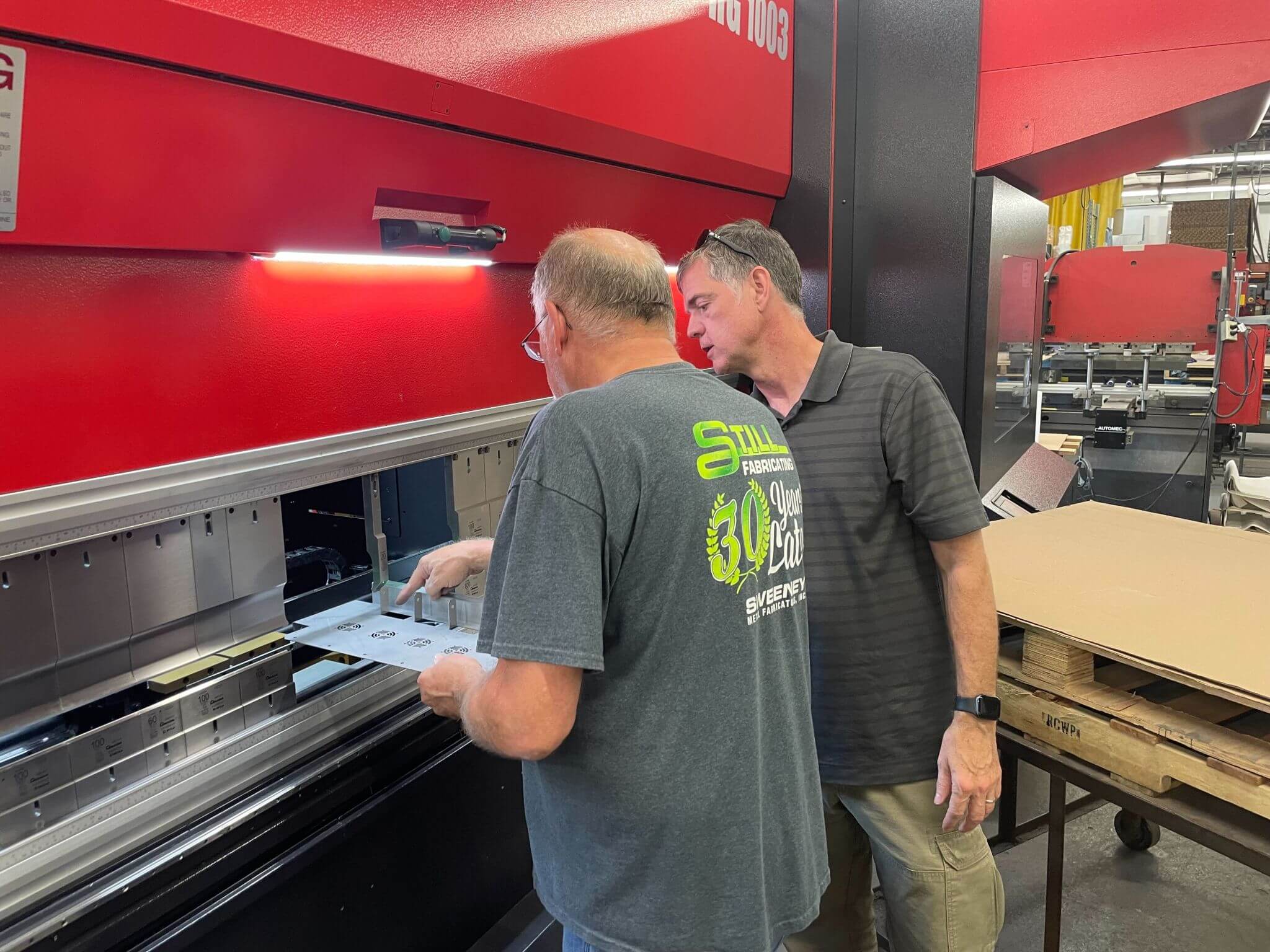
The experience altered her field of vision. Ordinary objects became assemblies of decisions. Someone chose the material, read the tolerances, calculated the setup, checked the lead time, and decided what failure might cost. McAuley found herself moving through the world with a new refrain: “One of my customers probably made that.”
Before the machines, there was the grid
McAuley's route to manufacturing ran through systems that were no less consequential, only less visible. She began at a public relations agency, moved into telecom, and then spent eleven years at EnerNOC, a Boston company working in demand response and energy management. The basic proposition required translation: software and connected sites could help large users reduce electricity demand when the grid was under strain.
Over that run, she grew from a one-person communications operation into the leader of a 25-person marketing organization, according to a colleague who worked beside her for nearly a decade. The remit crossed public relations, demand generation, category building, analysts, and the internal work of keeping a fast-moving company pointed at the same horizon.
The defining episode was not a launch. It was a legal fight. After an appellate ruling threatened the demand-response model, McAuley helped quarterback a multi-year campaign spanning lawyers, regulatory specialists, marketers, and communicators. The dispute reached the U.S. Supreme Court. In January 2016, the Court upheld the federal rule at issue. For McAuley, sitting through oral arguments was the professional moment that outlasted the campaigns and quarterly plans.
It also revealed her preferred kind of work. She describes her strength as seeing how separate pieces should fit together, the organizational version of making one plus one equal three. A regulatory case has more pieces than most marketing plans, but the discipline is recognizable: understand who knows what, build the shared reason, and keep specialists moving toward the same finish line.
A career filter with room for chemistry
After EnerNOC, McAuley joined CloudHealth by VMware in 2019 and led global marketing in the cloud-management category. In 2021 she became chief marketing officer at Quali, an infrastructure-automation company. Each move required a fresh technical vocabulary, but the questions she asks before making one have remained strikingly human.
McAuley’s five-question opportunity test
The list refuses the false choice between spreadsheet logic and instinct. Market size matters. Leadership matters. So does the private sensation of wanting to keep talking to the people in the room. Her old regret gave that last criterion teeth. Productive discomfort appears on the list too, a recognition that an executive role should not merely reward the skills already polished. It should expose the ones still rough.
At Paperless Parts, the contribution she identified was connective. Growth creates motion, but motion is not alignment. Sales, product, services, and marketing can all sprint while heading toward different tape. McAuley's job, as she frames it, is to make the why legible and show how daily work belongs to it. That is brand building from the inside out.
The magnifying glass and the hundred decisions
One of McAuley's most telling product stories begins in a conference room at a shop preparing to adopt Paperless Parts. The table was buried under technical drawings marked in rainbow highlights. An estimator, glasses down his nose, dragged a magnifying glass across a print. When he finally sat up, his body registered the cost of the process before any dashboard could.
A tiny callout can determine whether a shop makes money or loses it. Material, certifications, tolerances, setups, tooling, outside processes, and delivery all enter the estimate. Automating custom manufacturing cannot mean pretending this judgment is simple. McAuley's public argument against indiscriminate instant quoting is that complex work needs a combination of software, experienced decisions, secure collaboration, and relationships.
An estimator’s hundred decisions
Paperless Parts founding engineer Dana Wensberg’s shorthand: automate the easier eighty, then give the estimator a head start on the difficult twenty.This is where her background as a category translator earns its keep. The useful story is neither “AI fixes quoting” nor “experts must do everything by hand.” It is a division of labor. Let software assemble files, extract information, flag requirements, and preserve knowledge. Let experienced people focus on the decisions whose context can turn a profitable job into an expensive lesson.
The coach keeps the whole court in view
Away from software, McAuley is a mother of three who coaches whatever sport the season and her children require: basketball, softball, soccer. She has served on the boards of Scituate Little League and the local basketball association, as well as coaching youth soccer. It is tempting to call this separate from the executive biography. It looks more like the same instinct in sneakers.
Coaching asks a person to see the whole court while attending to one player's next step. It demands repetition, candor, encouragement, and the humility to make someone else's improvement the visible result. Former colleagues describe McAuley in similar terms: challenging the status quo without making the challenge about herself, advocating for people while expecting them to get better, and joining the work when the work gets untidy.
Her 2022 priority at Paperless Parts was recruiting and training a great team, across the company rather than marketing alone. Four years later, her public activity still circles the same subjects: product education, customer reality, new roles, and the people behind the tools. The categories have evolved from energy intelligence to cloud governance to industrial quoting. The operating idea has barely moved.
Make the invisible work visible, then show people where they fit.The connective idea across McAuley’s career
The irony of McAuley's manufacturing story is that the supposedly dull category gave her a more vivid account of technology than the shinier ones. It has physical consequences. A missed symbol can erase a margin. A secure form can protect a customer's design. A faster, more accurate quote can help a family-owned shop win work, buy equipment, and give an estimator back an afternoon.
On the factory floor, language loses the luxury of vagueness. The metal either bends to specification or it does not. The part fits or it does not. McAuley's work lives one step earlier, in the stories and systems that help people decide what should be made, what it will take, and why the effort matters. She almost passed on the category. Then she got close enough to see the parts.