Before Daniel Raskin learned to market invisible systems, he helped manufacture very visible ones. In the mid-1990s, he worked in book publishing, including a spell as a production editor responsible for Barnes & Noble Classics. The list included the McGuffey Readers, old instructional books whose authors were long dead but whose audience, inconveniently for anyone announcing the death of print, was not.
That opening chapter looks like a detour from a career later filled with phrases such as open-source identity, GPU-accelerated analytics, revenue attribution and full-stack observability. It is more useful to read it as the key. A production editor lives between the material and the reader. The work requires accuracy, arrangement and a firm opinion about what belongs on the page. Raskin changed industries, but he never really left that border.
His public career now stretches beyond 25 years and across a peculiar collection of systems that ordinary people mostly encounter only when something goes wrong. At Sun Microsystems, he worked in product management and became chief identity strategist. At ForgeRock, he moved through marketing and strategy into senior product leadership. At Kinetica, he explained a database designed to process fast-moving data with GPUs. Then he co-founded Mperativ, a company built to explain what marketing did to revenue. In May 2026, after Lative acquired Mperativ, he became chief marketing officer of Virtana, where the system in need of explanation is the modern enterprise itself.
The recurring assignment: translate the machinery
- Publishing
- Sun identity
- ForgeRock
- Kinetica + Mperativ
- Virtana
The years when identity had to travel
At Sun, Raskin’s territory was identity and access management: the difficult business of deciding who may enter a system, what they may do there and how the rules travel across an organization. After Oracle acquired Sun, a group of former Sun people carried an open-source identity approach into ForgeRock. Raskin joined them in 2012.
He explained the wager plainly at the time. Oracle had chosen a different strategy and would not continue along the open-source identity road. ForgeRock would. Its Open Identity Stack was meant to stretch centralized access management beyond corporate servers to mobile devices, social networks and cloud services. The setting was technical, but the plot was human: companies no longer owned every doorway through which customers arrived.
Raskin first led marketing and strategy at ForgeRock, then product management. Virtana says he joined when ForgeRock had roughly $4 million in annual contract value and participated in its high-growth years before the company’s eventual public listing at a $3 billion valuation. The most interesting part is not the large final number. It is the change of chair. Plenty of executives claim product sympathy from marketing. Raskin took responsibility for both disciplines.
“Product management and marketing are intertwined, especially in the world of SaaS companies.”Daniel Raskin, Product Talk, 2023
That overlap became his working address. A product leader has to decide what the system should do. A marketing leader has to decide which consequence matters enough to lead with. Both jobs fail when they mistake a list of features for an argument.
A drone makes the database visible
In January 2020, during Raskin’s term as Kinetica’s CMO, local television offered a compact demonstration of his method. He appeared on KTVU with Tony Hale of the San Francisco Estuary Institute to discuss a program that used drones to locate trash before it flowed into San Francisco Bay.
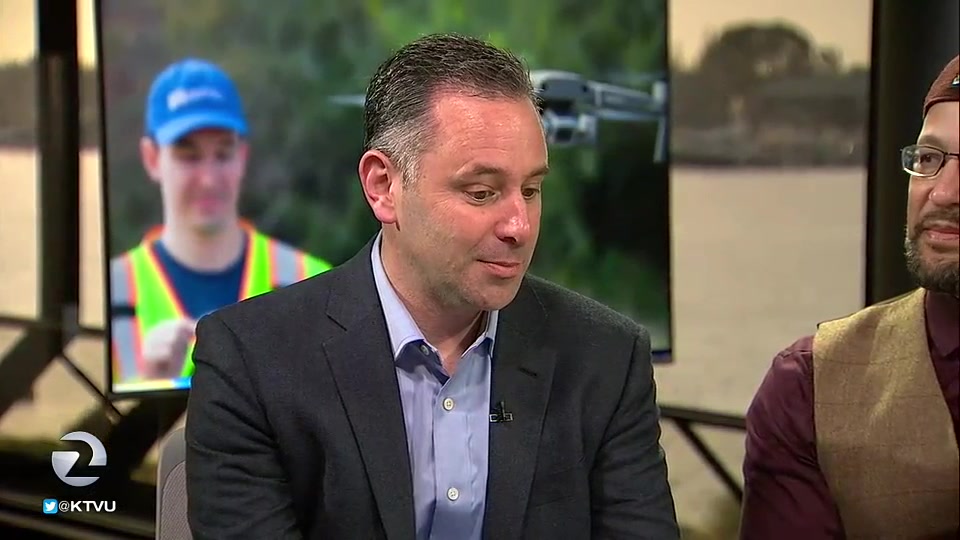
The segment did not require viewers to care about GPU cores. It gave them a drone, a patch of landscape and an avoidable piece of rubbish. The database became intelligible through an outcome. Raskin’s career is full of products sold to enterprises, but this may be the neatest miniature of his craft: let people see the system doing something in the world.
At Kinetica he also hosted conversations with data and technology leaders on the company’s Telekinesis podcast. The role suited someone whom former colleagues describe publicly as both technically fluent and naturally communicative. One recommendation credits him with creating “autonomy, freedom and fun.” Another notes the less common pairing of technical IQ and humility. Such comments are inevitably partial, but they match the public manner: explain the machine without behaving as if you invented gravity.
Coffee, credibility and the CMO
Mperativ began, in Raskin’s telling, with coffee. He and Jim McHugh sat in a San Francisco café and worried at a question: how could AI change the way marketers connect investment to pipeline and revenue? They founded the company in 2021 with a stubborn diagnosis. Marketing had a credibility problem because its tools were excellent at counting activity and much worse at describing economic consequence.
Clicks, leads and engagement scores could fill a presentation. They did not necessarily help a chief financial officer decide where the next dollar should go. Mperativ tried to build a common model spanning marketing, sales and customer success. Campaigns would connect to pipeline. Attribution would reach the account and opportunity level. AI would turn the resulting data into a narrative fit for an executive meeting.
The sharpest part of the thesis was social, not computational. Raskin frequently spoke about getting the CMO a seat at the revenue table. This is corporate language, but it describes a recognizable embarrassment. Departments arrive at the same meeting carrying different definitions of success, then spend the hour disputing the scoreboard. A shared model is a peace treaty written in data.
“For as long as I can remember, CMOs have been fighting for a seat at the revenue table.”Daniel Raskin, on Mperativ’s acquisition
Mperativ’s work found practical uses. Lative reports that AskNicely rebuilt its go-to-market data foundation and cut cost per opportunity by 30 percent in one quarter. At Trulioo, the platform became the common view used in weekly funnel reviews by the CEO and CFO within two quarters. Those examples say more than a pile of feature names. The software changed who could trust the meeting.
The founder chapter closes cleanly
In May 2026, Lative acquired Mperativ. The fit was unusually literal. Lative modeled sales capacity, quotas and productivity. Mperativ modeled the marketing engine feeding that capacity. Put together, they could ask whether the pipeline being created matched the sales organization available to close it, then test what would happen if spending, hiring or conversion rates changed.
Raskin thanked the people around the five-year project by name: McHugh, engineering leaders Nicolas Philippe and Allison Gau, investors Warren Weiss and Will Elmore, and the Lative team. His acquisition announcement carried pride without pretending that the company had solved every corporate argument. Mperativ’s product became Lative’s Marketing Intelligence layer; existing customers moved with it. The idea survived the logo.
The Raskin test
Can the claim travel across departments without changing its meaning? Identity must travel across devices. Marketing evidence must travel from CMO to CFO. Observability must travel from an infrastructure signal to business impact. The nouns change. The test does not.
Now the whole stack wants an editor
Virtana appointed Raskin CMO one week after Lative announced the acquisition. His remit includes global marketing strategy, brand development and demand generation. His subject is observability across hybrid and multi-cloud environments: applications, services, data pipelines, GPUs, CPUs, networks and storage. It is an impressive inventory and a dreadful elevator pitch.
Raskin’s own description begins with the changed shape of the problem. Applications have become distributed systems. AI workloads are spreading quickly. A failure can begin far from the place where its symptoms appear. A storage queue may slow a container; a network constraint may look like an application flaw. A collection of dashboards can produce more signals and less understanding.
At a 2026 Conf42 session with Virtana product director David McNerney, the title made the tension memorable: “When the Stack Lies.” The proposed remedy is system-aware observability, context that connects dependencies and helps operators identify the actual constraint. Once again, the useful product is not merely a measurement. It is an explanation sturdy enough to support action.
This is where Raskin’s publishing beginning stops looking quaint. Enterprise AI has no shortage of text. Agents can generate reports, summarize incidents and produce a fluent account of almost anything. The shortage is editorial judgment: which evidence matters, whether the causal chain is real and what the reader should do next.
Writing after the writing machine
Raskin is an enthusiastic employer of AI, not a nostalgic defender of the typewriter. Mperativ used it to generate executive narratives from marketing data. Virtana uses agentic AI to investigate operational signals. Yet when asked in 2024 what companies should seek in new marketing graduates, he answered: “Writing, writing, writing!”
His reasoning was wonderfully unfuturistic. Scripts, white papers, advertising and presentations still need sharp minds behind the sentences. As generative AI increases the quantity of acceptable copy, good writing becomes more valuable because it signals selection. Someone noticed the difference between the fact and the flourish.
That distinction runs through his route from books to observability. The old Barnes & Noble volumes needed production, structure and a reason to remain in circulation. Open-source identity needed a story that could follow customers into the cloud. A GPU database needed a drone over the bay. Marketing needed to account for revenue. AI infrastructure now needs to reveal where the trouble actually began.
Raskin’s career has not followed a single technology. It has followed the moment when a complex system meets a skeptical reader. The reader might be a developer, a buyer, a CFO or an engineer staring at an alert. The assignment is the same one a production editor would recognize: keep the truth, remove the fog and put the consequential detail where nobody can miss it.