The fix looked finished. Tests passed. The alert fell silent. Then, the following day, the same family of database errors returned. In Antimetal’s account of an internal trial, its agent reopened the issue it had just helped close. Somewhere between a green test suite and a running system, reality had declined to cooperate.
- Started with AWS savings; expanded into production operations.
- Connects code, deployments and telemetry to investigate failures.
- Reported fewer errors in its own stack, with human review.
- The useful lesson: keep checking after the fix ships.
01The bug that came back
Antimetal’s June 2026 experiment covered seven services producing roughly 3,000 error logs a day. The company reported a 76% reduction in one day, holding near 720 over the following month. Engineers reviewed every change. Some fixes addressed logging or configuration rather than broken application code; the percentage measures error volume, not uptime.
The database bug was a race between workers writing identical content. A first patch fixed one path; another remained vulnerable. Sequential tests missed the collision. Continued monitoring caught it, and a second fix changed the storage approach. The achievement worth copying is the decision to reopen a case. Software has an unfortunate habit of behaving impeccably in court and badly in public.
02First the bill, then the burden
Matthew Parkhurst and Shreyas Iyer founded Antimetal in 2022. Parkhurst is CEO; Iyer is CTO. Its initial brief was practical: help businesses spend less on AWS. The early platform analyzed spending and usage, modeled commitment risk and offered automated recommendations. Reported early customers included CarVal, Clay and Gnosis Freight.
A $4.3 million seed round preceded a $20 million Series A announced in June 2025, led by Sound Ventures. The latter accompanied an infrastructure-management beta. The two disclosed rounds total $24.3 million. Buying cloud capacity efficiently had become the opening chapter of a larger proposition: reduce the work required to keep software running.
“Writing code is no longer the hard part.”Shreyas Iyer · June 2025
Iyer’s 2025 argument was that faster coding pushes pressure downstream. Deployments, scaling and debugging still consume attention. Knowledge fragments between developers and infrastructure specialists, while logs, tickets and conversations accumulate in separate places. The intended customer is the engineering organization spending its days reconstructing what its systems already know.
03The database was an innocent bystander
Antimetal’s own early incident agent exposed the difficulty. At an unnamed analytics company, report exports failed. The agent gathered evidence and blamed database overload. It was wrong. A deployment had introduced a synchronous dependency; latency provoked retries, and the database suffered downstream. More evidence had produced greater confidence without better understanding.
That failure helped motivate a persistent world model. Antimetal describes four connected layers: what exists, what changed, how failures propagate and what the system means to people. A service map alone cannot explain why “exports” matters to a customer or why a dependency appeared yesterday. The proposed advantage is remembering those relationships before the next incident begins.
04An investigator above the dashboards
The current platform names Triage for organizing production signals, Patrol for watching risks and drift, and Agent Builder for creating custom agents. It starts with read access; customers control permitted actions. Changes default to existing approval routes. Autonomy here has a permissions menu, which is rather more reassuring than an adjective.
Antimetal sits above existing observability tools. Its competitive claim is to connect their evidence and carry an investigation toward action. An internal SRE team can do that work manually; incident.io Investigations and Resolve AI offer competing approaches. The relevant comparison is the quality of the investigation and its verification, not the number of dashboards on either side.
April 2026 brought Antimetal MCP, a connection for coding agents in tools such as Cursor and Claude Code. Users can request an investigation or a fix without assembling each observability tool separately. The business remains B2B SaaS: order forms or checkout specify fees and subscription terms. A buyer needs an environment-specific quote.
05Less data to read, more history to see
The technical work includes how to present telemetry to agents. In August 2026 research, Antimetal described storing repeated event structures once, retaining changing values, timestamps and links to raw records. It reported fitting 10 to 100 times more telemetry into the same context window.
That can expose a slow memory leak or a retry pattern spanning services. It also has limits. The company found less benefit for focused bugs whose answer already sat in one stack trace; compression could add overhead. This is a useful distinction for buyers: wider historical context matters most when the failure crosses time or system boundaries.
06The company automates its own homework
Antimetal’s internal Anvil application handles much of customer implementation. It moves through scoping, configuration, security, verification and launch. People still review sensitive steps and results. The company reports roughly 80% less hands-on work on its most complex onboardings. Anvil is an internal tool, not another product on the shelf.
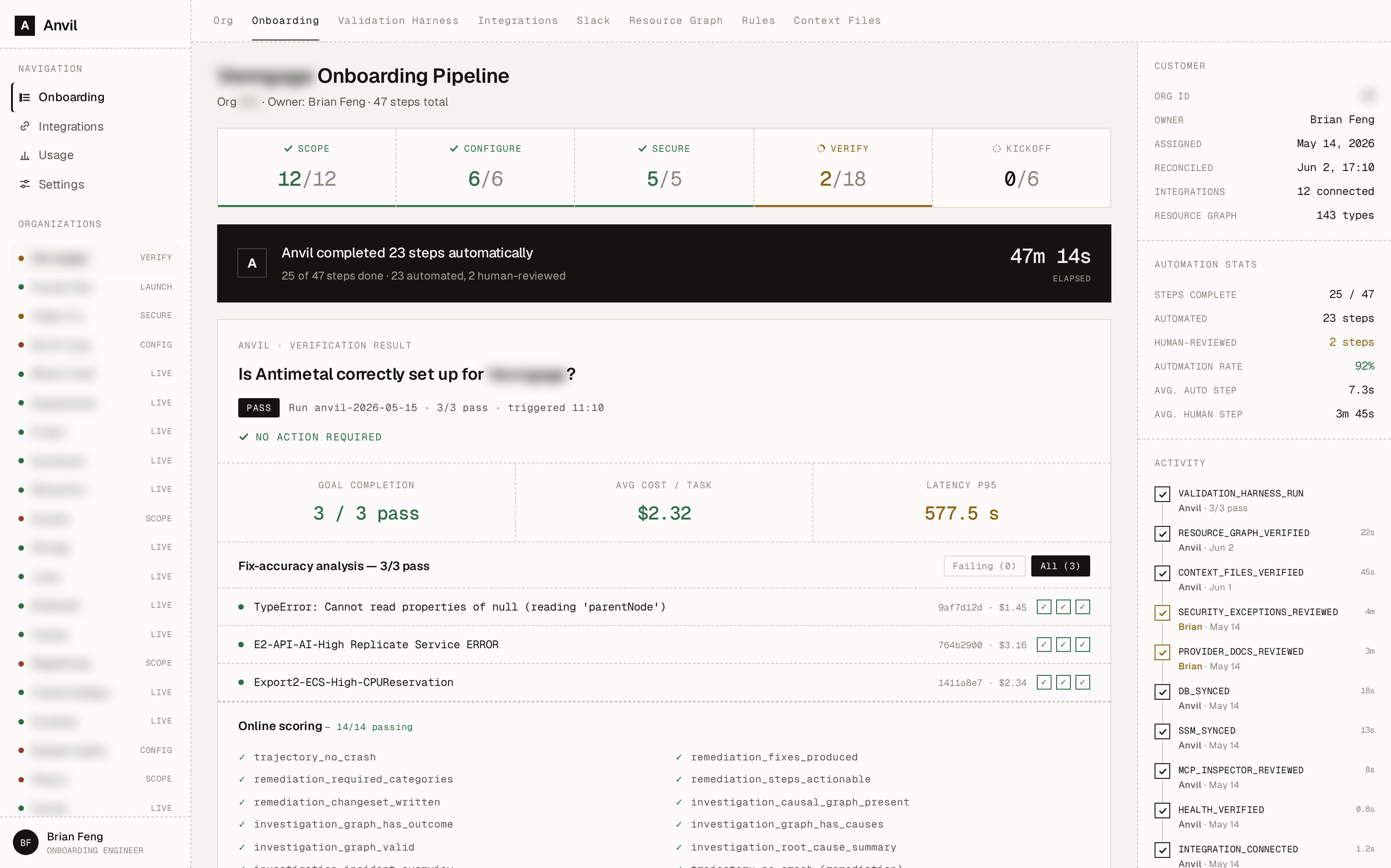
Its recruiting page advertises on-site New York roles. The operational philosophy is visible in Anvil: turn repeated coordination into software before hiring around it. Whether that works elsewhere depends on how much implementation is repeatable and how much requires judgment about a customer’s particular business.


07What you can steal from the method
There is an older, tastier lesson. In April 2024, Antimetal delivered more than 1,000 branded pizzas to startups and investors. CNBC reported a roughly $15,000 cost and more than $1 million in added annualized net revenue, with about 75 recipients becoming customers, according to Parkhurst. That was reported annualized revenue, not cash collected over lunch.
The campaign reached a concentrated audience with a useful gift. A scattered market or an offer without demonstrable value would make copying it less convincing. The engineering lesson is similarly conditional: an agent needs connected evidence and explicit permissions. Antimetal’s terms also exclude time-critical and mission-critical use.
For a team considering the product, the practical experiment is modest: connect a bounded environment, retain approval, and measure investigation quality and recurring failures. Keep watching after the merge. The next morning may have an opinion.