The first clue in a software outage is often a liar. A latency alert blames the checkout service; the trouble began in a database connection pool. A pod restarts; the trigger was a deployment three services away. By the time the right engineer has opened the right dashboard, the incident has developed a social life of its own: a Slack thread, a bridge call, several competing theories and a customer who noticed first.
NeuBird, founded in 2023 by Goutham Rao and Vinod Jayaraman, sells an AI investigator for precisely this moment. It connects to the monitoring and cloud tools a company already uses, queries telemetry where it lives, assembles evidence and proposes a root cause. When a fix is possible, it stages one under the customer's approval rules. It is an enterprise software business serving site reliability, IT operations and platform teams, with a product that sits between observability and action.
- NeuBird investigates incidents across logs, metrics, traces, alerts and deployment changes.
- Its first engine, Hawkeye, plateaued near 80% accuracy; the company says Falcon approached 92% on the same investigations after a redesign.
- Customers pay for active investigations and analyses through credits; incoming alerts and triage are included.
- Proposed production changes pass through policy controls and an audit trail.
The first detective had a script
Hawkeye, NeuBird's earlier agent, could investigate enough incidents to win customers. Yet the company says its accuracy stalled around 80%. The obstacle was oddly human: it arrived at an investigation with its reading material already chosen. NeuBird's software gathered the telemetry, topology and past incidents it thought relevant, packaged them into a fixed context bundle, and handed that bundle to the model.
That made sense when language models needed close direction. As they became better at choosing tools and revising hypotheses, the prepared dossier turned into a ceiling. A missing clue could not be discovered if the investigator was confined to the file on its desk. NeuBird rewrote the reasoning loop, keeping its underlying data layer. Falcon, the replacement, can ask for a fresh slice of telemetry, follow a dependency, test a suspicion and ask again.
Those are company-reported figures, not a public benchmark. Their more useful lesson is architectural. When a task depends on evidence scattered across systems, supplying a model with a larger pile of preselected material may be less valuable than letting it retrieve the next piece deliberately. The engineer's question - what changed right before this broke? - becomes a path through live systems, not a search for the cleverest summary.
An alert is only the invitation
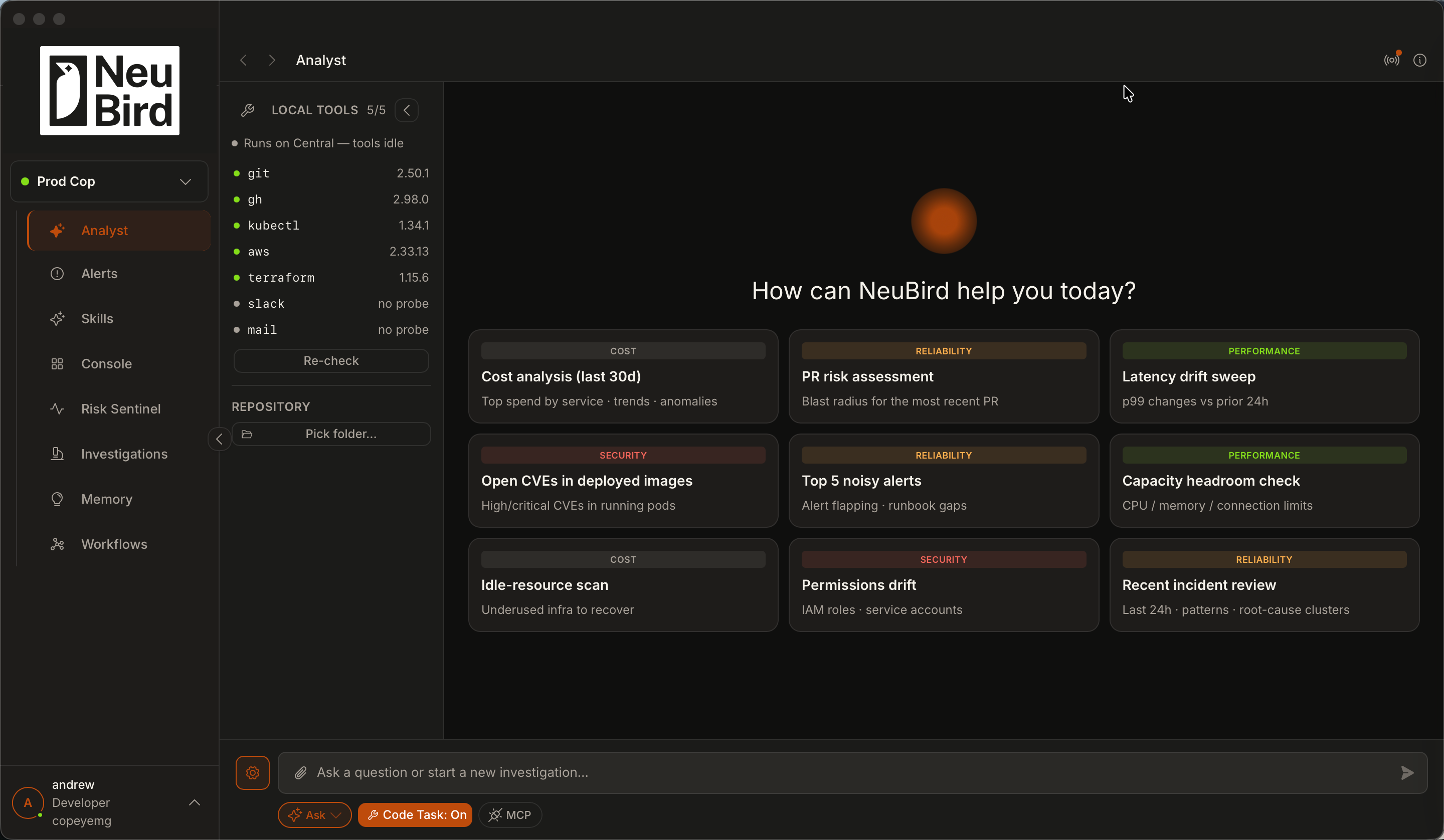
NeuBird's advertised workflow starts when an alert arrives, though the company also markets checks that look for risk before a page. The agent can examine metrics, logs, traces, cloud resources and recent code changes across integrations including Datadog, AWS, Azure, PagerDuty and Splunk. It maps service relationships and attaches evidence to a diagnosis. Engineers can see findings in a web app, desktop app, terminal or tools such as Slack. An MCP server lets compatible developer assistants request operational context.
This makes NeuBird different from a monitoring dashboard. A dashboard shows a reading; an incident investigator tries to explain the relationship between readings. It also makes the product different from a generic chat box laid over one observability tool. NeuBird's pitch depends on looking across tools and retaining conclusions from earlier investigations while leaving the underlying telemetry in place. Its current platform calls this shared record an operations memory for engineers, managers and other agents.
The distinction matters in a multi-cloud company. The clue in CloudWatch might be a deployment, the symptom in Datadog a rising response time, and the consequence in PagerDuty a page. An engineer can connect those dots. NeuBird is betting the same engineer would prefer to spend those minutes checking a coherent hypothesis.
A useful employee with a permission slip
The point where diagnosis becomes action is also where the stakes change. Reading a metric is reversible. Restarting a service can be an incident of its own. NeuBird's platform describes three policy modes: suggest, recommend and act. It says actions are scoped, recorded and subject to approval; customers can grant more autonomy to specific repeatable tasks. The company has also connected its investigations to Red Hat Ansible Automation Platform, matching a proposed remedy to existing job templates. A known fix can then run through an established, audited automation system.
This is a practical answer to the question every operator will ask: who gets blamed if the robot is wrong? In NeuBird's design, the agent must show its work and the organization decides which work it may perform. That does not remove operational risk. It gives a team a way to measure trust one action at a time.
“NeuBird AI surfaces what matters, fast. It diagnoses issues, flags inefficiencies, and gives us the full story before our team even has to dig.”Anthony Hanrahan, CTO of Kai AI, in a NeuBird customer story
Kai AI, which provides legal automation, offers a less theatrical example than a midnight outage. Its team used NeuBird to spot underused GPU resources and trace document-processing latency to a memory leak and pod restarts. The customer story says diagnosis and action became ten times faster. DeepHealth, another named customer, says NeuBird helped its engineers resolve an outage in minutes. These accounts describe specific deployments; they do not establish what every customer will see.
The bill follows the investigation
NeuBird's public pricing makes an unusual choice: unlimited incoming alerts and continuous triage are included, while active investigations and analyses consume credits. Its examples put 1,000 monthly alerts at roughly 100 recommended credits, with one credit for a standard investigation. Enterprise pricing is custom. The model aligns the bill with questions answered rather than raw logs stored - apt for a company that says it queries data in place and keeps investigation conclusions instead of a second copy of telemetry.
The market is crowded with observability vendors, cloud-native monitoring suites, incident management software and new AI SRE companies. Datadog and Dynatrace already have AI features; teams can also build their own agents. NeuBird's chosen position is the shared layer across that estate: one governed connection to telemetry and models, one memory of what happened, and an investigator that can propose the next move. That proposition is most compelling where the tools are numerous and the cost of assembling context is high. A small, simple stack with a good on-call runbook may have less to gain.
The company announced a $22 million seed round led by Mayfield in 2024, later raised a $22.5 million extension led by Microsoft's M12, and reported another $19.3 million in April 2026, bringing its stated total to $63.8 million. It joined the 2025 AWS Generative AI Accelerator and has expanded deployment options to customer VPCs, on-premises systems and isolated environments. These moves follow the same argument as the product: enterprise AI will be judged less by how fluently it speaks than by how carefully it handles production.
There is a useful idea here even for a team that never buys NeuBird. When an incident review ends, save the reasoning, the evidence and the approved fix in a form the next investigation can find. Connect systems so a fresh hypothesis can be tested against live data. Keep the permission to act separate from the ability to suggest. The first clue will still lie now and then. The point is to build an investigator that knows how to ask the second question.