The most useful moment in Honeycomb's origin story is an argument. Christine Yen, a product engineer at the mobile-backend company Parse, would ship something. Charity Majors, who ran infrastructure, would arrive with the news that it had broken. The pair had the same production system and different views of reality. Metrics could say the system was sick. Logs could turn the hunt into archaeology. Neither could answer the odd, urgent follow-up: which users, on which build, taking which path, under what conditions?
Facebook acquired Parse and handed its engineers an internal analytics tool called Scuba. Yen later described much of Facebook's tooling as a poor fit for Parse, but Scuba stood out. It let the team slice and dice live production data quickly. The next question could follow the previous answer instead of waiting for new instrumentation or another index. Once Yen and Majors had worked that way, leaving Facebook without it felt absurd.
They founded Honeycomb in 2016 to bring that capability to ordinary engineering teams. The company now sells a cloud observability platform for logs, metrics, traces, service-level objectives, frontend performance, and increasingly AI applications. Its customers include Duolingo, HelloFresh, Slack, Vercel, Vanguard, Robinhood, Booking.com, Fender, Dropbox, and Nubank. In the company's 2023 Series D announcement, it reported more than 600 customers worldwide.
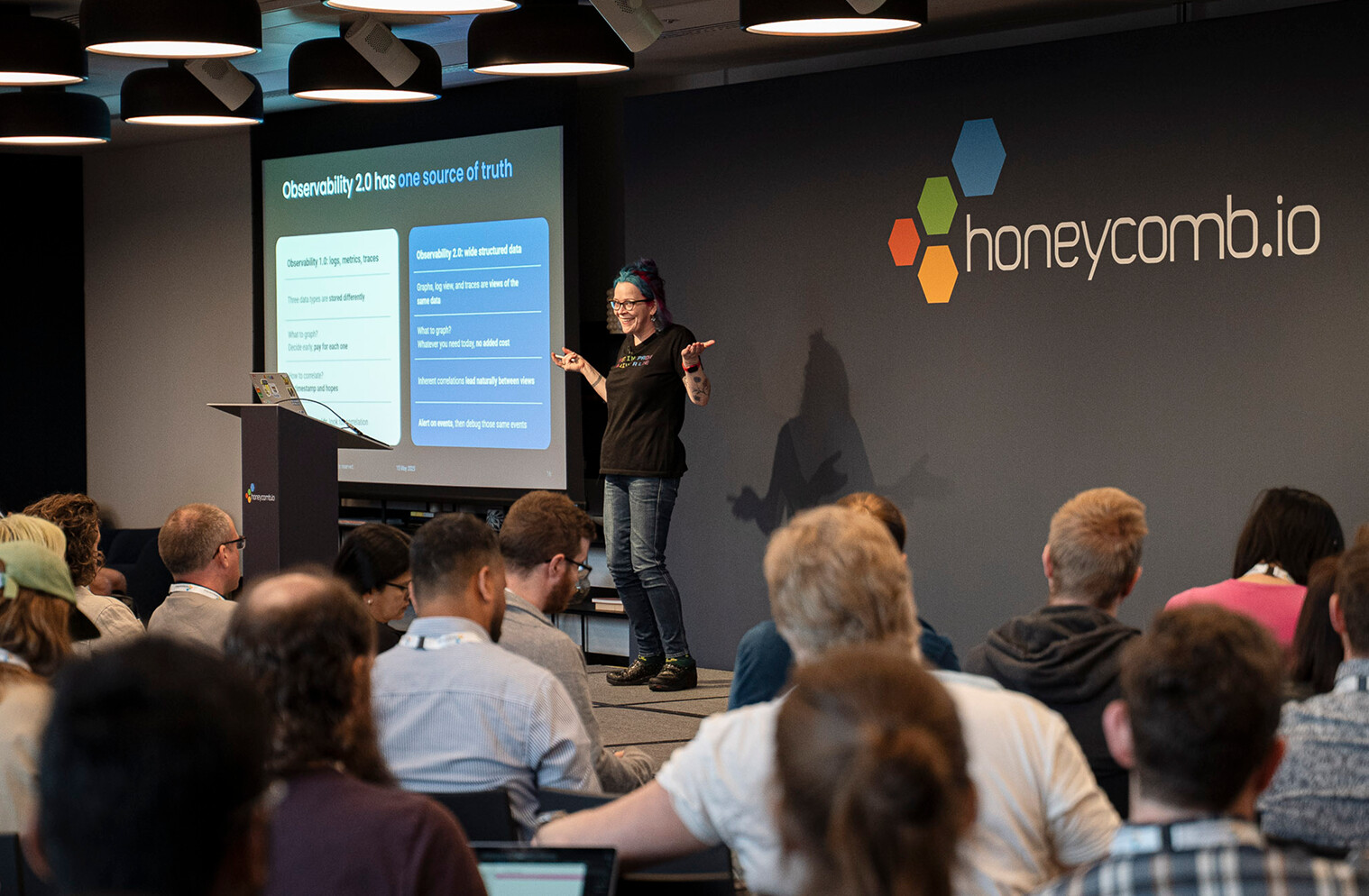
01 / The thing they actually sell
A query engine with an opinion about curiosity
Honeycomb collects structured telemetry through OpenTelemetry and other integrations, stores it in a column-oriented system, and makes it fast to query across many dimensions. A single “wide event” might describe a request with its user ID, build version, endpoint, region, device, customer tier, trace context, and dozens of other fields. High cardinality is the important phrase: a field such as user ID can have millions of distinct values without being treated as an expensive mistake.
That design changes the workflow. A dashboard is excellent when the team knows the question in advance. Production incidents are impolite; they often refuse to repeat the last incident. Honeycomb's Query Builder, distributed tracing, heatmaps, Service Map, and SLOs let an investigator move from a broad symptom to one trace. BubbleUp makes the trick especially legible: draw a box around the strange cluster and the product compares those events with the baseline across every available dimension.
The newer AI layer sits on this foundation. Canvas is a shared workspace where engineers can ask questions in natural language, run automated investigations, and encode team runbooks as skills. Honeycomb's hosted MCP lets agents in tools such as Claude Code, Cursor, and Amazon Q query observability data. Agent Timeline lays out model calls, tool use, handoffs, and failures in order. AI BubbleUp reads comparative results and calls attention to dimensions likely to matter, while leaving the raw ranking visible for a human to check.
AI can inspect thousands of dimensions quickly. It still cannot recover context that the telemetry pipeline threw away.
02 / Cost, in both senses
The bill rewards looking. Ingestion still needs discipline.
Honeycomb's business model mirrors its product thesis. It does not charge for seats, queries, or extra custom fields. It charges primarily by incoming event volume. The current Free plan allows up to 20 million events per month. Pro begins at $150 monthly for 50 million events and scales to 750 million. Enterprise contracts use custom volume commitments and begin with a base allowance of 10 billion events per year. Metrics have their own data-point allowances, while Private Cloud, premium support, and services extend the enterprise sale.
This is a clever trade. Unlimited seats make it easier for a whole engineering organization to explore and collaborate. Unlimited queries remove the tiny financial hesitation before one more question. But event pricing is not automatically predictable. Span-heavy traces can generate large volumes; traffic surges happen; teams need sampling and telemetry governance. Honeycomb's open-source Refinery proxy performs tail-based sampling so customers can preserve errors and unusual traces while thinning routine traffic.
What did the company itself cost to build? Publicly disclosed rounds reached nearly $150 million by April 2023: early seed and Series A capital, a $20 million Series B, then $50 million Series C and Series D rounds. In 2022, Honeycomb said revenue had doubled for a second consecutive year and net revenue retention exceeded 160 percent. A valuation and current revenue are not publicly disclosed.
03 / What failed first
The old tools worked - until the question was new
Honeycomb's first failure was inherited. At Parse, conventional monitoring and logging were painfully slow at isolating a new failure mode in a shared, distributed platform. The tools answered known unknowns: Is latency high? Is this host down? They struggled with unknown unknowns: Why did requests from this peculiar combination of user, region, code path, and build become slow only now?
The founders' change of mind came from direct experience with Scuba. They stopped treating production understanding as a collection of preset charts and began treating it as exploratory data analysis. Honeycomb then encountered a commercial version of the same problem. Buyers asked for log tools or monitoring because those were the words and budgets they had. Yen has said the first year went into building a prototype and establishing a market, followed by years of turning excited early adopters into paying customers and learning how to sell a developer tool.
That patience is part of the differentiation today. Datadog, Dynatrace, New Relic, Splunk, Grafana, Elastic, Sentry, Chronosphere, and open-source stacks can all monitor modern systems. Honeycomb's sharper claim concerns the investigative experience: high-cardinality context without cardinality-based field charges, fast iterative queries, one data model across telemetry types, and collaboration around saved evidence. OpenTelemetry support also reduces instrumentation lock-in. A buyer can keep the collection standard even if the destination changes.
The product did not win by predicting every failure. It made being surprised less expensive.
04 / Proof in the customer story
Duolingo removed three tools. HelloFresh removed maintenance.
The cleanest proof is subtractive. Duolingo had separate systems for logging, search, and tracing. Engineers stitched a narrative together during incidents while a service graph sprawled “like a plate of spaghetti.” After adopting Honeycomb, the company said it sunset three tools, consolidated logging, and reduced total observability tooling costs by 16 percent. More important, its reliability work could connect an SLO to a user-facing feature such as the famous learning streak.
HelloFresh told a similar story. The meal-kit company reduced the infrastructure its platform team maintained and cut the number of tools product developers needed. It began using SLOs based on unsampled load-balancer logs so alerts could reflect the experience customers actually saw. The organizational work remained: business and engineering still had to negotiate an acceptable service level. A tool can reveal the conversation; it cannot settle it.
That caveat matters for AI too. In 2025 and 2026 Honeycomb moved aggressively into agent observability, private cloud, Metrics, Canvas, MCP, Agent Timeline, and AI BubbleUp. A three-year AWS collaboration adds distribution, marketplace procurement, and joint work on enterprise AI observability. Yet the durable advantage remains the same one learned at Parse: useful investigations require rich evidence and a team willing to follow it.
When this playbook does not work
Honeycomb can be too much machinery for a small, stable application that needs basic uptime checks. It disappoints when teams send thin, unstructured telemetry and expect the query engine to invent missing context. Event pricing also needs forecasting, sampling, and ownership at high volume. Organizations committed to running a fully self-hosted open-source stack may prefer Prometheus, Grafana, Loki, Jaeger, or related tools. And no observability product fixes an engineering culture where only the on-call specialist is allowed to touch production.
05 / What to steal
Five moves worth copying before buying anything
First, instrument around units of work and user experience, not around whatever a default dashboard happens to show. Second, keep identifying context - build, customer, endpoint, region, feature flag, and trace - in structured fields. Third, make one investigation lead naturally to the next question. Fourth, share the live trail of evidence so the handoff preserves reasoning. Fifth, price and govern the system so curiosity spreads beyond a small priesthood of observability experts.
There is also a founder lesson. Yen and Majors built from a problem they had felt repeatedly, then borrowed the interaction model from a tool that had already changed their own behavior. They did not assume the market would immediately understand the category. They published, spoke, open-sourced tools, contributed to OpenTelemetry, and gave the practice a vocabulary. The education looked like overhead. It became distribution.
Honeycomb is now ten years old, a long time for a startup still sharpening the category it helped create. AI-generated code and autonomous agents add a fresh source of strange behavior. That makes the old bet newly useful. The machines can ask more questions than humans, faster. The company still has to ensure those questions land on data worth believing.