The expensive moment in cloud computing is rarely the first one. It arrives later, when a clean diagram has become a thicket of services and every service is talking at once. Metrics tick. Logs narrate. Traces draw the journey. The company pays to collect the commotion, then pays again to understand it. Pankaj Thakkar has built his latest chapter around a politely subversive question: why should looking closely become a luxury?
As co-founder and CEO of Kloudfuse, Thakkar sells observability, the machinery that tells engineers what their software is doing. His sharper proposition concerns ownership. The data can remain inside the customer's cloud. Existing collectors can keep sending it. Familiar query habits need not be ceremonially burned. The platform's economics are designed to be forecast rather than discovered with a wince at the end of the month.
This sounds like a commercial argument, and it is. It is also recognizably the work of a systems engineer. Thakkar's career has moved through four invisible layers of modern computing: location, search, networks and telemetry. At each stop, the work involved giving software a better model of a complicated world.
A handheld map and a lifelong question
Two decades before cloud engineers began arguing about telemetry cardinality, Thakkar was at the University of Maryland making a map fit inside a Compaq iPAQ. His master's project used a Linux client to serve location-sensitive information on a compact handheld. A person could see another user on the map, click and talk. The server used small units of work called actions, an alternative to organizing the system around threads, with scalability already on the agenda.
The project became part of Rover, a location-aware computing system described in an October 2002 cover feature for IEEE Computer. Its imagined destinations included museums, amusement parks, shopping centers and offices. The old hardware now belongs in a glass case. The design instinct aged better: context is useful only when a system can collect it, connect it and respond without collapsing under the crowd.
Thakkar had arrived at Maryland after earning a computer science and engineering degree from IIT Delhi. He also worked as a teaching assistant for operating systems, helping with recitations and project evaluation. It is a tidy prelude to the rest of his career. He was learning how systems behave and how to explain that behavior to other people, twin obligations that eventually meet in a founder's job.
The network becomes an idea
After university, Thakkar worked at Ask Jeeves, the search company remembered for putting a butler in front of the web. By 2010 he had joined Nicira as a senior software engineer. Nicira's defining move was to separate the logic of a network from the boxes and wires that carried traffic. Networks could be modeled and controlled in software. VMware bought the company in 2012 for approximately $1.26 billion, and Thakkar continued at VMware as a principal engineer until 2020.
His name appears across a long patent record for distributed network virtualization: logical switches, network controllers, managed forwarding elements, tunnel endpoints and virtualized middleboxes. Patent language can make electricity sound like probate, but the underlying theme is lively. Physical infrastructure was learning to accept abstraction. An operator could describe what the network should do, and software could arrange the details.
Nicira placed Thakkar among engineers including Martin Casado, Teemu Koponen and others who helped move software-defined networking from an argument into deployed technology. It also gave him a close view of how an infrastructure category changes. First the old constraint looks permanent. Then someone draws a cleaner boundary. Eventually, customers wonder why the boundary was ever elsewhere.
“We want customers to feel in charge of their data.”Pankaj Thakkar, on Kloudfuse's operating premise
Telemetry with a deed, not a lease
Kloudfuse began in 2021 with Thakkar, Krishna Yadappanavar and Ashish Hanwadikar as co-founders. The founding group brought experience from Nicira, VMware, Springpath and Cisco. Thakkar initially served as CTO. By 2025, company material identified him as CEO, a shift from chief builder to the executive responsible for making the whole company legible.
When Kloudfuse emerged from stealth in November 2023, it announced $23 million in total funding, including a $17 million Series A. The product joined logs, metrics, events and traces in a unified observability data lake. It supported OpenTelemetry and existing commercial agents. It ran in the customer's virtual private cloud. The sales vocabulary involved cost, control and cardinality, three words that rarely improve a dinner party but often decide whether an engineer can debug production at 2 a.m.
Cardinality is the number of distinct combinations inside data. A metric labeled by service, region, endpoint, customer and version quickly develops more possible identities than a Victorian confidence trickster. Those dimensions are valuable because they let an engineer isolate a strange failure. They are expensive because storage and query systems must keep up with the multiplying detail. Traditional pricing can teach teams to sample or discard the very clues they may later need.
Thakkar's public language returns repeatedly to agency: customers should feel in charge, data lakes should accept existing instrumentation and observability should grow more slowly than the business it watches. His social posts use the phrase “your data at your terms.” The grammar is compressed; the intention is not.
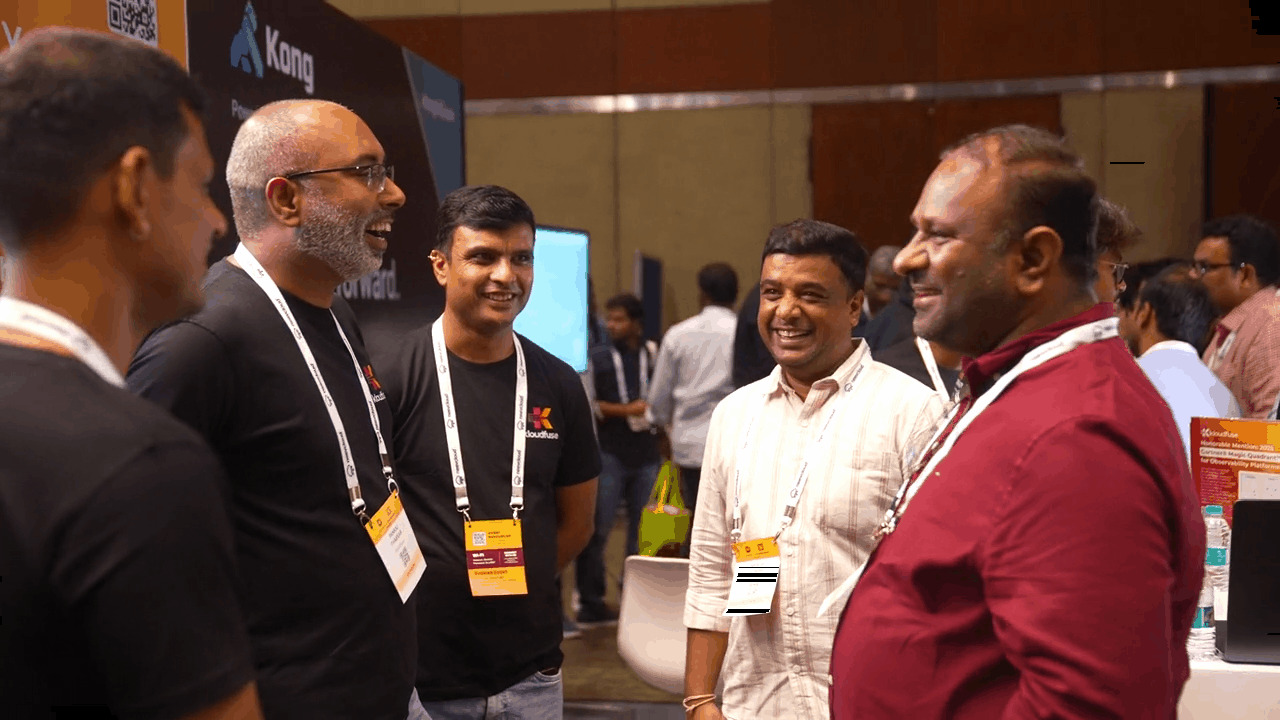
The CEO at the booth
At KubeCon India in Hyderabad in August 2025, Kloudfuse put that argument in front of a concentrated audience of cloud-native engineers. The company recorded more than 1,000 booth visitors and over 200 connections across two days. A published scene shows Thakkar and colleagues laughing with visitors beside the booth. It is infrastructure's natural habitat: a crowded room, a laptop within reach and someone explaining what broke last Tuesday.
The conversations clustered around familiar grievances. Bills rose faster than workloads. OpenTelemetry had become a default route away from proprietary collection. Teams wanted less alert noise and more control of data. The booth offered demonstrations, but the revealing detail was how quickly visitors moved from asking about the product to describing the ailments of their own stacks. Enterprise software earns attention when it supplies a vocabulary for frustration.
Thakkar also interviewed engineering teams using Kloudfuse and wrote about the modern observability problem for InfoWorld. These are acts of translation. A CEO with an engineering background must move between the patent diagram, the incident room and the budget review without pretending they are separate countries. A slow query becomes lost investigation time. Lost time becomes a business cost. A data-ownership choice becomes a security and governance decision.
Kloudfuse 4.0, introduced in May 2026, pushed further into that translation. The release emphasized cryptographic validation, signed software artifacts, workload isolation and governed access to AI models inside enterprise environments. A Kloudfuse cryptographic module had received an active FIPS 140-3 validation listing in March. Thakkar framed security as a property of architecture rather than an optional tier.
The newer platform also separated ingestion, query and control-plane workloads so each could scale according to its own behavior. This is a deeply unromantic detail with an attractive consequence: the observability system has less chance of becoming the problem it was hired to observe. The principle echoes the action-based server of his graduate work and the separated control plane of software-defined networking. Give each part a clear job. Let software coordinate the complexity.
AI now sits in the product's investigation layer, helping with anomaly detection, log patterns and root-cause analysis. Thakkar's argument is grounded in where the computation happens and who governs the data. An enterprise can use models against operational information without first shipping that information into a separate proprietary home. The useful question is less whether a dashboard can speak in complete sentences and more whether its answer can be trusted, audited and acted upon.
“Enterprise buyers should not have to choose between strong security and operational simplicity.”Pankaj Thakkar, introducing Kloudfuse 4.0
The recurring trick
Look across Thakkar's career and the categories begin to rhyme. Rover modeled location so software could respond to context. Nicira modeled networks so software could control traffic. Kloudfuse models operational behavior so teams can understand sprawling applications. The objects keep changing. The recurring trick is to take an invisible system, give it a coherent representation and return leverage to the person operating it.
There is also a founder's lesson hidden in the sequence. Infrastructure markets often appear settled because their inconveniences have acquired invoices and documentation. The opening appears when an engineer treats an accepted tradeoff as a removable design choice. Does rich telemetry require unpredictable spending? Must convenience require surrendering data? Must security arrive as a special edition? Each question turns a business complaint back into an architecture problem.
Thakkar's aspiration for Kloudfuse is plain in the company's mission: make advanced observability accessible, scalable and economically sustainable. The work is not finished, as infrastructure never is. Systems grow. Signals multiply. Yesterday's elegant boundary becomes tomorrow's bottleneck. A useful career may be measured by how often someone returns to the machinery, notices where control has drifted away and quietly moves the line back.