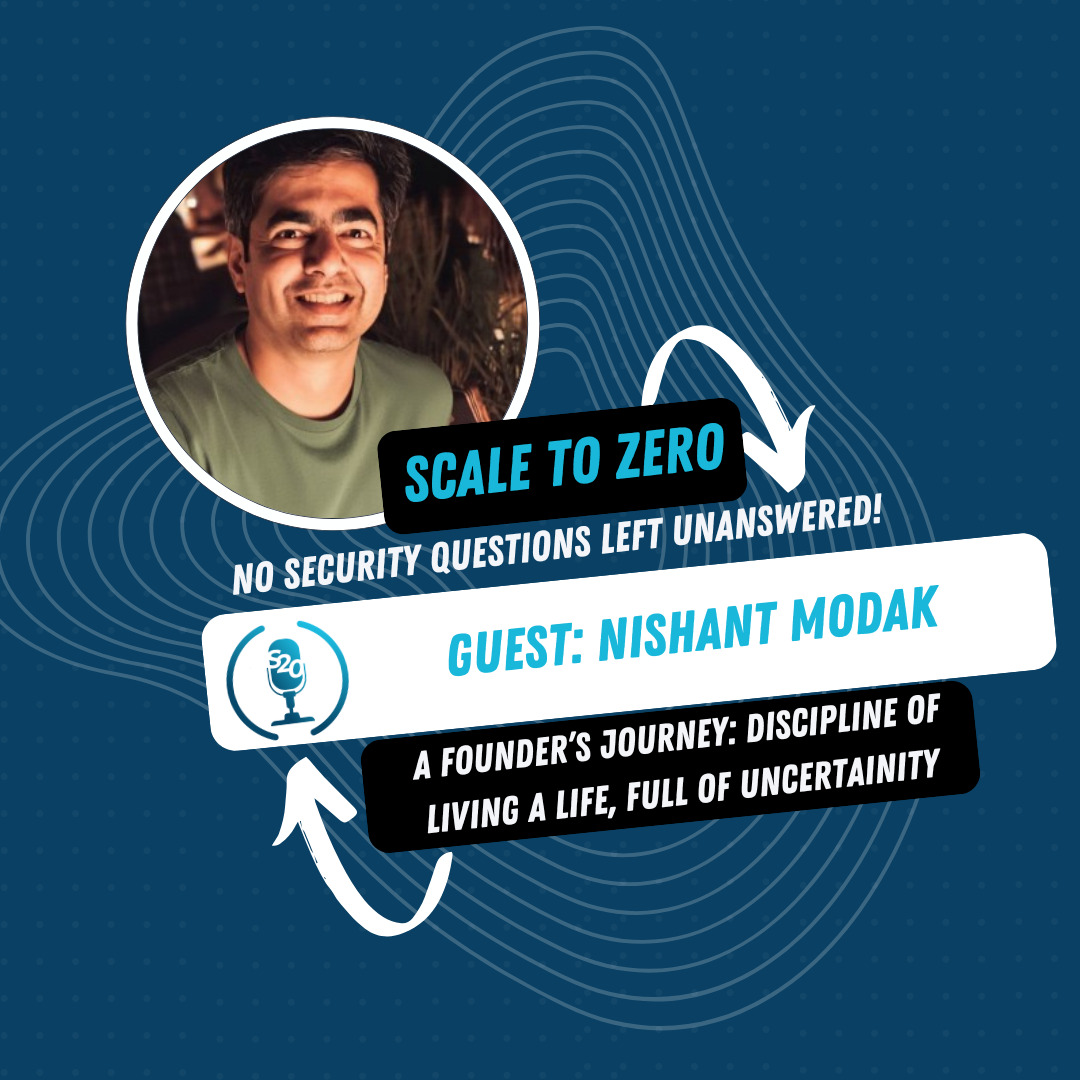
Just before Nishant Modak began recording an interview about the company he had spent nearly six years building, the microphone misbehaved. The software would not cooperate. People fiddled with settings, tried again and briefly occupied the exact territory that Last9 was created to map: something had failed, the reason was unclear, and the available clues were scattered.
Modak laughed at the coincidence. Failure, he said, is part of lived experience. Nothing runs at one hundred percent forever. The interesting work begins in the remaining sliver, where a team must work out what changed before annoyed users do the diagnosis for them.
That modest technical comedy is a good entrance into his worldview. Modak is founder and CEO of Last9, an observability company for the logs, metrics and traces generated by modern software. He is also, insistently, an engineer. The title has changed; the instinct has not. He still codes when he can because the work gives him a clean feedback loop and, as he puts it, helps him remain himself.
“Founders are just engineers who stick with a problem long enough and don't decide to give up.”Nishant Modak
The expensive education of a first company
Last9 was not Modak's first encounter with entrepreneurship. In 2012 he started a crowdfunded hardware product, a conspicuously difficult choice for a software engineer. The project proved there was demand before he went full time, but he underestimated what it would take to manufacture, sell and deliver the thing. He later described the company as a miserable failure and the following three years as a kind of immolation.
His line about it is funnier than any respectable postmortem: first-time founders are a sacrifice to the god of entrepreneurship. Yet the aftermath mattered. Constraint stripped away ornamental priorities. A crisis made it obvious which work was urgent and which work merely looked busy. The failure also answered a private question. He still liked building companies enough to attempt another one.
A later venture gave him the opposite experience. A customer called and asked for the company's name so it could send money. There was a small hitch: the founders had not yet registered one. Paperwork could be solved. Willingness to pay was the precious part. The episode hardened a rule Modak carried into Last9: he likes customers to start paying before he starts coding.
The map and the territory
The seed of Last9 accumulated through years of running systems at scale. Cloud architecture promised elasticity, but it also created thickets of services and dependencies. An engineer could draw a production system on a whiteboard and be perfectly sincere, then open the live telemetry and discover a different creature. Modak calls the two pictures “systems as imagined” and “systems as discovered.” Incidents breed in the delta.
In the company's early telling, Last9 was Google Maps and Search for microservices. It mapped the relationships among services, then helped operators locate a failure inside that graph. The language was accessible because the underlying job is strangely physical. During an outage, an engineer needs both an aerial view and street-level detail. Without the first, the system is a maze. Without the second, the fault is a vague red neighborhood.
The stakes became concrete in large streaming environments. An Indian Premier League match can place tens of millions of concurrent viewers behind one button. A small failure has an audience. Recovery cannot be measured in leisurely hours, and an operator cannot spend the innings opening ten tools in search of one useful clue.
A Tesla, a camera and an unlikely product thesis
One of Modak's more revealing product stories begins away from a server rack. In 2014, on an early visit to California, he saw a Tesla displayed at the Computer History Museum. It sent him thinking about traffic, autonomy and the sensors required to run a self-driving system. Nobody would trust a car to drive itself using a 140-pixel camera. Why expect software to operate itself from a blurred and incomplete view of production?
The analogy gave him a sequence. Cruise control came before adaptive cruise control; richer sensors enabled hands-off systems. Cloud infrastructure had provided a kind of cruise control for operations. Truly autonomous operations would need a higher-fidelity camera: telemetry detailed enough to reveal relationships in real time, preserve context and let either a human or an AI system reason about what it sees.
“The real problem is the human mental model of what actually should exist versus what exists is constantly diverging.”Nishant Modak
More data alone is not a cure. Telemetry is a three-headed big-data problem. It arrives in enormous volume, at high velocity and in awkward variety. Logs sit here, traces there, a cloud configuration somewhere else. A third-party API can change without consulting the diagram. The useful answer may even live in an old team conversation. The challenge is to assemble enough context for a person under pressure to understand what happened and act.
Terabytes of signals
Answers needed now
Logs, metrics, traces and context
Sell before the code gets comfortable
Modak knew the engineering problem intimately. He did not assume that intimacy amounted to a market. Before Last9 took shape, he spoke excessively with CTOs, executives and operators. Was the problem common? Did it hurt enough? Would people buy a solution? The questions sound elementary only after someone else has paid for the answer.
He compares product-market fit to flying a kite in a place with little wind. You run, adjust the angle and keep the line from tangling. Then the kite catches and begins to pull the thread. The pull is the evidence. Until then, the founder is supplying all the motion.
For an engineer, this work demanded a rewiring. Code responds quickly. Write a function, run it and receive either the small pleasure of success or a specific complaint. Modak calls it comfort food. Sales has nebulous inputs and brutally measurable outputs. A prospect can praise a product and never buy it. A message can take months to work. Discipline must survive a long stretch without applause.
His present week is divided roughly among product, marketing and sales. He still disappears down technical rabbit holes because he enjoys them, but he no longer confuses the speed of an engineering feedback loop with the progress of a business. Last9 grew out of the combination: technical obsession, repeated customer conversations and enough patience to keep running with the kite.
The company is also the people in the car
Asked what he got right, Modak returns to the team. Choosing who to work with matters more to him than nearly anything else because a founder cannot inhabit every problem at once. He wants colleagues who share a value system, work hard for customers and would, in his deliberately vivid phrase, take a bullet for one another. The choice compounds into company culture long after an early product decision has been rewritten.
His account of leadership is not romantic. A founder becomes the “chief intensity bearer,” responsible for sustaining movement even on a day when personal energy has misplaced the memo. He admits that iteration speed has been a repeated failure point. Believing in a change does little if the organization cannot make it happen soon enough.
Outside technical books, he reads widely: ancient DNA and human origins, the survival story Endurance, and books about prose such as Bird by Bird and Draft No. 4. The selection fits. Modak likes systems, but he also likes the human explanations inside them. He describes vacations primarily as time with family, wherever they happen to be. His laptop comes too.
When knowledge becomes programmable
By 2026, Modak's language had moved beyond maps. Databases made data programmable. Web APIs made information exchange programmable. AI, in his framing, is beginning to make knowledge programmable. For production engineering, that could collapse design intent, team memory and runtime evidence into one reasoning timeline.
The destination is autonomous operations: systems able to observe, decide and act with progressively less human intervention. Modak does not pretend the company has arrived. The journey is long, he says. His camera analogy places a useful restraint on the ambition. Before software is permitted to heal itself, it needs a faithful view of the patient. Before agency comes context.
There is a continuity to the route from that failed hardware company to Last9. Both began with a builder staring at an uncertain system. The first taught him that a product is not a market. The second is organized around a related humility: an architecture diagram is not production. Reality has to pull on the thread. The work is noticing when it does.
“Practice comes before perfection.”Nishant Modak