In most software companies, the call that wakes an engineer is short on explanation. A service is slow. A checkout failed. Someone in another time zone cannot load a page. The machines, meanwhile, have been talking all night. They have produced logs, metrics, traces, events and alerts in quantities that would shame a municipal archive. The engineer’s problem is rarely a lack of evidence. It is finding the evidence that matters before the next alert arrives.
Dash0, founded in Germany in 2023 and now headquartered in New York, sells a way through that mess. Its platform accepts OpenTelemetry data, connects signals to the services and resources that produced them, and gives developers and site reliability engineers a place to investigate. The wager that makes it interesting is simple: a better observability tool should sometimes persuade you to store less.
- What it does: monitors applications and infrastructure through connected logs, metrics, traces and other signals.
- Who uses it: engineering and platform teams at more than 800 customers, according to Dash0.
- What differs: open instrumentation, filtering before storage, per-signal pricing and AI agents that can help investigate.
The second company
Mirko Novakovic had already lived one version of this story. He founded Instana, the application monitoring company IBM bought in 2020. Dash0’s other founders - Ben Blackmore, Miel Donkers, Marcel Birkner and Michele Mancioppi - also came from observability work. Their first question was the one any sensible investor would ask: why start another monitoring company in a market full of them?
Their answer was that the market had learned to collect data faster than it had learned to connect it. Logs might be in one system, metrics in another, traces in a third. A team could pay handsomely for all three and still spend its outage copying identifiers between tabs. Proprietary collection agents made leaving harder. Dash0 chose OpenTelemetry, an open framework for producing and moving telemetry, as the foundation rather than a compatibility checkbox at the edge.
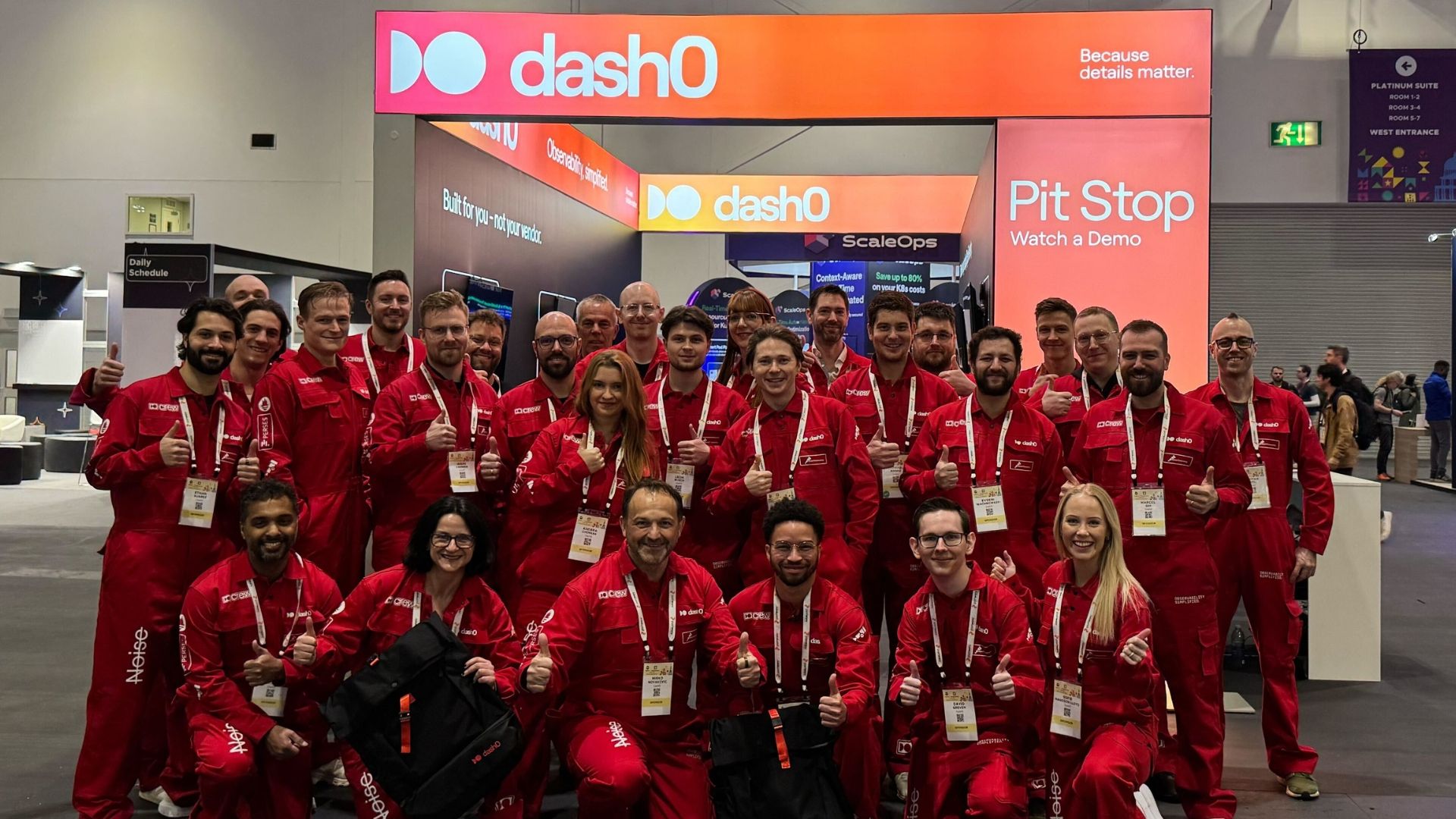
The company opened its beta in September 2024 and announced a $9.5 million seed round that November. Early design partners included catchHR, ChargeTrip and Porsche Digital. It was a crowded entrance, but the premise was specific: preserve standard instrumentation, then make the day-to-day search through it less punishing.
A filter with a business model attached
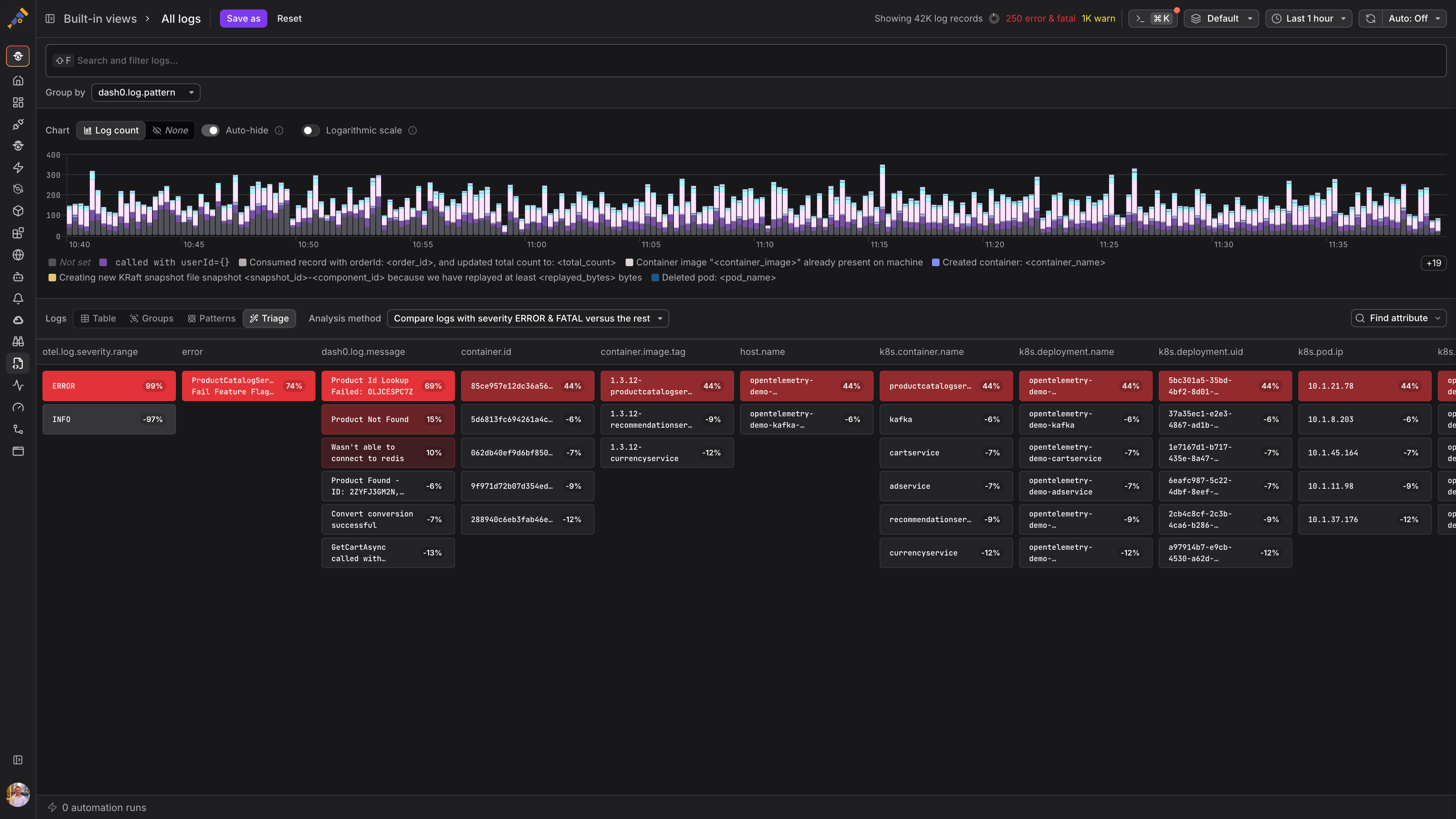
In March 2025, Dash0 introduced SIFT: spam removal, improved telemetry, filtering and grouping, and triage. The name is a little too neat, but the first step is worth dwelling on. Dash0 lets users turn unhelpful telemetry into a spam rule before those records reach storage. The rules can be exported as OpenTelemetry Transformation Language and run in a customer’s own collector. That turns a click in the interface into a portable operational decision.
The price list reveals why this is more than a product flourish. Dash0 charges for signals ingested and separately for signals kept in storage. As of September 2026, one million log records or spans carry a listed ingestion charge of six cents and a 30-day storage charge of 54 cents; metric data points have their own lower rates. Filtering after ingestion does not erase the ingestion charge, but it can avoid storage charges. Agent0 actions are billed in credits, while AI Coding Insights is priced per user. Customers can see the levers instead of guessing which field made an invoice swell.
For one million log records at the public rates: $0.06 to ingest + up to $0.54 to store for 30 days. If SignalControl drops records before storage, the storage portion for those records falls away. Actual bills depend on signal mix, retention and volume tiers.
There is a tradeoff. A filter can remove the one clue that later turns out to matter. The sensible copyable lesson is to start with obviously repetitive records, inspect what the rule would discard, and keep the rule in version control. Dash0’s model rewards that discipline. It cannot substitute for it.
The 3 a.m. test
The Telegraph offers a more useful test than a product diagram. Its platform team had hundreds of services and separate homes for alerts, logs and metrics. When an alert fired, engineers had to assemble the story themselves. In Dash0’s published customer account, the team says it brought those signals into one investigation flow and can now capture all website traffic rather than relying on heavy sampling. It reports that some root-cause searches that took hours can take seconds.
“The biggest shift is that we spend less time answering the question, ‘Where do I even look?’”A viadee engineer, describing its Dash0 rollout
That statement describes the product better than a long feature list. A developer can follow a request from browser activity into backend services, move from a log to its trace, inspect the resource attached to both, and build a dashboard or alert from what they find. Dash0 also offers synthetic checks, real-user monitoring, PromQL queries and Kubernetes views. These are familiar tools. Their value lies in reducing the number of joins a tired person must perform mentally.
The German consultancy viadee reports a similar, smaller-scale benefit: meaningful traces in one or two days in Kubernetes-based setups, then a reusable approach for different client environments. Its requirement was to instrument once and retain the option to connect to another backend. Open standards do not make migration effortless, but they give a buyer more room to leave than a proprietary collector does.
From seeing the fire to writing the fix
The company’s own ambitions changed as AI coding tools accelerated. Agent0 arrived in November 2025 as a collection of specialists with names such as Seeker, Oracle and Threadweaver. At general availability in June 2026, Dash0 described a workflow in which an agent can inspect production signals, follow an issue into code and draft a pull request for human review. That last phrase matters. A plausible patch is a proposal, not proof that an outage is over.
Dash0 also widened its map. It acquired Lumigo in February 2026 for AWS and serverless expertise, then Polar Signals in August for continuous profiling across CPU, memory and GPU workloads. SignalStore is the data layer meant to hold logs, metrics, traces, profiles, events and web activity under open interfaces. Darkplane, introduced in July, looks upstream at AI-written code and its route into production. The company is trying to connect the change that caused a problem with the telemetry that exposes it.
A $35 million Series A in October 2025 and a $110 million Series B led by Balderton Capital in March 2026 gave that plan a large budget. The company says it serves more than 800 customers, including Zalando, Taco Bell and The Telegraph. Its commercial alternatives are plain enough: Datadog, Dynatrace, New Relic and teams willing to operate their own Prometheus, Grafana and Loki stack. Dash0’s case is strongest where a team already values OpenTelemetry, wants its signals connected, and resents paying to retain data nobody reads.
The central question remains almost comically old-fashioned. When a system breaks, can the person responsible tell what happened, and can they do it before customers tell them? Dash0’s answer begins by throwing away the wrong evidence. For a company that sells access to data, that is a revealing place to start.