A film can reach your television before the popcorn bowl is washed. The movie theatre must make a more elaborate case. It asks for shoes, a journey, a showtime, and the temporary surrender of the remote control. Sara Moore's job is to make that trade feel generous. As Executive Vice President and Chief Marketing Officer of Cineplex, she markets an experience whose magic depends on people agreeing to be in the same dark room at the same time.
That is a wonderfully inconvenient product. It is also the point. A streaming menu offers abundance; a cinema offers an occasion. Moore's public language returns to this distinction through words such as escape, immersion, connection, and ritual. She does not speak only about the title on the screen. She talks about the sensory and social machinery around it: big sound, loved ones, recliners, and, inevitably, popcorn.
Her remit explains why. At Cineplex, Moore oversees brand strategy, creative services, content and social marketing, loyalty, consumer insight, and guest services. The list stretches from the first invitation to the last human interaction. Marketing, in this arrangement, is not a decorative curtain hung in front of the operation. It includes the ushers, data, rewards, interfaces, and tiny frictions that decide whether a promised night out becomes a good one.
The long route to the lobby
Moore did not arrive in cinema by travelling a straight industry line. Her earlier marketing positions crossed Rogers Wireless, Alliance Atlantis Broadcasting, Yahoo! Canada, and Mobilicity. The sequence reads like a compact history of how Canadian consumers learned to carry entertainment and information closer to themselves: broadcasting, web portals, mobile devices, and wireless service.
Then, in October 2011, she joined the Canadian Football League as vice president of marketing. The league was approaching the 100th Grey Cup, a rare brief in which an anniversary comes with a silver trophy, a national memory, and the pressure not to treat either like museum furniture. Moore joined the executive management team and took responsibility for research, creative development, advertising, and marketing communications across platforms.
The centennial celebration sent the Grey Cup through more than 100 Canadian communities, including Iqaluit. A trophy usually waits for people to come to it. This one went travelling. The gesture says something about Moore's recurring work: established institutions stay vivid when their rituals leave the archive and re-enter ordinary life.
At the CFL, modernization took several forms. Reebok developed complete Signature Uniforms intended to be bold, while the #MyGreyCup partnership with retailer eLUXE paired a major sporting event with fashion and female-focused outreach. Moore noted that the league had millions of female fans. Tradition was not being abandoned. It was being given more doors.
She later became senior vice president of business operations for the Toronto Argonauts, where the assignment widened from league marketing to the mechanics of a club and its game-day experience. By the time she joined Cineplex in 2019, Moore had spent years learning how an audience becomes a crowd, how heritage can attract rather than intimidate, and how an event earns a place on the calendar.
One experience, five handoffs
Cinema presents a similar sequence in more upholstered surroundings. The customer sees a post, checks a listing, chooses a seat, scans a loyalty card, enters a lobby, orders food, and settles into an auditorium. Each moment belongs to a different operational system. To the guest, it is one evening.
This is where Moore's operator sensibility matters. A clever campaign can put somebody in the booking flow. It cannot compensate for a clumsy arrival or an indifferent response when plans go wrong. Putting guest services and consumer insight beside creative and brand work creates a feedback loop: the promise travels outward, experience comes back as evidence, and the next invitation can be sharper.
In 2021, the national Where Escape Begins campaign made its case as a love letter to the theatre. Moore described moviegoers wanting to reconnect and recharge with loved ones, then pointed to the sights, sounds, and popcorn found in the cinema. It was emotional language attached to physical details. Escape was not a vague mood. It had a place, a smell, and a seat.
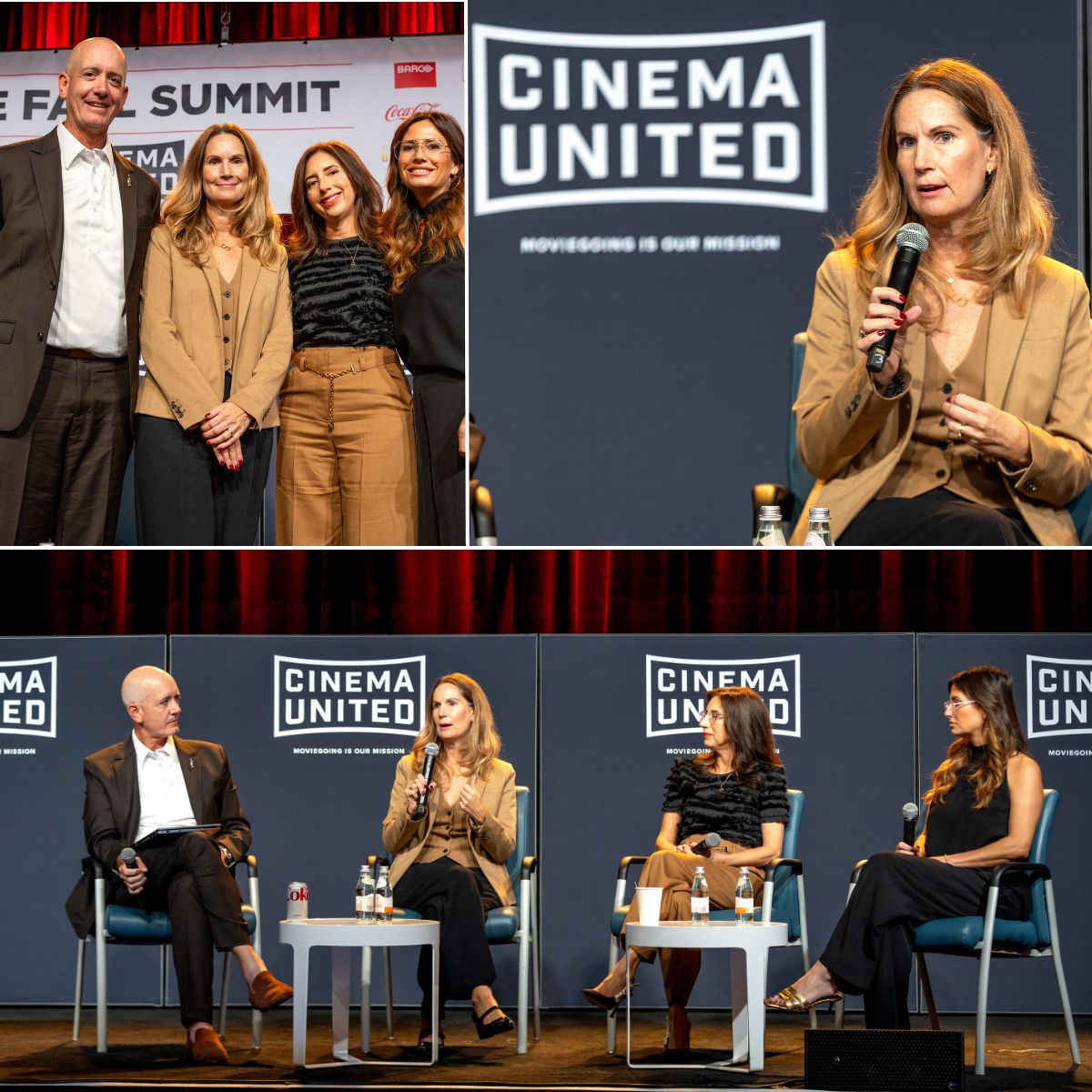
Four years later, at Cinema United's 2025 Fall Summit, Moore joined a panel called Beyond Popcorn: Building a Branded Experience. The discussion ranged across social media, artificial intelligence, audience insight, and the need for cinemas to own an identity beyond the studio marketing attached to each film. The conclusion was practical: digital and in-person experiences have to reinforce one another if a brand wants loyalty rather than a sequence of transactions.
The vertical feed meets the wide screen
The direct collision of those worlds came in 2022, when Cineplex brought curated TikTok videos into its theatrical pre-show. A feed designed for a phone appeared in vertical form on cinema screens. The partnership gave advertisers a new format and moviegoers a familiar kind of content in an unfamiliar frame.
There is an enjoyable contradiction in the idea. The phone's compulsive entertainment feed was recruited to warm up a room where everyone would soon be asked to ignore the phone. Moore framed the program around creativity, creators, and original pre-show content. The theatre did not need to pretend the smaller screen had never happened. It could borrow its language, enlarge it, and move the audience toward a shared feature.
When convenience changes a category, do not market inconvenience as virtue. Make the trip produce something the convenient option cannot: ceremony, scale, service, and a memory shared on the same clock.
The same thinking appeared around the theatrical release of Taylor Swift's concert film. Cineplex offered private auditoriums for groups of at least 50. Moore emphasized friends and family coming together for big screens and big sound. A filmed concert could, of course, be watched. The offer was to turn watching into attending.
Popcorn gets top billing
Then there is popcorn, the product that refuses to accept its supporting role. Cineplex has repeatedly built National Popcorn Day promotions around Scene+ membership. In 2024, Moore called popcorn the real star in the creation of movie memories. By January 2026, Cineplex had expanded the celebration to four days, and her phrasing had become even cleaner: “Popcorn isn't just a snack, it's part of the ritual of going to the movies.”
Marketers often hunt for a grand idea when the useful symbol is already making noise in a paper bag. Popcorn carries aroma, texture, anticipation, nostalgia, and a reliable amount of debris. It is ordinary enough to be democratic and specific enough to summon the theatre. Making it a loyalty reward does more than reduce a price. It restarts a familiar sequence: ticket, scan, bag, seat, lights.
Moore's own public communication has a little of that category joy. A recruitment post for a loyalty and guest-insight leader asked for someone “customer-obsessed,” promised excellent colleagues, and arrived with the expected popcorn and clapperboard emojis. When Cineplex's in-house creative team won two Silver Awards in 2025, she praised not a solitary genius but the briefers, brainstormers, photographers, videographers, makers, editors, designers, animators, producers, and polishers. The credits mattered.
That collaborative emphasis is consistent with the job. A CMO responsible for the whole guest journey cannot build the result alone. The loyalty analyst and the person who photographs a menu are working on different surfaces of the same experience. Moore singled out creative leader Mike Lucas while returning attention to the larger group. Movie magic, in this telling, has a production schedule.
A wider view from the boardroom
Moore's work now extends beyond Cineplex. She serves on Porter Airlines' board of directors and has earned the ICD.D designation from the Institute of Corporate Directors. Aviation offers another experience assembled from many handoffs: search, booking, arrival, waiting, service, and destination. It is not difficult to see the relevance of a leader accustomed to watching where brand promise meets physical operation.
Her Queen's University degree, completed in 1991, combined political science and history. It is tempting to give that pairing too much biographical magic. Still, both subjects train attention on institutions, behaviour, and the stories groups tell about themselves. Moore's professional career has repeatedly landed where those things become commercial questions.
The thread from Yahoo! Canada to the CFL to Cineplex is not a single medium. It is attention shaped into participation. Sometimes the invitation is a redesigned football uniform. Sometimes it is a vertical video on a very wide screen. Sometimes it is a bag of popcorn offered to a loyalty member. The object changes. The human hope remains modest and difficult: come out, bring someone, feel part of it, and want to return.
For cinema, that final return is the entire plot. Content will continue to multiply at home. The theatre cannot win by pretending abundance has vanished. It can make occasion feel scarce. Moore's work suggests the defensible part of moviegoing is not merely projection quality or the size of a recliner. It is the sequence of small agreements that turns a film into a night people had together.