There is a small joke in Sanket Kumar’s professional biography, and it does more work than most biographies manage in three solemn paragraphs. He is qualified, he says, to do electrical engineering. What he does instead is persuade people to care about cloud databases. It is the sort of joke an engineer makes after discovering that a circuit diagram and a sales territory are not entirely different creatures. Both have nodes, resistance, signal and the occasional expensive failure.
Kumar’s route to Tessell, where he works in enterprise growth for North America, is not a straight line. It begins with a Bachelor of Technology in electrical engineering at Government College of Engineering Kannur. It then passes through property sales, employee-benefits software and mobile-linking infrastructure before arriving at the peculiar, consequential world of enterprise databases. The products became more technical with every move. The buyers became larger. The conversations became longer.
The durable skill was translation. A salesperson working with database teams cannot simply arrive bearing enthusiasm and a calendar link. The customer may be deciding where critical Oracle workloads should live, how to recover them, who controls encryption keys, how much cloud capacity costs, and whether moving anything will cause an application to sulk at three in the morning. The vocabulary is technical because the risk is real.
The apprenticeship of the difficult product
In September 2020, Kumar joined Realty Assistant as a pre-sales executive. Four months later he moved into a sales executive role. Property is a useful first classroom for a seller: the purchase is important, the customer is cautious and the distance between interest and decision can be large. There is no hiding from follow-up. A missed detail tends to return wearing shoes.
He moved to Nova Benefits in January 2022 as a business development representative for the Asia-Pacific region. By October he had become a senior BDR; in March 2023 he stepped into an account executive role. Here the object of the sale changed from buildings to software and services for employers. The pattern, though, was becoming visible: Kumar entered at the edge of a sales organization, learned the product and buyer, then took on more responsibility.
Branch brought him into North American sales in October 2023. His manager was Rohit Mishra. In six months, Kumar moved from SDR to Senior SDR. Mishra later described him as an unusually dependable quota carrier, but the more interesting part of the recommendation concerned conduct: ownership, execution, consistency and a willingness to show other people what worked.
Look closely at the titles and another pattern appears. Pre-sales executive became sales executive. Business development representative became senior BDR, then account executive. SDR became senior SDR. The nouns barely changed; the responsibility did. Kumar’s résumé is a staircase built from small, legible promotions rather than ornamental leaps. That matters in a profession where activity is easy to count and judgment is harder to see. More calls can fill a dashboard. Better qualification, sharper research and steadier follow-through reveal themselves more slowly, in the quality of a pipeline and in whether teammates borrow the method.
A career measured in increasing complexity
Property sales
Benefits software
Mobile infrastructure
Cloud databases
“Electrical engineer by training. Somehow the universe decided cloud databases needed me.”Sanket Kumar, describing his professional detour
A manager returns to the same address
Careers produce all sorts of endorsements. There are titles, recommendations and awards, each polished for display. Then there is the endorsement that requires a budget: someone hires you again.
When Mishra moved to Tessell, he wanted Kumar on the team. Kumar joined in September 2024 as the first hire in a new go-to-market group. The move says something precise about professional trust. A manager who has already seen the missed calls, the difficult weeks and the unglamorous middle of a quarter has fewer illusions than a new interviewer. Repeat hiring is not nostalgia. It is due diligence with a memory.
At Tessell, Kumar helped build pipeline with some of the company’s largest target accounts. His title, Founding GTM - Enterprise Growth (North America), covers a job in which technical literacy and commercial patience have to share a desk. Tessell’s platform manages Oracle, SQL Server and open-source databases across major clouds while keeping data in the customer’s account. The pitch sits where infrastructure, cost, governance and organizational habit meet.
This is useful terrain for an engineer who chose sales. Engineering training does not guarantee an excellent seller, of course; a multimeter has notoriously poor rapport. But systems thinking helps. It encourages the habit of looking for dependencies, finding the source of resistance and asking what will fail if one piece moves. In enterprise selling, those are not merely technical questions. They are the map of the decision.
The first hire remembers being first
Kumar’s public manner is lighter than the enterprise subject matter might suggest. When Mishra marked ten months at Tessell and celebrated growing a BDR team from its first hire to seven people, Kumar appeared in the comments with a question: who, exactly, had that legendary first hire been? The answer did not require a database.
A colleague gave him a grander title: “Sanky, First of His Name, King of Pipeline Generation, Breaker of Quotas.” It is office banter in full ceremonial dress, and it hints at how Kumar sits inside the team. Colleagues describe him as collaborative, proactive and receptive to feedback. Mishra credits him with mentoring others and sharing what works. None of this is the lone-wolf mythology sometimes attached to sales. Pipeline may appear beside one person’s name, but the machinery behind it is social.
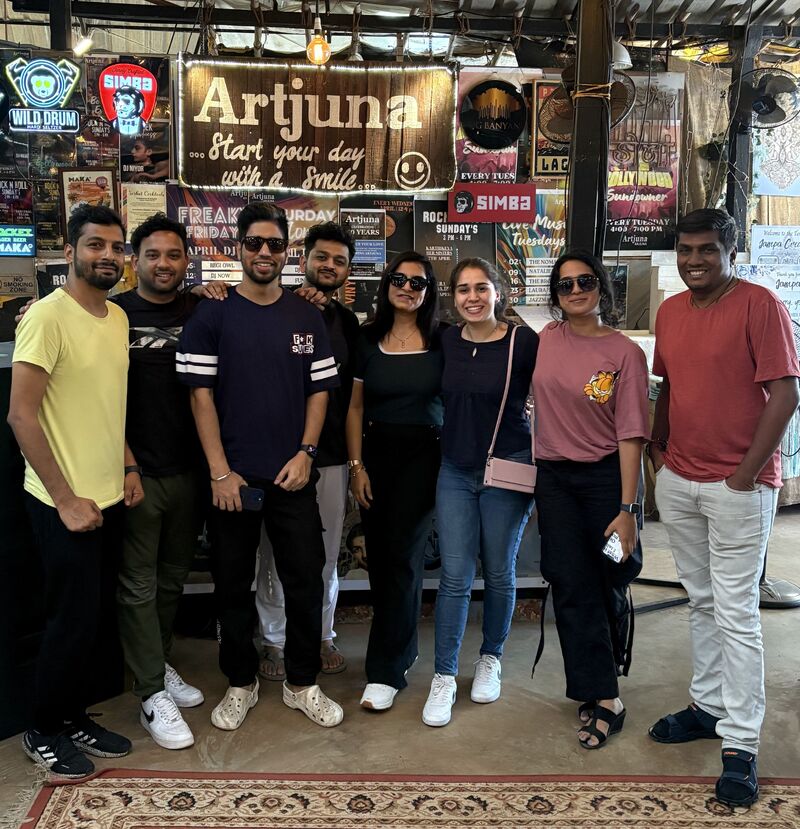
That instinct was visible in April 2025, when Tessell announced a $60 million Series B led by WestBridge Capital, bringing its total funding to $94 million. Kumar turned the company milestone into a recruiting note. He listed open BDR and senior BDR roles, named the people a candidate would work beside, praised the chance to learn, and attached a picture from the team’s first trip to Goa. The money was news. The team was the story he chose to tell.
The timing mattered. Tessell said the round would accelerate go-to-market expansion and research into AI-powered data management. The company, founded in 2021, was serving more than 40 large enterprises at the time of the announcement. A larger ambition requires more than a clever platform. It requires people who can enter an organization full of existing systems and explain a new operating model without insulting the old one.
It also requires restraint. Enterprise buyers have heard every adjective in the software cupboard. They do not need another promise that complexity has vanished; they need to know where the complexity went, who now carries it and what control they retain. Tessell says its control plane holds metadata while databases and backups remain inside the customer’s cloud account. For a growth operator, the distinction is the conversation: not merely what the platform can do, but what the customer does not have to surrender in order to use it.
Selling control, not novelty
Cloud software is fond of promising reinvention. Databases are less impressed. They carry years of decisions, dependencies and institutional scar tissue. Tessell’s proposition is therefore an interesting commercial problem: give enterprises a single way to manage databases across clouds while leaving the data, keys and governance in the customer’s own account. The offering is new; the reassurance rests on respecting what already works.
Kumar’s own career has a similar shape. He did not abandon engineering so much as move its habits into another context. At Branch and Tessell, the product demanded technical curiosity. In sales, that curiosity had to become useful to someone else. It had to reduce confusion, uncover a constraint or make the next decision less hazardous.
There is a temptation to make every career pivot sound like a dramatic act of self-invention. Kumar’s looks more practical. Start somewhere. Learn the buyer. Take the promotion. Move toward harder products. Keep the relationships strong enough that a former manager calls again. The result is not a cinematic leap but a sequence of earned adjacencies.
A repeat hire is a reference letter with a payroll attached.
His public record remains notably work-centered. There are no manifestos about disruption, no claims to have solved the ancient problem of human persuasion. Instead, there is a concise joke about an electrical engineer in cloud databases; a record of promotions; a manager’s confidence; a recruiting post that names the team; and a colleague’s affectionate, faintly ridiculous royal title.
The geography adds one last turn. His schooling included Kendriya Vidyalaya campuses in Port Blair, Mumbai and Visakhapatnam. His engineering degree came from Kannur. His early roles served Indian and Asia-Pacific markets; Branch and Tessell shifted his attention to North America; today his work is anchored in the San Francisco Bay Area. The career has widened by territory as well as product, without losing the modest recurring task at its center: understand the person across the table well enough to make a complicated decision possible.
Taken together, they describe a recognizable kind of operator. He is ambitious without pretending the work happens alone. He is technical without insisting that every explanation sound technical. And he appears to understand a truth that engineers and sellers eventually meet from opposite directions: a system works only when the connections hold.