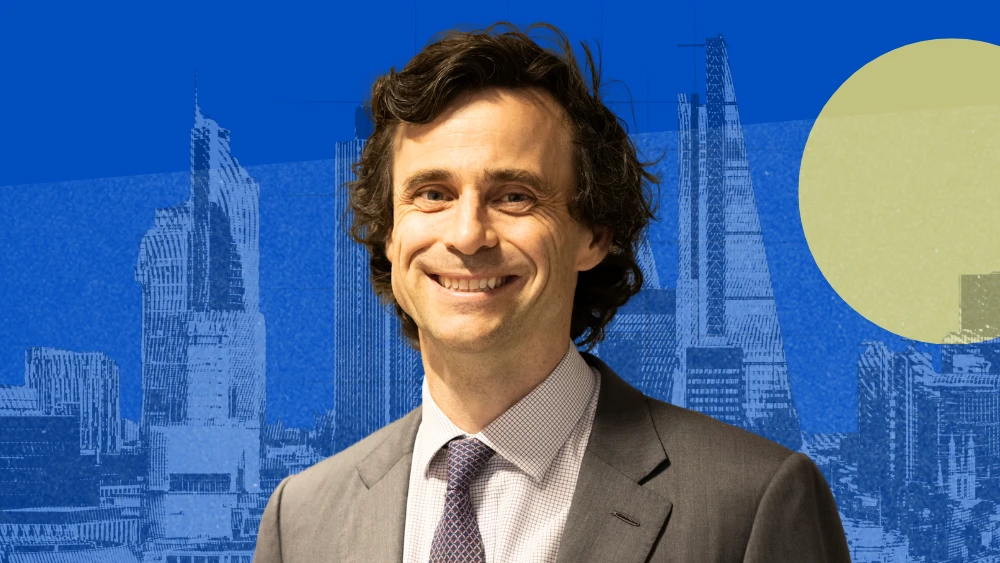
From Desert Trails to the Front Lines of Legal AI
There's a detail in the podcast title that tells you something about John Haddock: "Phoenix desert trails, a decade scaling Stripe, and now CBO at Harvey." In the podcast world, titles are calibrated. Someone chose to lead with the desert trails. That choice is intentional - this is not someone who arrived at his current vantage point by the most obvious path.
Haddock grew up in Phoenix, Arizona. He eventually landed at Stanford, where he did something unusual: he pursued a JD and an MBA simultaneously - Stanford Law and Stanford GSB, from 2012 to 2015. Along the way, he clerked for Judge Kimba M. Wood in the U.S. District Court and summered at Wachtell, Lipton, Rosen & Katz, one of the most elite and selective law firms in the world. This was someone with the option to become a very traditional kind of lawyer.
He didn't. In 2014, while still finishing his degrees, he took a business development role at WhatsApp - this was before the Facebook acquisition closed. By early 2015, he was at Stripe.
Over the next ten years, Stripe was his classroom, laboratory, and proving ground. He moved through roles that spanned the entire company: Risk Product Lead, General Manager of Banking-as-a-Service overseeing Card Issuing and Banking products, and ultimately Head of Enterprise Sales. He was in rooms with the Collison brothers. He helped build foundational products that millions of businesses now rely on. He learned how to move fast inside a company that was itself moving fast inside the financial system.
So much of the lawyer's job today is just piecing together context. Harvey's trying to solve how you pull together all the different pieces of context.
- John Haddock, CBO at HarveyWhy He Left Stripe for a Legal AI Startup
When Winston Weinberg, Harvey's CEO, came calling in early 2025, Haddock did what any former lawyer with a rigorous analytical brain would do: he ran diligence. He asked Weinberg to connect him with customers - not prospects, not cheerleaders, but actual users. He wanted to see whether the product worked in practice, not just in pitch decks. It did. He joined in May 2025.
Harvey is named after Harvey Specter, the fictional attorney from the TV show "Suits" - a detail that either amuses or annoys you depending on how seriously you take yourself. The company was founded in 2022 by Weinberg and Gabriel Pereyra, backed by Sequoia, Kleiner Perkins, OpenAI's Startup Fund, and Elad Gil. Its core insight is that the legal profession handles enormous volumes of structured, precedent-driven work - exactly the kind of domain where AI models, trained on the right data, can unlock compounding gains.
Haddock's role is to make that insight legible to law firms. He oversees strategy, partnerships, customer success, and all go-to-market activity. His direct team includes a 50-person group composed almost entirely of former Big Law attorneys - former partners, associates, and counsel who understand both what lawyers need and how to speak to them credibly. It is, in essence, an in-house law firm embedded inside a tech startup, and it is Haddock's organizational design.
How He Thinks About Selling AI to the Legal World
Law firms are not fast-moving technology adopters by nature. They are built around precedent, risk aversion, and client confidentiality. Selling them a generative AI platform requires more than a good demo. Haddock's framing is practical: Harvey should be the "first port of call" when a lawyer faces a client problem. Not a replacement for legal judgment. Not a party trick. The first tool you reach for.
His view on the data problem is characteristically direct. The conventional argument in AI circles focuses on model capability - which LLM is smarter, faster, or cheaper. Haddock pushes that framing aside. Data is the binding constraint, not hype. Harvey's partnership with LexisNexis, announced in late 2025, is exactly this thesis made concrete: access to better, more specialized legal data translates directly to better model performance in legal contexts.
He manages trust as a product feature. When clients ask how Harvey protects their confidential data, Haddock's answer is structural: Harvey maintains an "eyes-off" policy. Firm data is not used to train models. Client matter information stays within the firm's jurisdiction. The question "how do you replicate and enhance trust?" is not marketing language for him - it's the core design challenge.
On scaling internationally, his record at Stripe proved useful. Harvey launched early with elite UK and European firms - Ashurst, A&O Shearman, Cuatrecasas, Macfarlanes - before the American expansion gained momentum. Canada followed, with Harvey's Toronto office anchored by Gary Lam, a former Netflix and Twitter engineer. Australia came next. Each market has a different regulatory environment, different bar association structure, different culture around technology adoption. Haddock coordinates all of it.
I think of it as a sign of our success in bridging legal AI into the mainstream.
- John Haddock, on viral Reddit criticism of HarveyThe Rare Operator Who Speaks Both Languages
The legal technology sector is full of operators who came from tech and learned law as a second language, and lawyers who went into tech and never quite lost the courtroom cadence. Haddock is something different: he passed through both worlds at an unusually high level before the intersection existed as a recognized career path.
He was at Wachtell, which has no peer in M&A advisory work, before Stripe was building card issuing infrastructure. He clerked for a federal judge before he understood what a payment network was. And then he spent a decade at Stripe - a company that, more than almost any other, rewired how global commerce works at the infrastructure level. The combination is not common.
When Harvey faced a moment of public criticism - a viral thread on Reddit questioning the quality of AI-generated legal work - Haddock's response cut against the typical PR reflex. He called it proof of crossing into the mainstream. That's a specific kind of confidence: not the confidence of someone who hasn't read the criticism, but of someone who has and doesn't think it's the story.
His blog posts reveal a practitioner's instinct. "How CINOs Are Reshaping Law Firm AI Strategy" (July 2025) addresses a specific phenomenon - the rise of Chief Innovation Officers inside law firms who are now driving technology decisions. "Harvey's Principles for AI Adoption and Rollout in Law Schools" (October 2025) addresses a longer-term market development question: if the next generation of lawyers trains on AI tools from day one, what does that mean for the profession? These are not brand awareness plays. They are the writing of someone thinking three moves ahead.
The Roles That Built Him
How He Got Here
What John Haddock Says
"So much of the lawyer's job today is just piecing together context - Harvey's trying to solve how you pull together all the different pieces."
On Harvey's core value proposition"The most important thing I have with my clients is trust. How do you replicate and enhance that trust?"
On AI adoption in law"I asked Winston to put me in touch with a whole bunch of different customers to validate Harvey's actual capabilities versus market hype."
On his diligence before joining Harvey"Data - not hype - is the biggest constraint in AI performance."
On legal AI's real ceiling"We expect firms to be careful as they make technology choices, but it's been a great sign of momentum that so many firms are now embracing it."
On Harvey's adoption momentum"Harvey needs to be where lawyers do their work - that means wherever they are, on whatever device they're on."
On Harvey's product philosophy