The factory gave Samuel Tan’s team half an hour. Machines had to be powered down for a safe installation, and an Indonesian plant could offer the lunch break. When the bell marked its end, two production lines were sending data to Auk’s cloud dashboard. It is a useful scene to keep in mind when reading about a business devoted to digital transformation. Here, the transformation had an appointment with lunch.
Tan, the CEO and co-founder of Auk Industries, had encountered the problem in operations work: companies wanted to digitalise, yet cost and complexity slowed progress. Auk, established in 2016, set out to make the first steps lighter. Its early office was a garage; some furniture came from offices clearing out. Tan also described an early lesson in building features customers did not need. The team learned to listen more closely before committing engineering effort.
There is a pleasing severity to the factory’s deadline. Half an hour allows a product very little vanity. It must fit into somebody else’s working day. A founder can choose the language of the presentation. The customer gets to choose when production resumes.
Before the dashboard, the production line
Tan’s route into the business ran through places where operations already mattered. At GE Aviation, he worked on a cross-functional response to a high-pressure compressor vane-sector problem affecting new engine builds for Boeing 777 aircraft. He participated in GE’s Operations Management Leadership Program, with its rotational assignments and functional training. An aircraft component has a way of making the consequences of a production delay quite concrete.
At McKinsey, he worked in the Operations Practice on lean manufacturing and supply chains. His projects covered industries including semiconductors, consumer goods, logistics and public transport. His professional biography describes workstreams delivering gains above 20 percent in equipment effectiveness and labour productivity, and reductions above 40 percent in downtime associated with setup and changeovers. These are accounts of his earlier project work, rather than promises attached to every Auk installation.
His education joined engineering with business at the National University of Singapore, where he graduated with first-class honours. His public education entry also records an aeronautical engineering specialisation and a thesis on heat transfer through fluid flow in wavy microchannels. The subjects reach from a narrow channel to an entire enterprise. Each asks, in its own vocabulary, what is happening inside a system.
Read together, these experiences give his subsequent business a particular emphasis. Auk deals with measurements, but the founder arrived with experience of decisions made around those measurements: production scheduling, changeovers, supplier operations, the awkward places where a plan meets an actual machine. The dashboard comes later in that sequence. First comes the work that somebody wants to understand.
What a number is supposed to do
Auk combines industrial IoT hardware with software analytics. The hardware captures activity from connected machines; the software helps teams examine performance, losses and bottlenecks. The company says its edge processors capture 10,000 readings per second from connected sensors, with aggregation performed at the edge. That capacity is a company specification, not a measurement of Tan’s personal productivity, however tempting the joke.
The more revealing detail is the connection between scales. Auk lets teams look at an individual asset and then consider the production line or plant around it. A machine’s local performance and a factory’s output are related, but they answer different questions. Tan’s business lives in the passage between them. Managers need a view broad enough to set priorities and close enough to investigate a particular loss.
Auk’s digital performance management offering connects data across assets and organisational levels. It describes a closed loop: establish a baseline, prioritise an improvement, then check the business result. That last step is an unusually useful antidote to an attractive dashboard. A screen can make activity visible; a baseline makes a claim about improvement testable. There is a difference between having more information and knowing whether the work got better.
For a person with Tan’s operations background, this is familiar territory expressed through a product. The questions remain practical. Where is time being lost? Which problem deserves attention first? Did the intervention help? A factory has ample room for complicated answers. The first question should at least be easy to ask.
A factory result has a human side
In 2019, Tan and fellow Auk co-founder Joseph Lum appeared together as members of the SCS-SMF Manufacturing Tech Interest Group. Their discussion of digitalisation included SATS BRF, subsequently known as Country Foods. Across three processing plants and more than 70 machines, the example reported a 30 percent increase in equipment output and a 25 percent reduction in labour-hours within months of adopting IoT.
The mechanism described was everyday operations work: balancing machine loads and scheduling manpower with real-time equipment performance information. Those figures belong to that particular example. Their interest lies partly in the unglamorous activities beneath them. Someone still has to arrange the work, interpret the constraints and decide how the next shift should run. Technology has a supporting role in a thoroughly human production.
Tan’s public involvement has extended to education, too. In 2022, he welcomed Auk’s collaboration with Singapore Polytechnic, where the company’s industrial IoT solution was being showcased. Bringing the equipment into an educational setting makes the subject tangible. A future engineer can encounter a system as something to examine and use, rather than a phrase to repeat. For an industry crowded with ambitious nouns, this is a welcome service.
The first customer, again
By January 2022, Auk had expanded into Malaysia, Indonesia and Thailand. Tan pointed to Southeast Asia’s manufacturing base, but described the difficulty of entering markets with different regulations and business cultures. His phrase for the process was “getting from zero to one”. The first handful of customers in each country were especially challenging.
That observation complicates the tidy picture of expansion as a set of pins on a map. The product may already work elsewhere. A new customer still has to trust the installation, the support and the proposition. Regional growth asks a founder to repeat an early task under new conditions. Experience helps; it does not abolish the introduction.
“getting from zero to one”Samuel Tan, on entering each new ASEAN market
In a September 2023 radio conversation with Chua Tian Tian, the breadth of Auk’s customer base became a central question. The company described serving businesses ranging from a Nonya confectionery shop in Bedok to Fortune 500 companies. The contrast is memorable because the scale changes so much while the basic operational concern remains recognisable: seeing what equipment is doing and finding useful improvements.
For Tan, that range gives accessibility a commercial meaning. A system intended for different sizes of manufacturer has to survive different resources, expectations and working routines. The small business and the multinational will ask different purchasing questions. Both deserve a product whose practical usefulness can be understood without an extended dictionary of fashionable technology terms.
A handshake in Hanoi
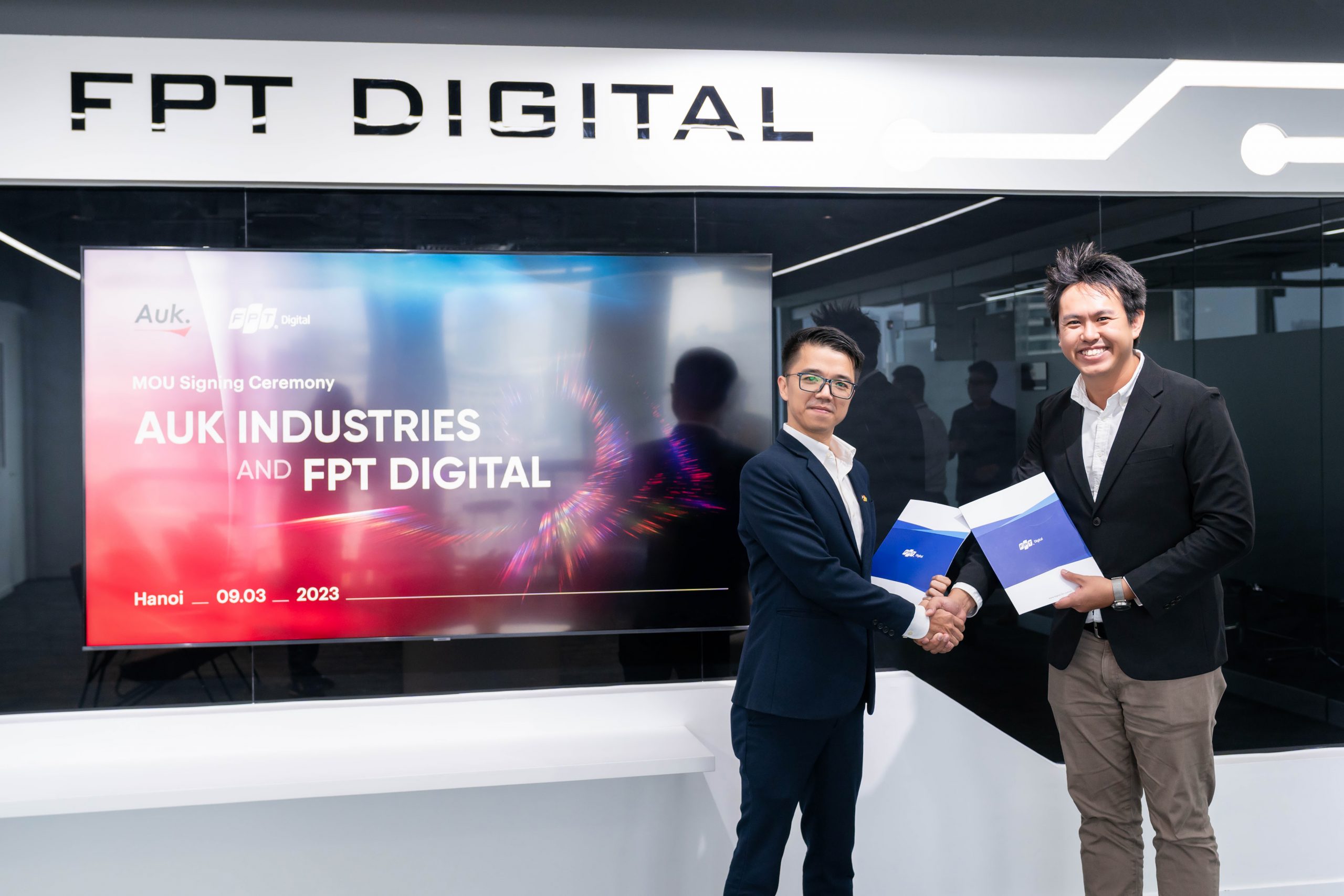
On 9 March 2023, Tan attended the partnership signing between Auk Industries and FPT Digital at FPT Digital’s headquarters. Eu Harn Lee represented Auk alongside him; Le Hung Cuong attended for FPT Digital. The collaboration paired Auk’s operational analytics with FPT Digital’s digital transformation consulting, including work on the transformation roadmap.
The arrangement brings two kinds of work into the same conversation. One concerns the information coming from the factory. The other concerns how a business organises its changes. Neither task becomes trivial merely because the parties have shaken hands. But the division helps explain why a company offering simple deployment can still value extensive relationships around it.
Tan has also spoken positively about the individual investors around AngelCentral, describing useful conversations through the fundraising process and afterwards. There is a consistent preference here for partners who contribute more than a transaction. A founder working with industrial customers needs a network that can stay involved when a conversation becomes an implementation. The calendar of a factory leaves plenty to discuss after the pitch is over.
The factory gets a new interface
In September 2026, Auk announced an MCP integration in beta with selected customers. Through the Model Context Protocol, an AI assistant can connect to Auk’s plant data. The company described assistants reading operational measures such as overall equipment effectiveness, losses, reason codes, runs and rejects. This is a development in the company Tan leads, with customer availability still described as a beta.
The prospect is straightforward: a manager can ask a production question in ordinary language. The foundation remains the machine data and the definitions used to calculate performance. An eloquent answer is only useful if the underlying operational information deserves confidence. The newer interface therefore returns the business to a concern familiar from its earlier work: making factory performance intelligible enough to act upon.
Auk’s stated ambition is to make industrial digitalisation accessible to manufacturers of different sizes, and to involve the people using it. The company takes its name from a seabird, borrowing the image of a light approach paired with a deep dive. It is a rather less burdensome mascot than a rocket. The factory, meanwhile, continues to have its own timetable.
That timetable is a good place to leave Tan’s story. Whether the interface is a dashboard or a conversation with an assistant, useful technology has to earn time in a working operation. The lunch break supplied a memorable early test. The larger task continues every time another team asks what the numbers mean and what it should do next.