The order arrived before the product. Mobashir Mohammad remembers a prospective customer placing a pre-order for something that existed only as a concept. For a researcher accustomed to proving that a wireless protocol worked, this was a different kind of result. Someone with a problem wanted the solution enough to commit to it before the finished device was there.
It is an unusually tidy founding moment for a business whose work happens in untidy places. Ackcio sends readings from industrial sensors through wireless networks, including in tunnels, mines and construction sites. These are environments where a signal has rather more to negotiate than the distance between your sofa and your router. The ground changes. The work changes. The route a message takes may have to change with them.
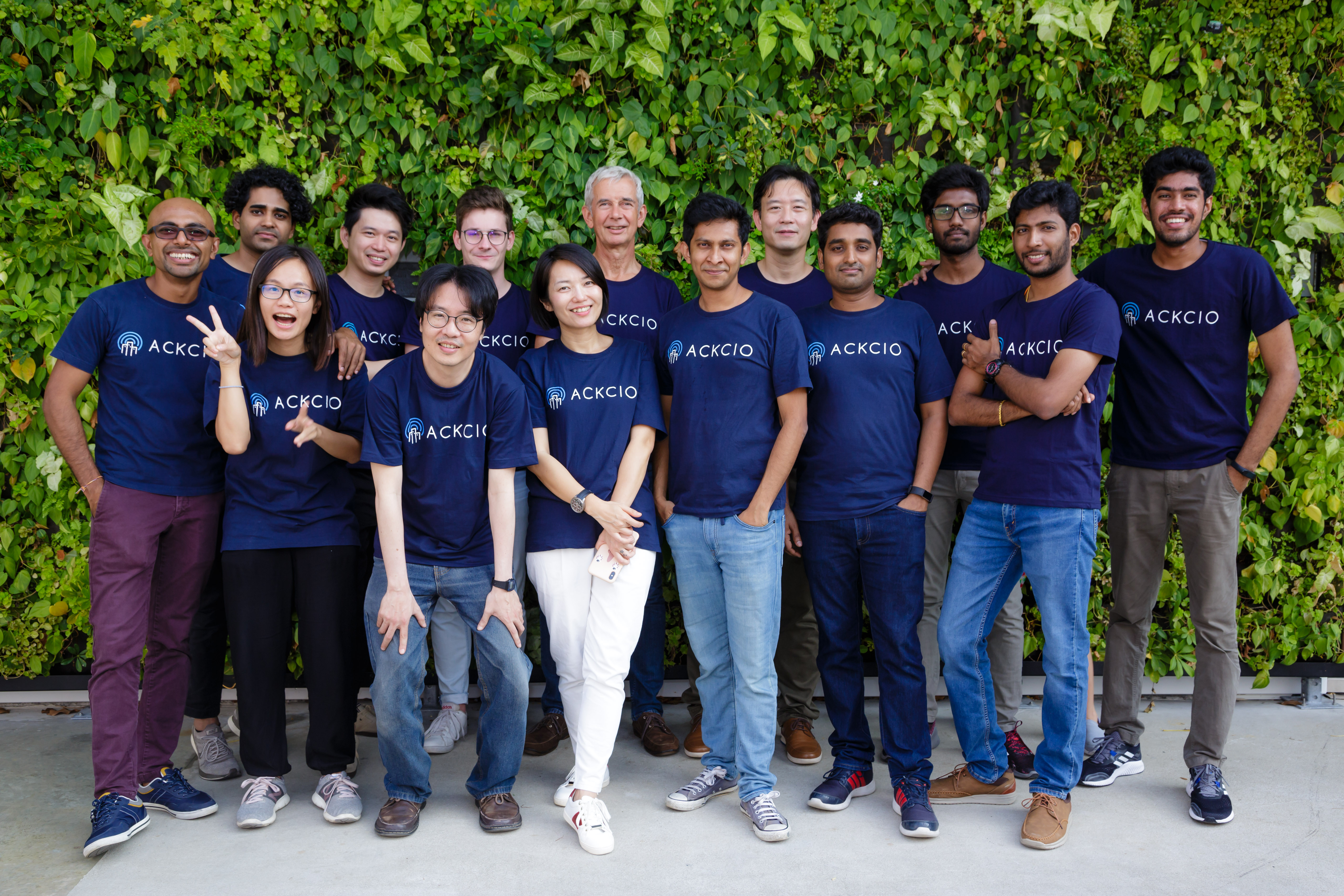
Mohammad co-founded the Singapore company with Nimantha Baranasuriya in 2016. He was its chief technology officer before becoming CEO. Today he leads business operations as well as research, development and product engineering. The early pre-order still explains something about the whole enterprise: the customer’s need gave his research a destination.
Before the laboratory, the family business
He grew up in Kolkata, in a family of entrepreneurs. Working with his father from an early age introduced him to the everyday mechanics of business. By the time a doctorate supplied the technical expertise, starting something of his own already had a familiar shape. Entrepreneur First’s arrival in Singapore supplied an opportunity to bring those two educations together.
His first international journey took him from Kolkata to Singapore in 2012. Ten years later, he marked the anniversary by trying to recreate a photograph taken outside Marina Bay Sands. The building remained reassuringly recognisable. His life had become considerably harder to fit into a single frame.
In that anniversary reflection, he counted a doctorate at the National University of Singapore, building Ackcio with Baranasuriya, and travel to 30 countries for leisure, conferences and business. He also celebrated finding his partner, Mathilda. It was a personal inventory rather than a corporate scorecard, the kind in which a relationship and a company can occupy neighbouring lines.
The affection for travel had been there while he was a graduate student. A career involving trips abroad appealed to him; conferences offered a way to start. Later, the company would operate across six continents. He could permit himself a little joke at the expense of Antarctica, the continent still refusing to join the customer list.
A radio with better manners
His parents’ advice was to “talk less and listen more”. On his personal website, Mohammad jokes that wireless radios obeyed this instruction better than he did. It is a cheerful way into a field with a demanding practical question: how do small, low-power devices communicate reliably when other technologies are filling the air with interference?
At NUS, he worked in Professor Chan Mun Choon’s research group on synchronised, low-power wireless communication. His doctoral thesis addressed dependable wireless sensor networks. The word dependable carries considerable weight here. A connection that succeeds in a quiet demonstration has further work to do before anyone can rely on it in a busy urban environment.
His academic work included Oppcast, which received a best demonstration award at IPSN in 2016, and a NUS Research Achievement Award that year. In 2015 he spent time at Microsoft Research India, collaborating on a smart heating, ventilation and air-conditioning system. Wireless research was already meeting buildings and their practical demands before Ackcio existed.
He also contributed to Indriya, an open wireless research testbed used internationally. An upgraded version, Indriya2, brought support for heterogeneous devices and improved the infrastructure’s handling of data. A testbed lets researchers try ideas on real equipment. It gives an argument somewhere to meet an awkward fact.
This is an instructive part of his background. The work involved making connections usable for other people, as well as making them possible. A research platform has to accommodate experiments it did not invent. An industrial product has to accommodate customers it did not train.
“You don’t have to have a Ph.D. to configure or install our units.”Mobashir Mohammad
Two doctorates meet a construction problem
Mohammad and Baranasuriya met in a NUS laboratory while pursuing their doctorates. They joined the first Singapore Entrepreneur First programme, which ran from September 2016 to March 2017. Their skills were closely related. The useful question was where those skills could remove a difficulty someone was already experiencing.
Baranasuriya’s father, a civil engineer, connected them with construction professionals. Conversations with potential customers exposed the frustrations of monitoring worksites. Those customers shared expertise and gave the founders access to equipment and sites. The design could take its shape from actual working conditions.
Then came Mohammad’s pre-order. His recollection gives the transaction its proper importance without requiring a grand revelation scene. A prospective buyer had supplied an answer to the question every research-led company must eventually ask: would anyone choose this if it became available?
Ackcio was registered on 22 December 2016. Its early work included a long-range wireless mesh system for tiltmeters, developed with instrumentation and monitoring contractors in Singapore. The first Ackcio Beam solution was deployed on Singapore construction sites in 2017. That year, three full-time employees joined the founders at a coworking facility in Block 71, one-north.
The name added a small concession to fantasy. Ackcio draws on “accio”, the Harry Potter summoning spell. The business brings distant sensor readings to the people who need them. It is a pleasing name for a company whose actual magic requires radios, engineering and someone remembering to configure the equipment.
Give the message another way home
Ackcio’s mesh approach allows nodes to communicate with one another on the way to a gateway. A reading can travel through intermediate devices rather than requiring every device to reach the receiver directly. That matters when the environment makes a single path inconvenient or unreliable.
In his demonstrations, Mohammad has explained how devices can find an alternative route when an obstruction interrupts a link. Channel hopping addresses another problem: interference on a busy frequency. The network can switch channels, while remote configuration lets users alter how often readings are taken. The engineering is aimed at keeping data moving as conditions change.
The attraction is easy to understand without pretending that every site needs identical equipment. Manual collection and cabled systems still have applications, especially when readings are infrequent. Deployment, maintenance, power and coverage all enter the calculation. Mohammad’s public explanations discuss those trade-offs. Wireless has to earn its place through the requirements of the project.
There is a human consideration in this technical preference for alternative paths. A construction team has a project to deliver. Asking it to become expert in radio networking adds another job. The founder with a doctorate has therefore spent time explaining why installing his equipment should not require one.
Leave room for the next sensor
Compatibility became another organising principle. Industrial monitoring brings together sensors, data loggers and software that may come from different manufacturers. A customer choosing one component can discover that the choice narrows what can be used alongside it. Mohammad’s approach has been to make Ackcio’s data loggers work with a range of sensor types.
The team studied customer use cases and built a wishlist for its logger. It also designed extra measurement precision into the device, anticipating future sensor improvements. Engineering room for an upgrade could help a customer avoid replacing the logger when the sensor changed. It is a fairly practical expression of optimism: leave space in the specification.
That collaborative outlook extended to software integrations. In discussing Ackcio’s integration with Inzwa’s cloud platform, Mohammad described a goal of simplifying geotechnical monitoring. Collection, transmission and visualisation have to connect if a reading is to be useful. Each handover asks the customer to trust another piece of the chain.
By 2018, Ackcio was exporting to Australia, Indonesia and Thailand. A S$4 million Series A followed in 2021. Its geography continued to widen; by 2026, deployments spanned more than 55 countries across six continents. The work included settings as different as South Africa’s Cradle of Humankind and Britain’s Palace of Westminster.
The cartoonist at the control panel
As a child, Mohammad wanted to be a cartoonist. He continued sketching characters as a hobby during his doctorate. His campus tastes were specific: peanut butter waffles with extra peanut butter, satay with peanut sauce, and bubble wrap to pop. At Microsoft Research, he developed enough enthusiasm for foosball to wish his university had more tables.
These details make room for someone besides the executive. Research years contain small pleasures as well as papers. They also contain rejection. His advice to prospective graduate students was to take setbacks sportingly and keep working, while avoiding the unhelpful sport of measuring progress against apparently tireless fellow candidates.
NUS recognised him among its Outstanding Young Computing Alumni Award winners in 2025. On 1 October that year, it scheduled him to speak on wireless solutions for large-scale infrastructure monitoring. In 2026, he joined Tatler’s Gen.T Leaders of Tomorrow list. The researcher had returned to the university conversation carrying a company’s field experience.
Ackcio’s ambition remains to make reliable wireless monitoring an industry standard. For Mohammad, that means continuing a question he began asking in the lab, now with customers, colleagues and a business attached. The pre-order was an early vote of confidence. Every working installation makes the question more concrete: can this reading reach the person who needs it, when they need it?
Follow the connections
More from Mohammad, his research and the people building alongside him.
- Personal website
- Research publications
- Ackcio
- The founding conversation
- Kolkata, cartoons and campus life
- The ten-year photograph
- Summoning data from sensors anywhere
- NUS alumni recognition
- Gen.T Leaders of Tomorrow, 2026
- Wireless systems and installation
- Designing for sensor compatibility
- Watch the monitoring webinar