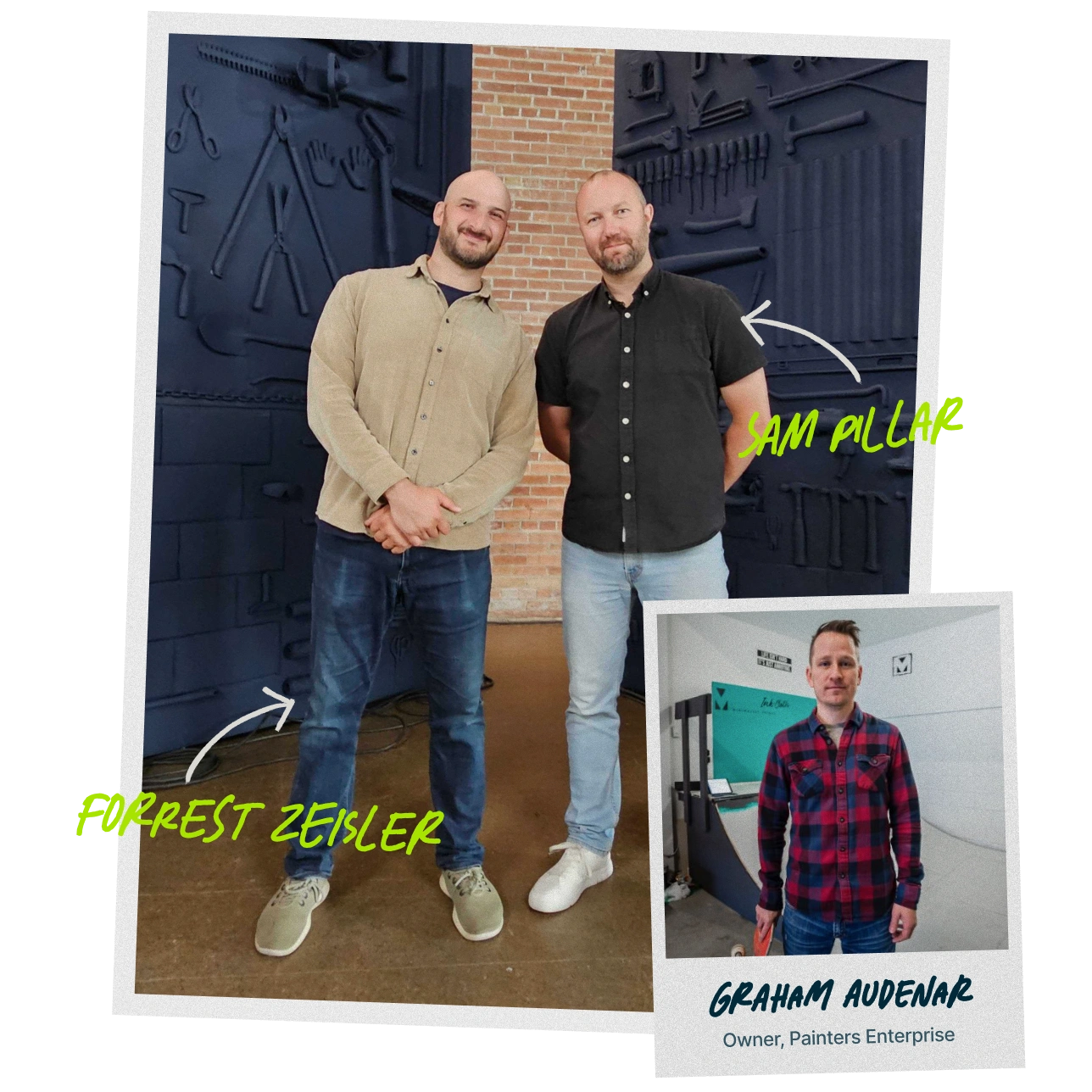
Graham Audenart ran a painting company in Edmonton. Sam Pillar and Forrest Zeisler were building software. The useful part of the arrangement was that Graham could tell them when their work was rubbish. He owned Painters Enterprise, Jobber’s first customer, and the two developers kept returning with versions for him to try. A painting contractor had acquired something rather unusual: a software team willing to hear that its latest idea needed another coat.
That relationship gives Pillar’s story its shape. Before the funding rounds, the expanding staff and the discussions about artificial intelligence, there was a business owner spending too much time administering work instead of billing for it. Pillar had seen the same trouble while freelancing for small businesses. Crews needed to know where to go, what to do when they arrived and how to communicate with customers. The gaps between those tasks were swallowing time.
He and Zeisler launched Jobber in 2011. Their starting ambition was modest enough to fit on an invoice: generate $10,000 a month, cover costs and pay themselves. By 2019, Pillar was discussing ambitions for $100 million and eventually $1 billion in annual revenue. The customer problem had stayed recognizably small. The business built around it had stopped being small at all.
A commerce degree with code in the margins
Pillar grew up in Vancouver and also spent time in Toronto and Regina before attending the University of Alberta in Edmonton. He studied computer science, became interested in intellectual property law, and graduated with a commerce degree focused on business law. His education crossed the boundary he would later spend his working life crossing: how technology works, and what makes people willing to use it.
Management consulting came next. He decided it did not suit him and returned to software through freelance projects for small businesses and nonprofit organizations. This was a useful detour. A freelancer meets the person with the problem directly. There is less room to hide behind an impressive presentation when the client still cannot get the crew to the right address.
The work exposed a mismatch. Business software existed, but the needs of a small service company could disappear inside tools designed for broader markets or larger employers. A painter, plumber or landscaper had a practical sequence to manage. A system that understood that sequence could help without requiring the owner to become a software specialist first.
Pillar’s appreciation for those owners became part of his business judgment. Starting a small service company meant selling, organizing and delivering the work, often with very little separation between those responsibilities. He had found a group whose daily difficulties could tell him more than a tidy market diagram.
Two strangers, one working relationship
The partnership began in an Edmonton coffee shop, where two freelance developers started discussing what they were working on. Zeisler knew someone connected to a painting business that needed the kind of software Pillar was developing. The introduction brought their interests into contact with an actual customer.
Years later, Pillar described an advantage in having started as strangers. Their relationship developed around the business, leaving room for disagreements without the extra worry of damaging an old friendship. They could argue about decisions. Naming the company was one that generated heat.
He has also credited Zeisler with helping him temper his ego. The admission matters because partnership stories often become suspiciously frictionless once a company succeeds. Pillar describes himself as someone who can get energized and lose his anchoring. His account leaves the awkward parts in place: commitment does not remove differences, and a good idea still has to survive a conversation.
Trust accumulated through keeping promises and showing up. There was no established office routine to enforce accountability at the beginning. They had to supply it themselves. The romantic part was the chance meeting. The less photogenic part was returning to work.
“By doing what we said we were going to do, showing up.”
Sam Pillar, on building co-founder trust

The clipboard is a formidable incumbent
In 2018, Pillar identified spreadsheets, carbon copies and pen and paper as Jobber’s biggest competition. It is an unusually revealing answer from a software founder. A clipboard requires no migration plan. Its owner already knows how it works. To replace it, a product has to earn its place in a busy day.
Jobber’s basic proposition followed the work: quote, schedule, invoice and get paid. Different trades could use the same underlying sequence while keeping their own particular jobs. That common ground made it possible to build beyond a custom project for one contractor.
The founders refined their early versions with blunt customer feedback. By the time Pillar spoke about that process in 2023, Graham was still a customer. The longevity is more interesting than a launch-day testimonial. A first customer who stays keeps the founding assumptions within reach, even as the company acquires new departments and new language for what it does.
Another early customer supplied a similar reminder. In 2023, Pillar met Kirk Brown of Kirk’s Lawn Care, Jobber’s fourteenth customer, who had signed up in 2012. Pillar described the meeting as a chance to pause and remember a business that had grown alongside his own. Software companies count subscriptions. People remember who picked up the phone.
- 01Quote
- 02Schedule
- 03Invoice
- 04Get paid
An Edmonton company with a widening map
Pillar’s business took root in the city where he had studied. Edmonton offered an environment in which a young company could recruit and retain people without immediately competing on the same terms as larger technology hubs. He has pointed to the local university and colleges, the quality of their graduates and the difficulty of building early momentum where talent is expensive.
His ambition for the city was substantial. He wanted to build a company on the scale of Shopify while maintaining an Edmonton presence. That gave the familiar startup question of location a different emphasis: how much could be built from the place where the founders already had a foothold?
Recognition followed. Jobber received Start Alberta’s Tech Deal of the Year award in 2021. Pillar was named among EY’s 2023 Prairies Entrepreneur Of The Year winners. The honors belong to different parts of the story, but both reflect a company becoming visible beyond its first circle of customers.
Pillar is now based in Toronto. Jobber’s office map includes Edmonton, Toronto, Vancouver, Kitchener and Boston. The geographic reach has widened without erasing the origin. A coffee shop and a local painting contractor remain a much easier beginning to picture than an organizational chart.
What a hundred million dollars actually measures
In February 2023, Jobber announced a $100 million US growth round led by General Atlantic, with existing investors participating. The planned uses were research and development, sales and marketing, and acquiring customers. Capital gave Pillar more room to build; it also raised the scale of the decisions he had to make.
At that announcement, Jobber reported more than 200,000 service professionals using its software in 60 countries. Its customers had delivered over $13 billion US in revenue during 2022. Those are separate measures: money invested in Jobber, people using the platform and revenue earned by the businesses it serves. Mixing them produces a dazzling number and a poor understanding of the company.
By July 2026, Jobber reported more than 400,000 service professionals across over 50 industries. The growth helps explain why Pillar’s job has changed. A founder can no longer rely on knowing every conversation that led to a product decision.
In his 2025 conversation with Evan McCann, he discussed executive hiring, company culture and the fresh challenges that arrive as a company doubles in size. Staying close to customers remained a central concern. The original feedback loop was simple enough for two people. Keeping its spirit inside a larger company requires deliberate work.
The evening shift behind the day’s work
Pillar’s view of workplace culture has a practical streak. He has argued that people need to understand how their work contributes to the company’s mission and how they can develop. A stocked kitchen and flexible schedules may be welcome. They do not answer an employee’s question about where the job is going.
The same attention to time appears in his conversations about artificial intelligence. With Zeisler and home service entrepreneur Adam Sylvester, he has discussed how AI might help with scheduling, quoting and communication. The attraction is straightforward: these jobs consume hours around the skilled work that customers actually hire someone to do.
There is a considerable difference between presenting an exciting technology and persuading an owner to let it handle part of a working business. Pillar and Zeisler’s discussions return to trust and practical usefulness. Customer service still involves a relationship. Automating an interaction does not make that relationship irrelevant.
In 2026, Pillar appeared with 1-800-GOT-JUNK? founder Brian Scudamore in Jobber Summit programming about systems for growing a home service business. The pairing fits his continuing interest in the operator’s problems: how to organize a company well enough that its owner can pursue the next stage without personally carrying every task.
Listen to one owner.
Build for many owners.
Keep the first habit.
A vintage Mercedes and a very old question
There is a less corporate Pillar in the margins. He has talked about vintage Mercedes and a past as a bicycle courier. These details are welcome precisely because they do not need to become a leadership theory. A founder is allowed to like an old car without its engine representing the future of commerce.
Still, the work he has chosen remains unusually close to ordinary physical life. Someone paints a room, clears a garden or repairs a furnace. Around that service sit appointments, estimates, messages and payments. Pillar has spent fifteen years building a business in those surrounding tasks.
The most revealing measure of his progress may be the continued presence of the people who were there early. Graham could reject a version. Kirk could remember the founders doing the coding and selling themselves. Their businesses make the passage of time tangible.
Jobber now reaches far beyond that original circle. Pillar’s challenge is to keep earning the kind of response that started it: an owner looks at the software, tries it in a real working day and has something specific to say. The company can grow into more cities, more trades and more automation. The question at the other end of the screen remains wonderfully ungrand: will this make tomorrow easier?
Continue the conversation
- Jobber
- Sam Pillar on LinkedIn
- Watch: Tank Talks with both founders
- Read: the co-founder conversation
- Listen: The Hard Part
- Read: Kirk’s Lawn Care reunion
- Listen: AI and home service
- Read: the Edmonton decision
- Read: career and early development
- Read: growing a work culture
- Read: the funding announcement
- Explore: Jobber Summit