The modern manager’s day is an archaeological dig. One promise is buried in Slack, another in the calendar, a third in notes from a 1:1 that occurred three Tuesdays ago. Then comes the hard question: Why has Maya gone quiet? A generic chatbot can suggest empathy and open-ended questions. It cannot know Maya, the reorganization, the two shortened meetings, or the goal that quietly stalled. Rypple.ai was built to know the difference.
Founded in Palo Alto in 2024, the small company started with an accessible proposition: put a personalized leadership coach in every manager’s pocket. No appointment, no executive title, no coaching invoice with four digits. A manager could ask for help with a performance review, a negotiation or an awkward conversation at any hour.
That was useful. It was also incomplete. The manager still had to reconstruct the context, write the agenda, remember the commitment and send the follow-up. The first version solved the thinking moment but left the work intact. Rypple’s product history reads like a company gradually discovering that the enemy was not ignorance. It was managerial entropy.
01 / The turn
From a coach with answers to a system with hands
The September 2024 beta was an on-demand AI coach: ask anything, get personalized guidance, rehearse the conversation. In October 2025, Gen 2 widened the frame. A dashboard arrived, along with more than 50 “Performance Boosters,” 35 field guides, Google Calendar sync and meeting intelligence. Meetings could generate briefs, transcripts and action items. Voice mode followed in November. Slack arrived in December.
By July 2026, Gen 3 made the change explicit. Rypple no longer wanted to be the clever adviser sitting beside the work. It wanted to carry some of the load. Its rebuilt decision engine surfaces a daily “win condition,” watches for people who need attention and turns a spoken or typed sentence into a goal, a scheduled meeting, a drafted note or a prepared 1:1. Messages wait for the manager’s approval before they go out. In people management, that pause is not friction. It is the product behaving responsibly.
02 / The actual product
Three systems, one manager-sized problem
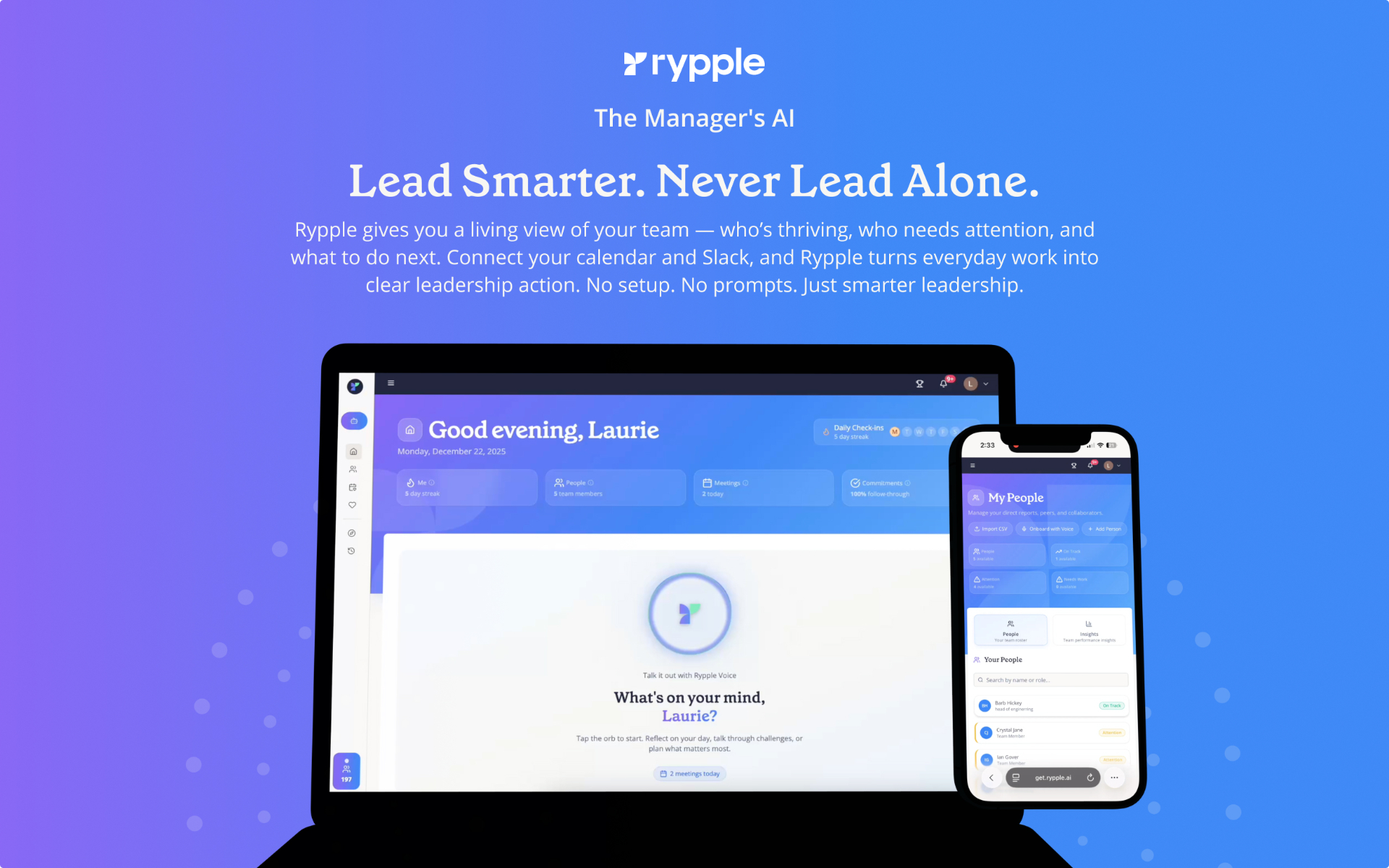
Rypple now describes itself through three connected products. “My People” is the memory: living profiles for reports, peers and the boss, assembled from meetings, notes, commitments and goals. It shows who needs attention and why. “Meetings HQ” is the operating room: preparation before the conversation, voice or transcript debriefs afterward, and action items routed back into the people record. “Ask Rypple” is the interface: a coach available by text, voice or Slack that can advise and, with permission, act.
The distinction from ChatGPT is not raw eloquence. General assistants are perfectly capable of producing a diplomatic feedback script. Rypple’s claim is context: a structured memory of a particular team over time, plus workflow connections. The pitch is that “Maya seems checked out” should not trigger a management textbook. It should trigger an answer informed by Maya’s actual recent pattern, with a draft ready if the manager wants it.
“Managers don’t need more theory - they need support in the moments where management actually happens.”Ian Gover, founder of Rypple
This puts Rypple between several markets. It competes with executive coaching and scalable coaching platforms such as BetterUp and CoachHub; with performance and people systems such as Lattice and 15Five; with work trackers such as Asana; and with general AI assistants. The positioning is less “better chatbot” than a stitched-together layer across work, people and self. Traditional coaching is deep but expensive. HR systems are organized but administrative. Generic AI is flexible but starts nearly cold. Rypple tries to be continuous, specific and cheap.
03 / Who pays
A lunch-priced wedge into the HR budget
For an individual manager, the arithmetic is deliberately undramatic. Premium costs $12.99 a month after a 30-day trial, with unlimited people and conversations. That includes the memory, meeting support, Ask Rypple and leadership workflows. Business plans are sold by conversation rather than a public price list. They add organization-wide billing, Slack and system integrations, onboarding, company playbooks and aggregate views of leadership health and adoption.
The self-serve product is the wedge. A manager gets immediate utility from a prepared agenda or a remembered promise. The enterprise product is the expansion: HR can embed its language, playbooks and escalation rules, then observe patterns such as 1:1 consistency and commitment follow-through without reading private coaching conversations. That last boundary matters. Rypple says the business view is pattern-based rather than surveillance-based.
Customers are managers at every level, especially the “forgotten middle” with little access to formal coaching. The buyer on the other side is an HR or learning-and-development leader trying to support many managers without scheduling another cohort program. Rypple publicly claims more than 15,000 manager users, though it does not publish a roster of customer organizations.
04 / The acquisition
Why Betterworks wanted the moments between reviews
Rypple was backed by AI Fund, Andrew Ng’s venture studio, which featured Ian Gover and the company in a 2025 portfolio showcase. Its disclosed funding amount and revenue remain private. On June 2, 2026, Betterworks acquired the company for an undisclosed price.
The founding team made the category choice less random than it might appear. Gover had spent more than two decades around HR technology and earlier co-founded the talent-development company Everwise. Laurie Hawco brought product, engineering and digital experience; Olivier Malafronte brought coaching practice and research into leadership and AI. Around them, Rypple assembled advisers from HR operations, leadership coaching, data science and academia. The resulting culture, at least in its public philosophy, is skeptical of management theater. Leadership is treated as a practice rather than a title, growth belongs inside the working day, and AI is described as a mirror rather than the manager. That is a sensible creed for software entering conversations where tone, power and careers meet.
The logic is visible without a spreadsheet. Betterworks operates enterprise performance programs: goals, feedback, skills and reviews. Rypple operates in the messy daily moments that create the evidence for those programs. One works from the organizational cycle down; the other works from the manager’s Tuesday afternoon up. Betterworks said the products would initially remain independent while the teams study adoption and identify useful integrations.
The acquisition also explains Rypple’s evolution. A conversational coach can be a feature. A system that connects manager behavior, team context and performance evidence can become infrastructure. The company’s most important change of mind was moving from “help the manager think” to “help the manager finish.” That is the difference between a pleasant session and a product that earns a place in the workday.
The coaching was the wedge. The memory made it sticky. The actions made it software.The Rypple product arc, in one line
05 / The steal
Find the verb your advice leaves unfinished
Founders can copy the sequence without copying the category. Start with a high-anxiety question users already ask. Give a useful answer immediately. Then watch what happens next. If the user must gather context, repeat details, transfer the output, chase a person or remember a promise, those unfinished verbs are the roadmap. Rypple moved from coaching to memory to action because every answer exposed another chore.
The second lesson is to collect context from work already happening. Managers are unlikely to nourish one more pristine database. Calendar events, meeting debriefs, voice notes and commitments are more plausible inputs because they sit inside the existing routine. The third is restraint: show the evidence behind an insight, corroborate a serious concern and keep the human in approval loops. Trust compounds more slowly than context, and disappears faster.
When the idea does not work
- The manager will not connect meetings, calendars or ongoing context. Without memory, the advantage over a general chatbot shrinks.
- The organization treats employee data as a shortcut to automated judgment. Coaching signals are clues, not verdicts.
- The team has no stable management rhythm. Software cannot prepare a 1:1 that never happens or repair trust nobody practices.
- The problem demands a human coach, HR professional, lawyer or clinician. A difficult conversation tool is not a substitute for accountable expertise.
Rypple’s bet is neither mystical nor guaranteed. It asks managers to entrust a great deal of workplace context to software. It depends on clean integrations, careful permissions and people using the system consistently enough for its memory to matter. A vague nudge can annoy; a false high-stakes inference can damage trust. The company’s own product language - evidence, receipts, corroboration, approval - suggests it understands the hazard.
Still, the sharpest detail in the story is wonderfully mundane. The manager does not need another inspirational framework at 4:50 p.m. They need to know what they promised at 10:00 a.m. Rypple built around that gap. Betterworks bought the company. And the humble follow-up, patron saint of competent management, finally got its own agent.
Keep exploring