The first thing Cloverleaf's AI coach had to learn was not to call itself an AI coach. It was 2018. ChatGPT was four years away. Software that promised to understand a colleague's personality and whisper advice before a meeting sounded less like professional development than a prop from a nervous science-fiction film. “It wasn't wanted,” co-founder Kirsten Moorefield later recalled. “It was scary to people.”
So the Cincinnati startup changed the label to “automated coaching.” The technology stayed. The founders kept combining behavioral assessments with prompts delivered inside email, calendars and collaboration tools. Then the world caught up. Today, every serious workplace software vendor seems to have found an AI assistant in the supply closet, and Cloverleaf can finally use the phrase it once had to hide.
That eight-year wait is the most revealing thing about the company. Cloverleaf is not a brand-new chatbot with a leadership-development wrapper. It began with the less glamorous work of mapping how people behave together, then spent years trying to turn that data into something useful at the exact moment a manager needs it.
“The first thing Cloverleaf's AI coach had to learn was not to call itself an AI coach.”The category existed. Buyer comfort did not.
The product started with a better question
Cloverleaf's roots go back to conversations among colleagues at Epipheo, a Cincinnati video studio. Darrin Murriner, Moorefield, Ford Knowlton and Levi Bethune wondered why some workplace cultures felt unusually good. Their conclusion was not a management-poster slogan. Culture, they thought, was produced in the small relationships between peers.
The first public beta, launched in 2016, looked like a culture matchmaker. Team members took personality tests; the software displayed how their traits might interact and let a manager imagine the team with or without a prospective hire. About 700 people used it. Individuals could join free, while the early Pro and Enterprise tiers cost $19.95 and $100 a month.
The sums behind it were equally modest. The founders had put in roughly $10,000. Their first application to Cincinnati's OCEAN Accelerator was rejected. Instead of treating that as a verdict, Moorefield spent the next year interviewing possible customers while working around a newborn's nap schedule. Better feedback produced a sharper product, and OCEAN later accepted Cloverleaf with a $50,000 investment that let Murriner and Moorefield work full time.
The important change was from describing a team to coaching one. A personality report can tell a manager that a colleague prefers direct communication. Cloverleaf wants to appear before the difficult one-on-one and help that manager draft the opening sentence. Static insight became a repeated, situational service.
Three products, one forgotten-PDF problem
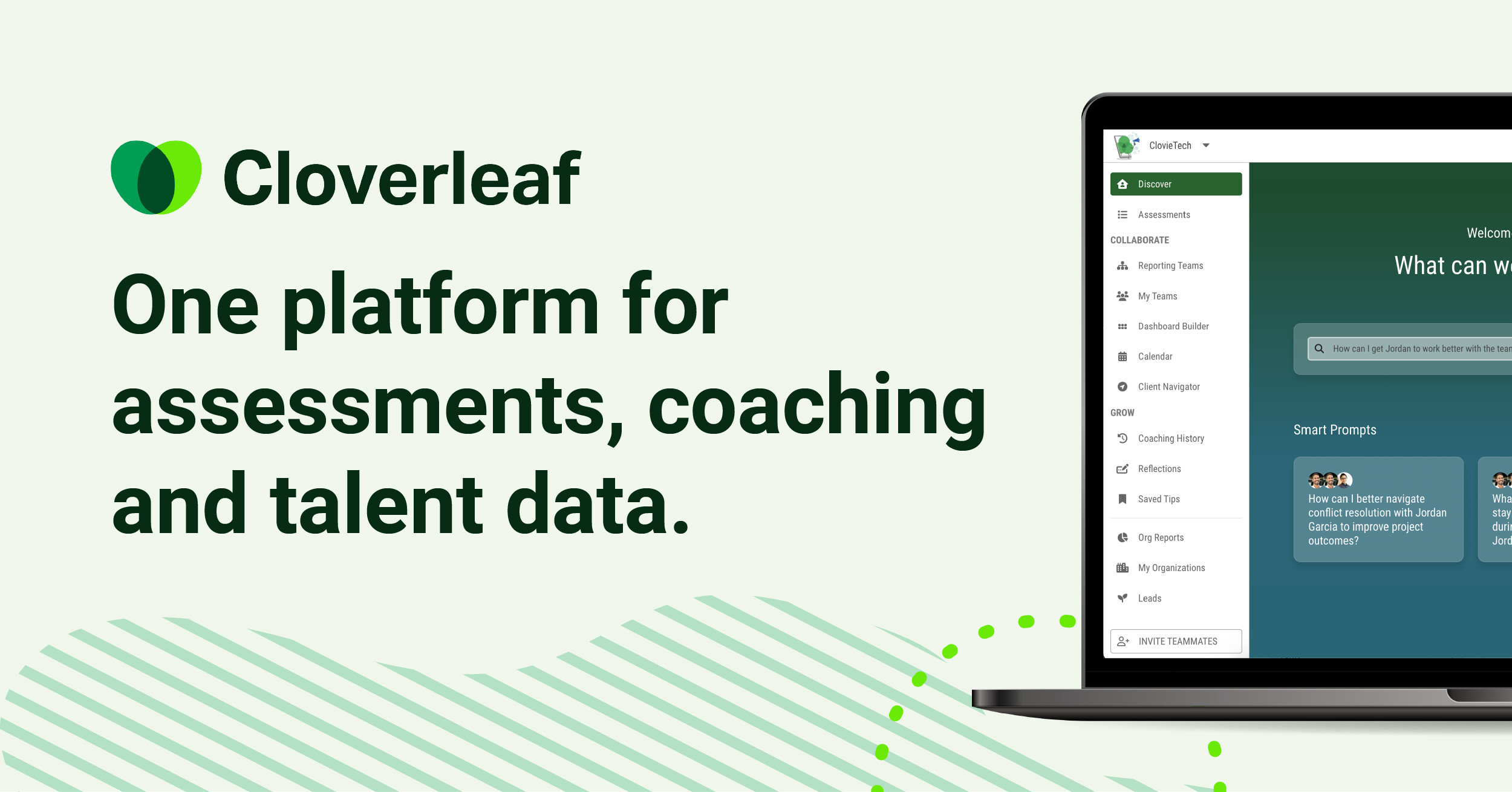
Cloverleaf now packages the business as Assess, Coach and Connect. Assess consolidates up to a dozen familiar instruments in one system, including DISC, Enneagram, 16 Types, CliftonStrengths, Strengthscope and Insights Discovery. Administrators can send tests, track completion and compare team dynamics without stitching together spreadsheets and logins. The company says customers save an average of 32 percent on assessment spending.
Coach is the active layer: daily suggestions, role-play for awkward conversations, 360 feedback, meeting preparation and answers informed by a person's profile and relationships. Connect brings in performance reviews, pulse surveys, skills, culture language and HR-system events. A promotion or a review cycle can become the trigger for coaching rather than another row in Workday.
The design choice is shrewd: employees do not have to remember to visit a learning portal. Coaching arrives where they already spend the day - Slack, Microsoft Teams, Outlook, Google Workspace or email. Workday and SAP SuccessFactors integrations add organizational context. The product can also connect to AI assistants through the Model Context Protocol.
That is Cloverleaf's difference from BetterUp Grow, CoachHub AIMY, Valence and a manager typing questions into a generic chatbot. Its claim is not merely personalization. It is relational personalization. The software considers who a person is dealing with, not only who that person is. It is also proactive: a nudge comes before the moment instead of waiting for someone to ask a bot for help.
The figures are the company's own: 95 percent of engaged users gain learning moments, 67 percent of those moments concern teammates, and 86 percent say team performance improves. They are useful signals, not a universal law of management. The harder proof is whether a nudge changes behavior after novelty wears off. Cloverleaf's reporting dashboards track activity, focus areas and improvement signals, giving talent leaders more than login counts to discuss.
Who pays - and what it costs
For companies, Cloverleaf is quote-based subscription software. HR, learning and development, talent leaders and managers can buy the modules separately and add more later. Large customers receive onboarding, integrations, reporting and security controls. The company advertises launches in days rather than months and holds SOC 2 Type II and ISO/IEC 27001 certifications.
The visible price tags
$2,400, $4,800 or $9,000 a year, with increasing admin seats, client duration, assessments and support.
Services start at $2,500. A 90-minute team session is listed at $5,000 virtual or $7,500 in person.
The second customer is easy to miss: the human coach. More than 150 coaches and consultants use Cloverleaf to remain present between sessions. One engagement at automotive-parts business XL Parts/TPH expanded from one leader to more than 500 users. Software did not replace the coach; it extended the coach's reach without requiring another hour on the calendar.
This channel exposes the business model's practical logic. A consultant sells judgment and trust. Cloverleaf supplies repetition. Its published partner plans range from $2,400 to $9,000 annually, with unlimited users inside client engagements. That lets a solo coach wrap ongoing prompts and dashboards into a larger program instead of billing only by the session.
$20 million bought time for the market to arrive
After the accelerator check came a $500,000 pre-seed round in 2018 and a $9 million Series A led by 1809 Capital in 2022. In March 2024, Advantage Capital led a $7.3 million extension with Conductive Ventures, Origin Ventures, ScOp Venture Capital, JobsOhio, Cintrifuse Capital and 1809 participating. Cloverleaf said the round brought total funding to $20 million and that revenue had tripled since the previous financing.
The customer list now displayed across its site includes Google, Reddit, The Home Depot, Duracell, T-Mobile and Visionworks. Cloverleaf says more than 45,000 teams trust the platform. In 2025 it reorganized the story around Assess, Coach and Connect and introduced a cleaner, accessibility-minded identity. In June 2026, Training Industry placed it on a Top 20 list for AI Coaching and Learner Support Tools. A category that once made people flinch now has a buyer's guide.
“Cloverleaf's moat is not the chatbot. It is the context assembled before the chatbot speaks.”Assessment + relationship + moment
What to copy - and when the trick breaks
The transferable lesson is not “add AI.” It is to find where useful information dies. Cloverleaf saw expensive assessment results stranded in PDFs and training lessons evaporating after workshops. It moved the insight closer to the decision and reduced the number of steps required to use it.
Deliver guidance at the moment of action. The best learning interface may be a calendar event, not a course catalog.
Rename a strange idea without discarding the underlying bet. Market language can lag product truth.
Use structured, permissioned context. Generic prose from a language model is not personalization.
Track behavior and team outcomes over time, not just opens, prompts and completed assessments.
The conditions matter. Cloverleaf is weaker when employees distrust how personality data will be used, when assessments become labels, or when an organization lacks a clear development goal. It cannot rescue a hostile manager, a vague competency model or a company unwilling to hold honest conversations. Teams outside supported work systems will lose the “flow of work” advantage. Too many nudges become notification wallpaper.
And software should not impersonate a human coach in moments requiring confidentiality, clinical judgment or moral courage. Cloverleaf works best as scaffolding: a reminder, a rehearsal room, a translation layer between two colleagues who genuinely want to understand each other. The company's oldest idea remains its strongest one. Culture is built sideways, relationship by relationship. The AI is useful only if it helps the humans do that part themselves.