The interesting part comes just before the money moves. A shopper has found something, considered the price and decided to buy. Then comes the small act of faith: this payment will reach the right place, for the right amount, and there will be someone to call if it does not. Ryan McInerney has spent much of his working life on the other side of that moment.
In September 2026, Visa’s chief executive described a curious gap in the arrival of artificial intelligence. Consumers were using AI to discover products and compare their options. Handing over the actual payment was another matter. “We are seeing adoption for shopping,” he said. The final purchase still tended to happen on a seller’s website. A clever recommendation, apparently, does not automatically earn the keys to the wallet.
That gap gives McInerney’s career a useful shape. Before he ran a payment network, he ran a consumer bank. Before that, he advised financial businesses. His work has repeatedly brought him to the awkward meeting point between a system’s capabilities and a customer’s willingness to use them. AI has made that meeting more fashionable. The underlying negotiation is familiar.
First, learn what happens at the counter
McInerney graduated from the University of Notre Dame in 1997 with a finance degree, then built his early career at McKinsey & Company. His consulting work focused on retail banking and payments, and he became a principal. The subjects that would occupy him for decades were already on the desk: how banks serve customers, how payments work and how large financial organizations change.
He subsequently moved into JPMorgan Chase, holding positions across product management, marketing, operations and risk. Those functions describe rather different working days. Marketing asks why a customer would choose a product. Operations asks how to deliver it repeatedly. Risk asks what happens when the assumptions fail. A banking executive eventually needs answers that can survive all three conversations.
By June 2010, he was chief executive of Chase’s consumer banking business. The scale was substantial: more than 75,000 employees, approximately $14 billion in revenue and a banking network that, when Visa recruited him in 2013, encompassed 5,600 branches. These were businesses with opening hours, employees and customers waiting for things to work. A branch network provides plentiful opportunities for an elegant plan to encounter an inelegant Tuesday.
The distinction matters when considering his later interest in new payment technologies. His background includes the practical machinery of serving people with money at stake. The move to Visa would take that experience into a business connecting financial institutions and merchants across borders, with many more parties needing to agree on how a transaction should proceed.
- 1997Notre Dame finance degree
- Before 2005McKinsey: banking & payments
- 2010Chase consumer banking CEO
- 2013 → 2023Visa president → CEO
Ten years before the top job
Visa announced McInerney’s appointment as president in May 2013, and he joined in June. He reported to Charlie Scharf. The remit included the global client organization, product management and a new solutions group intended to bring products and services to issuers, acquirers and merchants. It was a job positioned where customer needs met product decisions.
Scharf already knew his recruit. At the time, he emphasized McInerney’s payments knowledge, ability to manage large groups and understanding of clients. There is something revealing in the continuity. McInerney entered Visa as an experienced operator whose work and judgment had already been observed, rather than arriving as an unfamiliar name attached to an ambitious presentation.
He remained president through Al Kelly’s leadership. When the board announced the succession in November 2022, his responsibilities stretched across global businesses, market teams, products, merchants and client services. He became CEO on February 1, 2023. The promotion followed nearly a decade spent learning the company’s commercial relationships from the inside.
Kelly described an energetic partner with a detailed understanding of Visa’s operations. McInerney, in turn, acknowledged Kelly’s mentorship. A transition of that kind carries a particular expectation: familiarity should make execution easier, while leaving enough curiosity to question habits. Knowing where the switches are is useful. Deciding which ones to move remains the job.
“I’m on the road all the time.”
Ryan McInerney · September 2023
A global network, seen from the road
Seven months into his tenure as CEO, McInerney was asked how his daily work had changed. His answer began with the activities that continued. “I’m on the road all the time,” he said. He described meeting employees, clients, partners and regulators, and seeing what was happening in the markets where Visa operated.
He also spent time with product and engineering leaders on developments six months out, a year out and as far away as three years. That pairing is instructive: conversations about what customers need today alongside decisions about what they may need after several product cycles. A global payment network has to maintain both calendars.
His appetite for expansion was visible even before he took over. During a November 2022 conference appearance, a count of his remarks found more than 32 uses of the word “opportunity” in roughly as many minutes. The subjects included consumer payments, business payments and international markets. Some executives have a favorite adjective. McInerney appeared to have a favorite opening.
The more consequential point was the breadth of his interests. Visa’s growth could come from extending existing payment relationships, bringing more sellers into digital commerce and supplying additional services to financial businesses. Much of that work depends on partnerships. A payment network becomes useful when institutions and businesses with their own priorities can make it work together.
When the customer sends a machine
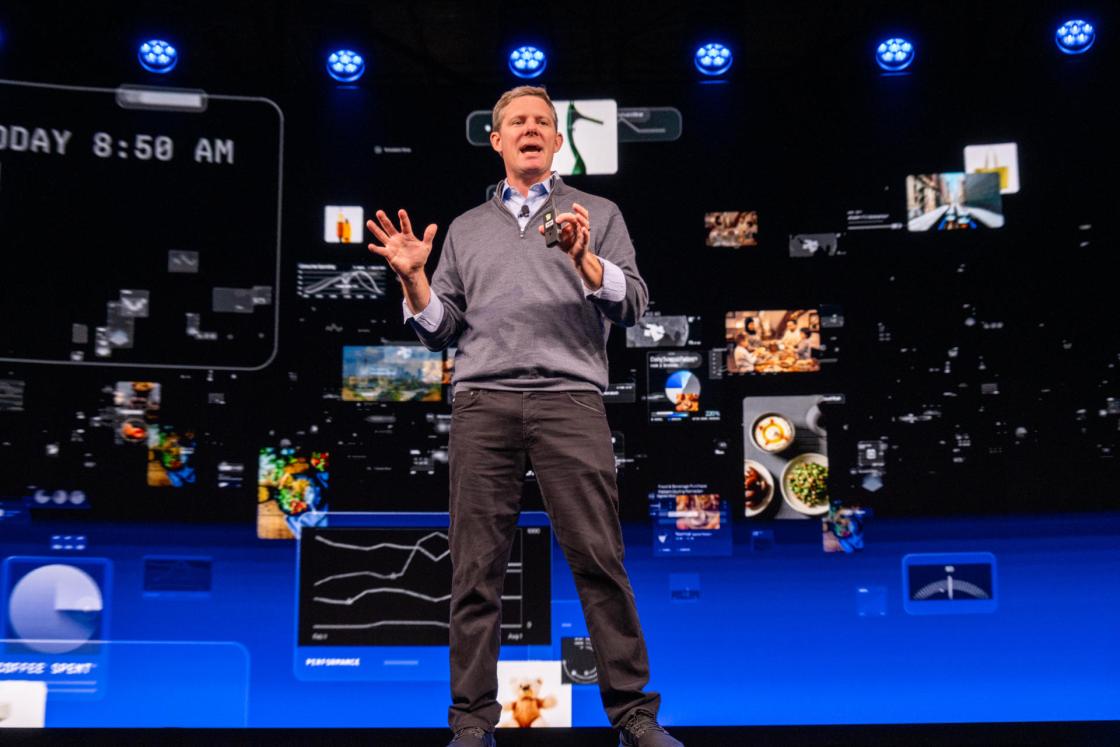
At Visa’s Global Product Drop in San Francisco on April 30, 2025, McInerney presented a further extension of that partnership model. Visa Intelligent Commerce would open payment capabilities to developers building AI commerce experiences. The list of collaborators included companies developing AI systems as well as businesses already involved in commerce and payments.
The appeal is easy to picture. An assistant could search for something, compare possibilities and help complete a purchase within limits chosen by the buyer. The permission is the difficult part. A shopper may welcome help choosing a flight while remaining quite particular about who gets to spend the money. Delegation needs boundaries that survive the journey from request to transaction.
That helps explain the emphasis on tokenization. In a May 2025 discussion, McInerney used Apple Pay to illustrate the idea: the credential in a phone is a payment token with a cryptographic element, rather than simply the familiar card number copied into a device. New interfaces can sit above protections that customers rarely have to think about.
Visa extended the approach with Trusted Agent Protocol, announced in October 2025 and developed with Cloudflare. It was designed to help merchants recognize approved agents, understand their intent and receive information about the consumer and payment. An online seller needs to distinguish an assistant carrying out a purchase from automation that should never get near the checkout.
By September 2026, McInerney was still drawing a distinction between AI shopping and autonomous payment adoption. That restraint belongs alongside the launch announcements. A technology can be ready for demonstrations while customers continue making up their minds. The company can supply tools and protections; the customer retains a fairly effective veto, exercised by doing the payment personally.
Three permissions before “paid.”
The less photogenic work of change
McInerney’s tenure also includes changes below the checkout. Visa completed its acquisition of Pismo in January 2024, adding a platform for cloud-based core banking and card-issuer processing. It expanded what Visa could offer financial institutions that needed to modernize the systems behind their customer experiences.
That work has fewer obvious visual attractions than a new shopping assistant. It concerns how banks build products, connect services and process accounts and cards. Yet a convenient screen relies on the systems underneath it. His banking background gives this part of the story a certain continuity: years after running consumer banking, he leads a company supplying more of its technological plumbing.
The business results during his tenure also carry a large operating burden. In the quarter ended June 30, 2026, Visa processed 71.7 billion transactions. Net revenue for its fiscal third quarter reached $11.6 billion, up 14% from a year earlier. Those figures describe the company’s activity, rather than a personal scorecard, but they show the scale at which his decisions now operate.
There is a harder part to that record. In July 2026, Visa said it planned to eliminate approximately 2,600 roles, about 7% of its workforce. McInerney framed the changes as an effort to improve efficiency and redirect resources toward opportunities with greater potential. Growth and job cuts appeared in the same quarter. The employees affected belong in any account of what changing a large company entails.
transactions processed
fiscal Q3 net revenue · up 14% year over year
A return to Notre Dame, another opening in China
Away from Visa’s product announcements, McInerney has maintained a connection to Notre Dame. He joined its Undergraduate Experience Advisory Council in 2019 and became a university trustee effective July 1, 2024. The graduate of 1997 had returned with experience of managing organizations whose decisions touch people well beyond the room where they are made.
The university’s announcement also supplies a small piece of the person behind the itinerary: he and his wife, Angela, have three children. His public biography is largely a working biography, organized around responsibilities. The Notre Dame connection adds something more durable than a job title: a relationship with an institution that spans his student years and his career.
On October 13, 2026, a new development brought his global responsibilities into focus. Visa received approval from the People’s Bank of China to begin preparations for a domestic bankcard clearing institution. McInerney described the next steps toward domestic operations. The distinction is material: permission to prepare precedes permission to operate. Even at Visa’s scale, access is earned through a process.
That is a fitting place to find him. A banking operator turned network executive, working on both an established market’s rules and a new technology’s permissions. The interfaces keep changing: a branch counter, a phone, an AI assistant. McInerney’s assignment keeps returning to the moment before the payment, when somebody has to decide whether the system deserves their confidence.